

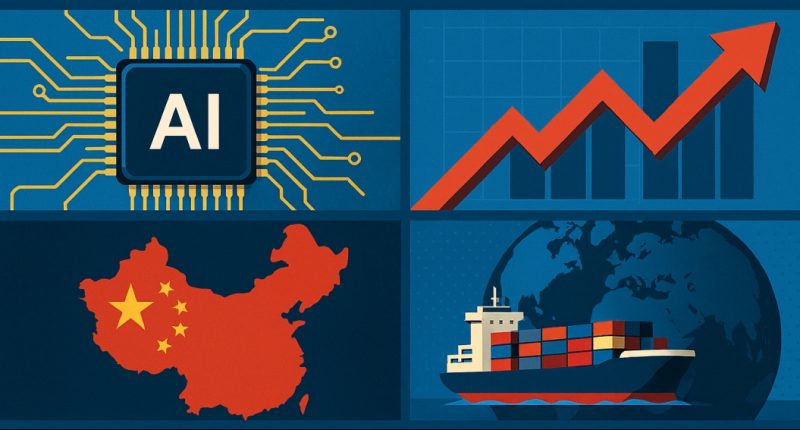
- Nvidia’s (NASDAQ:NVDA) AI chip dominance is under pressure from AMD’s (NASDAQ:AMD) rising innovation and strategic deals, while Intel (NASDAQ:INTC) and custom silicon players also gain ground
- Valuation and growth metrics favor Nvidia, but AMD’s open ecosystem and efficiency in inference workloads make it a compelling alternative for investors
- Geopolitical risks—especially U.S.–China export controls—threaten Nvidia’s global reach, prompting investors to consider diversification and hedging strategies
- Global trade tensions, including U.S.–E.U. and U.S.–Canada tariff disputes, are reshaping investment strategies, with defensive sectors and emerging markets offering resilience and opportunity
The semiconductor industry is in the midst of a historic supercycle, driven by the explosive growth of artificial intelligence, cloud computing, and edge devices. At the heart of this transformation stands Nvidia—long hailed as the undisputed leader in AI chips. But as competition intensifies and geopolitical risks mount, investors are asking: Is Nvidia (NASDAQ:NVDA) still the king of the hill?
Nvidia’s reign: Innovation and market dominance
Nvidia’s dominance stems from its early bet on AI and its proprietary CUDA software ecosystem, which has become the backbone of machine learning infrastructure. In 2025, Nvidia commands more than 90 per cent of the AI data-centre GPU market, with its H100 and Blackwell chips powering everything from ChatGPT to autonomous vehicles.
This article is a journalistic opinion piece which has been written based on independent research. It is intended to inform investors and should not be taken as a recommendation or financial advice.
Its financials reflect this strength: Nvidia posted record annual revenue of US$130.5 billion, up 114 per cent year-over-year, and a market cap that briefly exceeded US$4.5 trillion. The company’s innovation engine continues to churn, with new platforms like Blackwell and Rubin pushing the boundaries of generative and agentic AI.
The challenger: AMD’s sharp ascent
Enter: AMD (NASDAQ:AMD). Under CEO Lisa Su, AMD has transformed from an underdog into a formidable rival. Its multi-billion dollar deal with OpenAI to supply 6 gigawatts of AI compute capacity is a direct challenge to Nvidia’s dominance. AMD’s MI300X chips offer superior inference efficiency, and its open ecosystem is gaining traction among developers seeking alternatives to CUDA.
AMD’s valuation has surged, with its stock up over 30 per cent in 2025 and a market cap nearing US$350 billion. While Nvidia still leads in training throughput and ecosystem depth, AMD is no longer just a second source—it’s a serious contender.
Valuation: Is Nvidia overpriced?
Despite its growth, Nvidia trades at a P/E ratio of 57.7x, well above industry averages. However, analysts argue this is justified by its projected US$210 billion free cash flow by 2030 and a PEG ratio of 0.68, suggesting undervaluation relative to growth.
AMD, meanwhile, has seen its valuation spike following the OpenAI deal, making Nvidia the better value pick in terms of forward earnings.
Geopolitical risk: China, export controls, and immense exposure
Nvidia’s exposure to China—once a key revenue driver—is now a liability. U.S. export controls have restricted sales of advanced chips like the H100 and H20, while China has retaliated with bans and antitrust investigations. Nvidia’s CEO Jensen Huang warns that China is “nanoseconds behind” the U.S. in AI chip development, urging a reduction in restrictions.
AMD, while also affected, has diversified its partnerships and is less reliant on Chinese sales. Both companies face margin compression and strategic uncertainty in the region.
Investor takeaway
Nvidia remains the leader in AI chips, but its crown is no longer unchallenged. AMD’s rise, Intel’s (NASDAQ:INTC) resurgence, and the emergence of custom silicon (like Groq and Cerebras) are reshaping the landscape. For investors:
- Nvidia: Still a strong long-term play, but watch for dips to enter.
- AMD: High-growth potential, especially in inference and open ecosystems.
- Diversify: Consider exposure to emerging AI players and hedge against geopolitical risk.
Tariffs, trade and turbulence: Global investing in a fragmented world
The global investment landscape is being redrawn by a wave of tariffs, trade disputes, and geopolitical fragmentation. From the breakdown in U.S.–Canada talks to sweeping U.S.–E.U. tariffs, investors must navigate a world where politics increasingly shape portfolios.
U.S.–E.U. Tariffs: Autos, semiconductors, and pharma hit hard
In August 2025, the U.S. and E.U. finalized a trade framework imposing 15 per cent tariffs on European cars, semiconductors, and pharmaceuticals. While this averted a full-blown trade war, it raised costs for consumers and disrupted supply chains.
The E.U. agreed to purchase US$750 billion in U.S. energy and invest US$600 billion in strategic U.S. industries, but concerns remain about the deal’s balance and long-term impact.
U.S.–Canada breakdown: A trade war in the making?
Negotiations between the U.S. and Canada have faltered over tariffs and Canada’s now-rescinded Digital Services Tax. President Trump imposed 25 per cent tariffs on Canadian goods, escalating tensions and triggering retaliatory measures from Ottawa.
While talks have resumed, uncertainty looms over sectors like autos, forestry, and energy. Canadian firms are pivoting toward diversification, but the risk of a North American trade war remains.
Hedging geopolitical risk: Strategies for investors
In this fragmented world, investors must adapt. Key strategies include:
- Geographic diversification: Spread exposure across stable regions like Southeast Asia, Latin America, and the Middle East.
- Sector rotation: Favor defensive sectors—utilities, healthcare, and cybersecurity—during periods of volatility.
- Alternative assets: Gold, real estate, and cryptocurrencies have emerged as safe havens amid trade shocks.
- Local supply chains: Invest in companies reshoring production or building regional resilience.
Global diversification: Opportunity in chaos
Despite the turbulence, global diversification remains a powerful tool. Emerging markets offer growth potential, especially in energy, infrastructure, and digital services. Investors should monitor sovereign risk, currency exposure, and regulatory shifts to optimize returns.
Final thoughts
The semiconductor supercycle and global trade realignment are reshaping the investment landscape. Nvidia may still be king, but the throne is contested. Meanwhile, geopolitical risk is no longer a side note—it’s central to portfolio strategy.
Smart investors will hedge, diversify, and stay agile. The world is fragmented, but opportunity still abounds.
Join the discussion: Find out what the Bullboards are saying about NVIDIA Corp. and AMD, then check out Stockhouse’s stock forums and message boards.
Stockhouse does not provide investment advice or recommendations. All investment decisions should be made based on your own research and consultation with a registered investment professional. The issuer is solely responsible for the accuracy of the information contained herein. For full disclaimer information, please click here.