

Amid high oil prices, propped up by the US-Iran war, elevated debt levels, with emphasis the US government’s US$40 trillion IOU, and generationally high bond yields, reflecting concerns about the future earnings power of AI hyperscalers, the market is encouraging you to raise your standards for investing in a new stock, incentivizing you to put capital to work only after proving a company’s ability to usher its investor deck from pipe dream to viable go-to-market strategy.
The problem here is that this is easier said that done, with every public company on the planet keen to convince you, however scant the supporting data, that your money will perform best under its care.
This article is a journalistic opinion piece which has been written based on independent research. It is intended to inform investors and should not be taken as a recommendation or financial advice.
This is, perhaps, why investors have been increasingly turning to pharma for their next allocations – as evidenced by the S&P 500 Healthcare Index posting a 27 per cent return year-over-year (YoY) – comforted by the fact that top-returning stocks in the sector need verifiable evidence behind their drug candidates to harbor any hope of long-term returns.
Unlike energy and technology companies, whose YTD returns are considerably higher, but whose futures are far shakier, given tensions in the Middle East and the uncertainty surrounding AI’s ultimate utility, a pharma company’s verified ability to satisfy an unmet medical need may offer investors an especially effective way to sleep well at night.
The market’s most recent validation of this thesis comes from Moderna (NASDAQ:MRNA), one of the heroes of the COVID Pandemic, whose experimental cancer vaccine, Intismeran, designed to target mutations specific to a patient’s tumors, was shown to improve remission and reduce metastasis in melanoma patients when combined with Keytruda – developed by study partner Merck (NYSE:MRK) – compared to taking Keytruda alone.
Moderna stock remains up by more than 120 per cent since the news release, lifting its YoY performance to 444 per cent, offering newfound hope for the company to refresh its income statements now that demand for COVID vaccines has all but vanished.
The obvious question any opportunistic investor should be asking is then, which pharma companies are on the verge of the most meaningful breakthroughs when it comes to eradicating disease and improving patients’ quality of life?
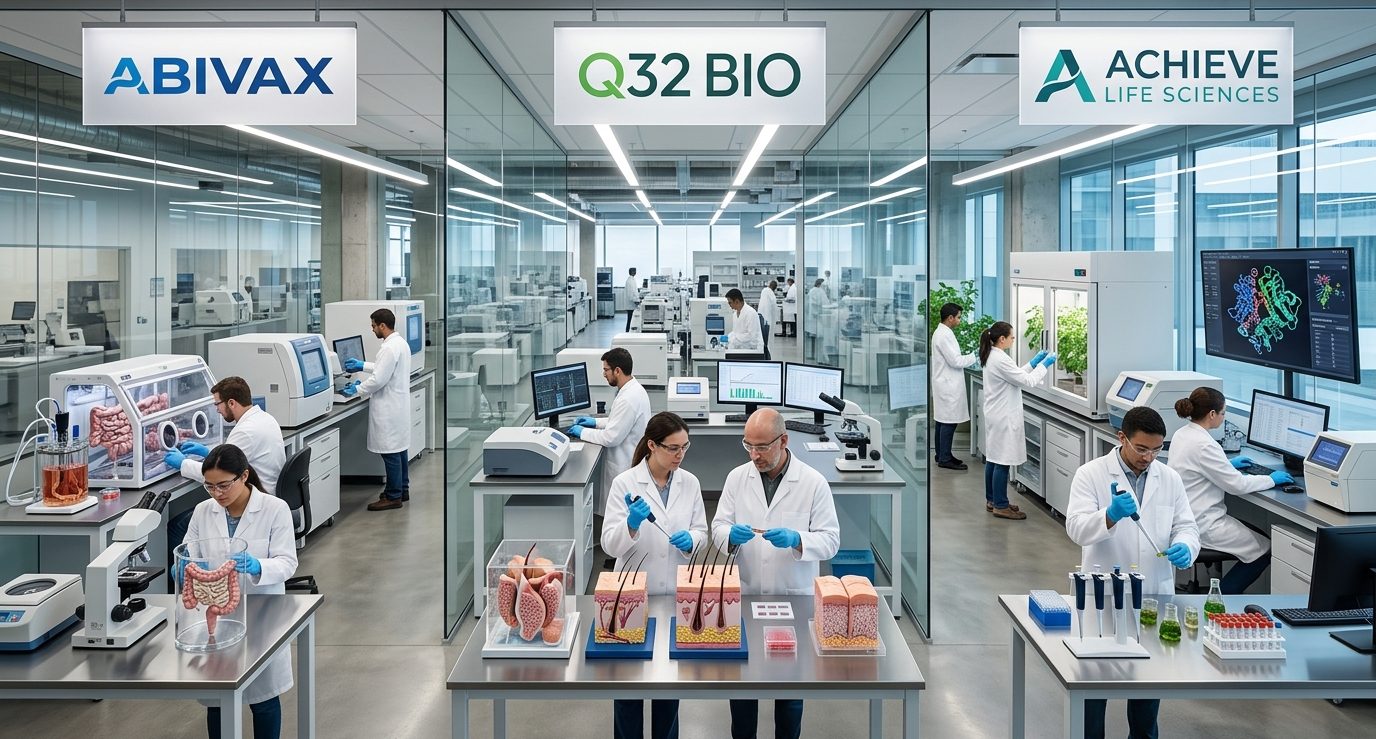
Abivax
A mid-cap pharma stock on the threshold between clinical study and burgeoning market presence is Abivax, market cap US$10.75 billion, whose mission is to deploy the body’s natural regulatory mechanisms against chronic inflammatory diseases.
The France and US-based company’s flagship drug candidate, Obefazimod (ABX464), is being developed to treat moderate to severe ulcerative colitis – an inflammatory bowel disease characterized by ulcers in the colon and a variety of uncomfortable symptoms, including fever, fatigue and cramping – whose US$8.7 billion global market is on pace to hit US$14.5 billion by 2025.
While about 30 per cent of patients either fail to respond or lose responsiveness to existing treatment options, the oral small molecule’s ability to enhance the expression of miR-124, a physiological miRNA and known anti-inflammatory, opens the door for an alternative, non-surgical option, with the company estimating that up to 1.3 million patients may benefit from the drug in the US alone (see slide 6 of the June 2026 investor deck).
Pre-clinical data backs this up, showing Obefazimod to be effective in mice, with phase-2 clinical trials successfully bolstering miR-124 expression and reducing inflammatory cytokines in the blood and colonic tissue of ulcerative colitis patients.
An ongoing phase-3 trial announced in June 2026 delivered statistically significant results, including placebo-adjusted remission rates of 39.3 per cent (25 mg dose) and 40.3 per cent (50 mg dose) after 52 weeks (see slide 29). A separate trial for difficult-to-treat patients also posted standout clinical remission rates of 23.5 and 37.2 per cent, respectively, with the drug showing no evidence of immunosuppression in phase-2 or phase-3 studies.
Looking ahead, Abivax is investigating Obefazimod’s ability to treat Crohn’s disease, another widespread inflammatory bowel disease, with topline results expected by mid-2027, to be potentially followed up by a phase-2a trial.
With the filing of a New Drug Application with the US Food and Drug Administration planned by year-end, a US$920 million capital raise closed in July, and a leadership team well-acquainted with the development and commercialization of related therapeutics, the company is a front-runner when it comes to revitalizing the standard of care for inflammatory bowel disease.
Abivax stock (NASDAQ:ABVX) last traded at US$116.15 and has added 49.95 per cent year-over-year.
Q32 Bio
Another much smaller pharma stock tackling a pervasive unmet need is Q32 Bio, market cap US$475.42 million, whose work centers on harnessing the immune system to help those suffering from severe alopecia areata live more fulfilled lives.
The disease affects about 700,000 people in the US alone, encompassing a more than US$10 billion global market on pace to double by next decade, mammoth figures that stand in contrast to the limited treatments available on the market today, many of which suppress the immune system with a broad brush, leading to systemic toxicity while not effectively preventing relapse.
Q32’s flagship drug candidate, Bempikibart, is vying to serve as a safer, more durable alternative, thanks to its demonstrated ability to inhibit the cells directly responsible for follicle destruction (see slide 7 of the August 2026 investor deck).
Bempikibart’s targeted mechanism of action, currently the subject of an ongoing phase-2 clinical trial, delivered durable response and safe redosing in the Signal-AA Part A study, as well as meaningful efficacy data and a well-tolerated safety profile in the Signal-AA Part B study, supporting future work towards the drug’s registration pathway and potential expansion into adolescent and more moderate cases (see slides 9-21).
Near-term catalysts investors should look out for include Part B findings at 36 and 52 weeks to be presented by year-end, a phase-3 study beginning in the first half of 2027, and results from an ongoing long-term follow-up study by the end of 2027, all of which position Q32’s established team of scientists, immunologists and drug developers, equipped with US$106.3 million in cash and only 29.8 million shares outstanding as of Q2 2026, to strengthen Bempikibart’s case for improving the alopecia patient experience.
Q32 Bio stock (NASDAQ:QTTB) last traded at US$16.36 and has added 730.46 per cent year-over-year.
Achieve Life Sciences
Our final pharma stock with grand ambitions is Achieve Life Sciences, market cap US$822.19 million, whose late-stage drug candidate, Cytisinicline, a plant-based alkaloid, is being honed as a treatment for nicotine dependence.
The problem at the centre of Achieve’s reason for being is a well-known one, with The World Health Organization estimating there to be 25 million adults in the United States who smoke combustible cigarettes, making tobacco the leading cause of preventable death. This is in addition to nearly 18 million adults who vape, according to NEJM Evidence, plus about 1.4 million middle and high school students, according to Nicotine & Tobacco Research, granting Big Tobacco quite the captive audience.
Concurrently, there are no FDA-approved treatments for nicotine e-cigarette cessation and limited non-nicotine oral therapies with reasonable safety profiles (see slide 18 of the July 2026 investor deck).
This is where Cytisinicline comes into play with its ability to interact with nicotine receptors in the brain and reduce cravings, while reducing the feelings of reward associated with nicotine consumption, as shown across multiple phase-3 trials demonstrating up to 5-6x higher odds of quitting smoking versus a placebo in patient subgroups including COPD, cancer and those with a high number of prior quit attempts. Achieve also completed a successful phase-2 trial for vaping cessation, achieving a 31.8 per cent cessation rate, versus 15.1 per cent for a placebo (see slide 17).
These best-in-class results led the FDA to award Cytisinicline with a Breakthrough Therapy Designation and the Commissioner’s National Priority Voucher, both for vaping cessation, elevating the drug into a national priority to address this major health crisis.
As per the Q2 2026 news release, Achieve is progressing towards a New Drug Application for smoking cessation, which may be approved by the first half of 2027, paving the way for a commercial launch, supported by a hefty US$187.3 million in cash, cash equivalents and marketable securities, not to mention a leadership team that reunites the executives behind Verona Pharma, acquired by Merck for US$10.8 billion in October 2025, whose COPD drug, Ohtuvayre, stands as one of the most successful specialty launches in recent history.
Achieve Life Sciences stock (NASDAQ:ACHV) last traded at US$7.94, adding 139.88 per cent year-over-year, but only 1.02 per cent since 2021.
Takeaway
The stock market’s inherent uncertainty, arguably the price of admission for any investor, can be controlled but never fully avoided. A great company today can always turn into a poor one tomorrow, and vice versa, given the right set of macro and microeconomic circumstances.
The pharma sector, however, has an ace up its sleeve, given that clinical trials rest on the scientific method, which can establish a direct connection between a new drug and a patient’s improved quality of life. This ability to demonstrate added value, beyond any in-house or third-party product evaluation, in essence guarantees the innovative drug a market, which will be ready and waiting for it once regulators confer their stamp of approval.
Now, while the pharma stocks I’ve profiled today haven’t made it across the full drug development cycle as of yet, rendering long-term shareholder value anything but a sure thing, they’re as close as could reasonably be expected for you to benefit from the full breath of a re-rating, should your due diligence deem it appropriate to put capital to work.
Join the discussion: Find out what investors are saying about these pharma stocks on the Abivax SA, Q32 Bio Inc. and Achieve Life Sciences Inc. Bullboards and make sure to explore the rest of Stockhouse’s stock forums and message boards.