

- Macroeconomic headwinds: Geopolitical instability, specifically US tariffs and tensions in Iran, are driving up oil prices and inflation, forcing central banks like the Bank of Canada and US Federal Reserve to raise interest rates.
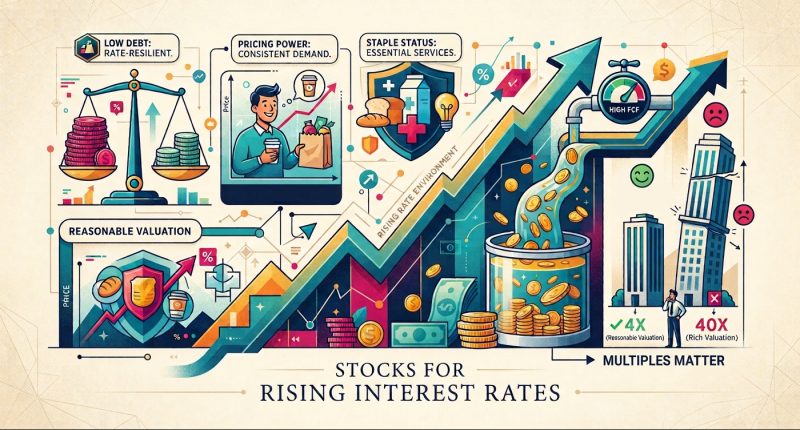
- Five traits of rate-resilient stocks: To protect portfolios from rising interest rates and shrinking consumer budgets, investors should target companies with low, fixed-rate debt, strong pricing power, essential “staple” products, consistent free cash flow to self-fund operations, as well as reasonable valuations that avoid multiple compression.
- Fundamentals over safe-haven assets: While inflation and rate resilience provide strong defensive protection, long-term stock success still ultimately depends on core business fundamentals: solving problems better than competitors, operating efficiently, and serving enduring market demand.
While interest rates are a useful tool to cool down an overheating economy or motivate a stagnant one, their immediate impact on borrowing costs and slow progression, whether up or down, can have profound effects on a portfolio.
US President Trump’s tariff regime, plus the latest instance of US meddling in Middle East affairs, prompting an ongoing blockade of the Strait of Hormuz and rising oil prices, have escalated global inflationary pressure and forced us into a rising-rate environment. In response, both the Bank of Canada and the US Federal Reserve increased policy rates during their most recent meetings.
This article is a journalistic opinion piece based on independent research. It is intended to inform investors and should not be taken as a recommendation or financial advice.
Should tensions in Iran persist, alongside the US’s strong-arming of its commercial partners, investors may benefit from increased exposure to stocks whose underlying companies don’t depend on low inflation and interest rates to execute their growth plans.
Luckily, these companies, while scarce, are not hard to find, thanks to a set of shared traits that helps them stand out from the competition.
1. Low debt
It takes money to make money, and if a company funds itself through debt, it will be saddled with higher payments aligned with rising interest rates once it’s time to refinance or if it’s under a floating-rate contract. These payments will, in turn, eat into profits and create downward pressure on the stock price.
To guard your portfolio against this headwind, limit your investable universe to companies with debt-to-equity ratios in the lowest quartile within their industry, ensuring that they’ll be the last to feel the brunt of a sustained rise in borrowing costs.
For an additional layer of protection, pay attention to a company’s interest rate coverage ratio, which measures how many times earnings can cover debt payments. The higher the number, the wider the cushion a company will have if debt payments rise.
Finally, investors can also favor companies with fixed-rate, long-term debt, over the variable and short-term variety, offering greater cash flow visibility into the future.
2. Pricing power
If your portfolio is full of stocks that track companies with established demand, it’s likely well-positioned to weather rising interest rates, because customers are primed to pay more for these beloved products and services, offsetting higher loans costs, negative sentiment associated with a slowing economy, not to forget the inflationary conditions that motivated hawkish monetary policy in the first place.
Think of Pepsi and Coca Cola’s multi-generational battle for supremacy in the realm of soft drinks, making their brands ubiquitous in pretty much any country. Or Visa’s payments network, whose unmatched reach across more than 200 countries offers commercial clients the largest addressable customer base. Or Microsoft’s productivity-enhancing cloud and workflow tools, which can carry exorbitant switching costs depending on the size of the client and the nature of the contract.
In each of these cases, companies have ample pricing power, or leeway to pass higher costs onto customers, knowing that the benefits they provide – or at the very least, customers’ perception of them – far outweigh the associated fees.
3. Staple status
When the cost of goods and services is high and interest rates are rising to get them under control, consumers will first cut discretionary items to make room on their personal balance sheets.
We’re talking luxuries such as going out to eat, traveling across the world for vacation, or adding a third, fourth (or fifth) streaming service to your monthly expenses to make sure you can properly unwind at the end of the day. Anything you want but do not strictly need.
Essential, or non-discretionary expenses, however, offer the most reliable staying power, as they enable basic living standards, such as groceries and healthcare, and core business operations, such as insurance and transportation, pointing us in the right direction to identify companies generally unbothered by higher costs.
If a company’s mission is to feed you, keep you healthy or keep the lights on, its stock probably commands a stronger floor compared to a company solely interested in entertaining you.
4. Strong free cash flow
The truth about pretty much any headwind in the business world is that, the more money you can throw at it without disrupting normal operations, the less of an issue it will ultimately be.
This is why profitability, specifically free cash flow (FCF), or cash left over after operating expenses and capital expenditures, should be a core component of your due diligence if you invest in single stocks.
While net income does not necessarily translate to cash in hand because it accounts for non-cash items, such as depreciation, FCF tracks how actual cash moves through a company, representing a more solid number for the purposes of paying dividends, buying back shares, reducing debt and reinvesting in growth.
An easy way to slice up the market into potentially undervalued free cash-flowing stocks is to screen for price-to-FCF ratios within the same industry, which corrects for the fact that certain industries are, by nature, more capital-intensive than others.
Investors can then analyze stocks with the lowest ratios, in the hopes of identifying FCF growth over a multi-year period, with a longer period serving as more substantial evidence of leadership’s skill at self-funding operations without having to tap debt or equity markets.
5. Reasonable valuation multiples
Our final rule for finding stocks well-equipped to shoulder rising costs and interest rates is to make sure your portfolio isn’t host to rich valuations, where investor expectations have likely gotten out of hand.
Suppose your FCF screen produces two companies you’re interested in, sporting 4x and 40x multiples, respectively, both of which are growing under the metric over the past few years.
For the purposes of valuation and ultimate stock selection, the question worth asking here is, why are investors willing to pay $40 for every dollar in FCF company A generates, while they’re only willing to pay $4 for every dollar earned by company B?
A quick scan of recent investor decks, financial statements and media coverage may reveal company A’s higher multiple to reflect recent exponential growth, in revenue, profits or both, which it may have a hard time besting in the future.
On the other hand, your due diligence may prove company B’s multiple to reflect excessive pessimism about future earnings power, plus a simple lack of market awareness, perhaps demonstrated by low trading volume and analyst coverage, making it a bargain at the current share price.
In an inflationary environment, where it’s harder to control costs and raise non-dilutive capital, it’s the more richly valued company that’ll be first in line for multiple compression, potentially dragging down your overall portfolio return.
Takeaway
A company’s resiliency against inflation and higher interest rates is a point in favour of its fundamentals, granting it immediate safe-haven status when demand outpaces supply.
That said, the trait is no replacement for solving a problem more thoroughly than competitors, in a market with long-term demand, through operations efficient enough to generate a profit, the trifecta at the heart of any company’s long-term success.
Join the discussion: Find out what investors are saying about inflation, rising interest rates and the stocks best-positioned to ride through them on Stockhouse’s stock forums and message boards.