

- Micron (NASDAQ:MU) and Anthropic formed partnership to co-design AI memory and storage systems, aiming to improve performance, efficiency, and cost for large-scale AI workloads
- The agreement includes a multi-year supply deal ensuring Micron provides key data centre components to support Anthropic’s growing AI infrastructure needs
- Micron is adopting Anthropic’s Claude AI internally for productivity gains and has also invested in Anthropic’s latest funding round to support future AI development
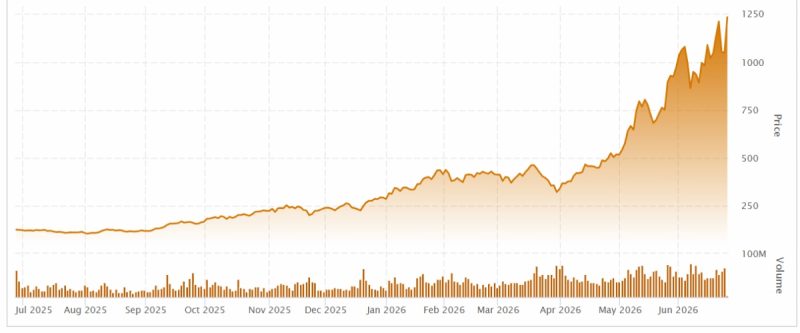
- Micron Technology stock (NASDAQ:MU) closed trading at US$1,205.50
Micron Technology, Inc. (NASDAQ:MU) and artificial intelligence company Anthropic have announced a multifaceted business agreement aimed at advancing the design, supply, and deployment of infrastructure needed to support next-generation AI systems. The partnership spans technical collaboration on memory and storage architecture, a long-term supply agreement, enterprise adoption of Anthropic’s AI models within Micron, and a significant investment in Anthropic.
This article is a journalistic opinion piece that has been written based on independent research. It is intended to inform investors and should not be taken as a recommendation or financial advice.
The companies said the agreement is structured to align the evolving requirements of frontier AI models with the underlying hardware systems that power them, particularly as demand for large-scale AI training and inference continues to grow rapidly.
“The AI revolution has permanently elevated the role of memory and storage solutions from the data centre to the edge,” Sumit Sadana, executive vice president and chief business officer, at Micron said in a news release. “Micron’s strategic collaboration with Anthropic brings together the industry-leading capabilities of both companies to innovate and scale next-generation AI infrastructure.”
“Our compute strategy depends on getting every layer of the stack right, and memory and storage are central to how efficiently we can train and serve Claude,” Tom Brown, co-founder and chief compute officer, Anthropic, added. “Partnering with Micron means we collaborate closely on optimizing these systems for our workloads and secure the supply we need. As demand for Claude grows, this is how we scale our compute for the long term.”
Micron will keep prices for its products sky-high for another five years, by signing 16 “strategic customer agreements”. More on that in a bit.
Focus on AI memory and storage architecture
At the core of the collaboration is a joint effort to improve how memory and storage subsystems support AI workloads. Frontier AI models, which require enormous compute capacity and data throughput, increasingly depend on high-performance memory and storage solutions to function efficiently.
Micron brings to the partnership its portfolio of high-bandwidth memory (HBM), DRAM, and solid-state drives (SSDs), which are widely used in data centres to support AI operations. Together with Anthropic, the company will analyze how these components perform across different AI workloads and how they interact throughout the full hardware and software stack.
The companies expect this work to result in measurable improvements in performance, energy efficiency, and cost effectiveness. In particular, they aim to optimize what they describe as “token economics”—a reference to the cost and efficiency of processing units of data used in AI model training and inference.
By linking system-level design with real-world AI workloads, the partnership seeks to address a central challenge in AI infrastructure: scaling performance while managing power consumption and cost.
Micron’s CFO, Mark Murphy recently told investors that the company is seeing “significantly higher” demand than it—or the industry—can supply, all thanks to the evolving demands of AI systems.
Long-term supply agreement
Complementing the technical collaboration, Micron and Anthropic have also signed off on a supply agreement covering memory and storage components for data centre use. The agreement positions Micron as a supplier supporting Anthropic’s infrastructure needs as it expands its compute footprint over the coming years.
The supply arrangement reflects the growing importance of securing reliable access to advanced semiconductor components in the AI sector. As companies race to build larger and more capable models, demand for specialized hardware—particularly memory and storage—has intensified.
By formalizing a multi-year supply relationship, both companies aim to ensure continuity and scalability in AI system deployment.
Enterprise adoption of Claude at Micron
In addition to infrastructure-focused initiatives, Micron has been deploying Anthropic’s Claude AI models internally. The company describes itself as an early adopter, using the technology to accelerate software development and enable more advanced, agent-based applications.
These deployments extend across engineering, manufacturing, and broader enterprise functions. According to Micron, applying AI to complex operational challenges has already resulted in productivity gains and new innovation opportunities.
Looking ahead, the company expects that further advances in AI capabilities—particularly in autonomy and reasoning—will open additional use cases, potentially transforming how products are designed, built, and managed at scale.
Assessing the investment in Anthropic
As part of the agreement, Micron has also made an investment in Anthropic’s Series H funding round. The investment underscores a shared commitment to advancing the infrastructure required to support increasingly sophisticated AI systems.
While financial details of the investment were not disclosed, the move aligns Micron more closely with a leading AI model developer at a time when industry collaboration between hardware and software providers is becoming increasingly critical.
Aligning hardware and AI development
The partnership reflects a broader trend in the AI industry: closer integration between companies developing AI models and those building the hardware systems that enable them. As models grow in size and complexity, bottlenecks in memory bandwidth, storage capacity, and energy efficiency have become more prominent.
By working together across design, supply, and deployment, Micron and Anthropic aim to address these challenges holistically rather than in isolation.
The companies indicated that the collaboration will continue to evolve alongside advances in AI technology, with the goal of enabling more scalable, efficient, and cost-effective infrastructure for future generations of AI systems.
Q3 earnings beat records
Micron released its fiscal Q3 2026 earnings after the market closed on Wednesday.
Revenue clocked in at a record US$41.46 billion versus US$23.86 billion for the prior quarter and US$9.30 billion for the same period last year.
In its Q2 2026 earnings report, the company predicted revenue of just US$33.5 billion, far below what was achieved. However, operating expenses were predicted to be around US$1.60 billion, but ended up being US$1,73 billion.
Revenue for that quarter was a record US$23.86 billion, versus US$13.64 billion for the prior quarter and US$8.05 billion for the same period last year.
In that news release, Micron’s top executive, Sanjay Mehrotra, spelled it out: “In the AI era, memory has become a strategic asset for our customers, and we are investing in our global manufacturing footprint to support their growing demand.”
Now the company is targeting revenue of US$50.0 billion in Q4 2026.
About Micron Technology Inc.
Micron Technology Inc. designs, develops, manufactures, and sells memory and storage products in the United States, Taiwan, Singapore, Japan, Malaysia, China, India, and internationally.
Micron Technology stock (NASDAQ:MU) closed trading around than 10 per cent higher at US$1,205.50 and has risen more than 860 per cent since the year began.
Join the discussion: Find out what the Bullboards are saying about chip stocks like Micron and check out Stockhouse’s stock forums and message boards.
The Market Online does not provide investment advice or recommendations. All investment decisions should be made based on your own research and consultation with a registered investment professional. The issuer is solely responsible for the accuracy of the information contained herein. For full disclaimer information, please click here.