

- Trenching at the Central Zone returned high-grade antimony and gold values, confirming strong surface mineralization over 170 metres
- The Central Zone may connect with the Main Zone, potentially extending the overall mineralized strike length beyond 1,000 metres
- Drilling and further exploration programs are underway to expand the deposit and test new targets across the Bald Hill project
- Antimony Resources stock (CSE:ATMY) opened trading at $0.56
Antimony Resources (CSE:ATMY) has reported assay results from 24 grab samples collected during a spring trenching program at the Central Zone of its Bald Hill Antimony Project in southern New Brunswick, highlighting a potential extension of mineralization beyond the established Main Zone and reinforcing the project’s broader exploration potential.
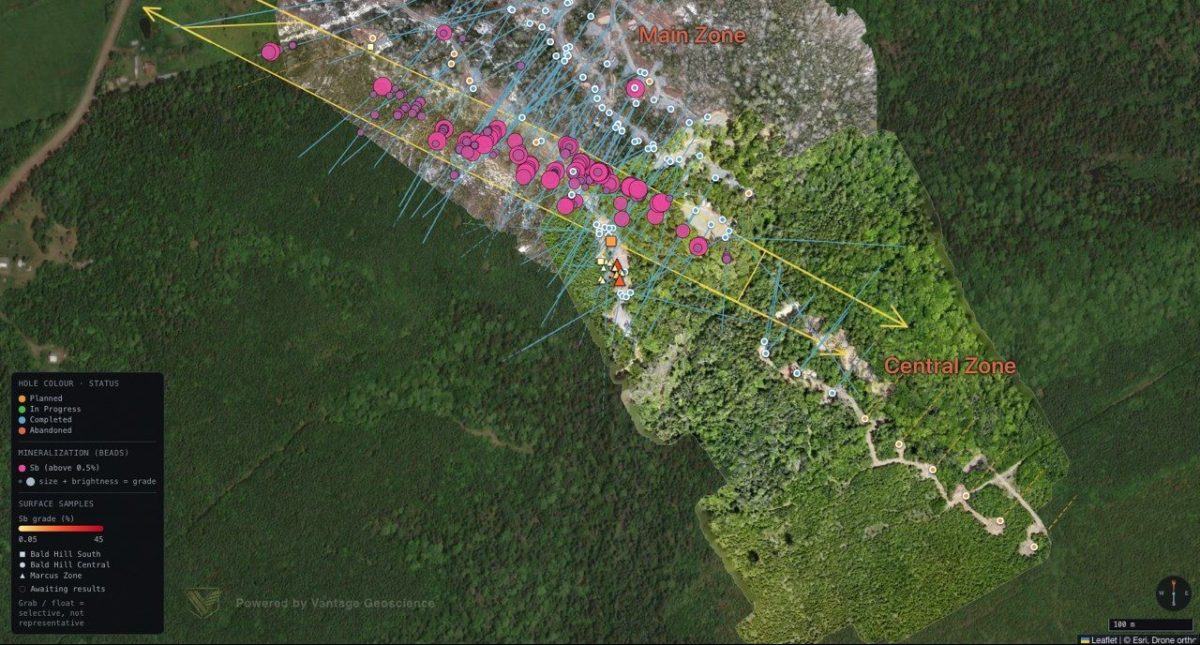
The samples were collected from trenches spanning approximately 170 metres along the Central Zone, one of three recently identified targets located about 150 metres south of the Main Zone. According to the company, the results point to a new area of antimony-bearing mineralization that could materially expand the footprint of the deposit.
The image above shows the surface trace of the known mineralization. The red symbols represent the surface projection of high-grade antimony intersections in drill holes. Yellow lines show the outline of the zone of antimony-bearing stibnite mineralization.
This content has been prepared as part of a partnership with Antimony Resources Corp., and is intended for informational purposes only.
Strong surface grades from Central Zone
Assays from the grab samples returned an average grade of 4.5 per cent antimony (Sb), with individual values reaching as high as 20.5 per cent Sb. Gold values averaged 0.43 grams per tonne (g/t), with peak assays of up to 4.72 g/t Au.
While noting that grab samples are inherently selective and may not be representative of overall mineralization, the company said the results nevertheless confirm the presence of high-grade stibnite-bearing zones exposed in trenching. The mineralization occurs within brecciated sedimentary rocks—a geological setting similar to that observed in the Main Zone.
The Central Zone trends northwest-southeast and appears to align with, and potentially connect to, the Main Zone. If continuity is confirmed, the company believes the mineralized system could extend the Main Zone’s footprint by more than 170 metres, bringing the total mineralized strike length to over 1,000 metres.
Drilling underway to test continuity
Antimony Resources has already begun drilling in the Central Zone as part of its ongoing regional exploration program aimed at expanding the known mineralized system. To date, more than 2,000 metres of drilling have been completed in this area.
Initial drill core logging has identified stibnite mineralization within breccias over widths of up to 37 metres—again consistent with the style observed in the Main Zone. Laboratory analysis of drill core samples is currently underway at Actlabs, with initial assay results expected within the next three to four weeks.
The company is simultaneously continuing to drill along strike of the Main Zone, which remains open in both the north and south directions.
Leadership commentary
“The assays from the 2026 spring trench program at the Central Zone have returned very high-grade results,” Antimony’s CEO, James Atkinson, PGeo, explained in a media release. “These samples continue to highlight the expanded potential offered by the New Zones from mineralization identified by field staff at Bald Hill. The field staff should be commended for their diligence in exploration and for identifying the expanding potential of the mineralization at Bald Hill.”
“We note that these assay values for antimony are similar to previously released results obtained in this area in 2014 (9.2 per cent Sb over 2.6 metres) but show that the mineralized zone is much larger than previously thought,” he added.
Bald Hill: A high-grade antimony project in North America
The Bald Hill project is considered one of the more advanced and higher-grade antimony exploration assets in North America. Historical and recent drilling has outlined a mineralized zone exceeding 600 metres in length and extending to depths of at least 350 metres.
Grades in the Main Zone are reported to average between 3 per cent and 4 per cent antimony over widths of approximately 4 to 5 metres, with the system remaining open in all directions. Based on a 2025 NI 43-101 technical report, the project hosts a conceptual exploration target of approximately 2.7 million tonnes grading between 3 per cent and 4 per cent Sb.
The company cautions that this estimate is conceptual in nature, as insufficient work has been completed to define a formal mineral resource. It remains uncertain whether further exploration will result in delineation of a mineral resource compliant with NI 43-101 standards.
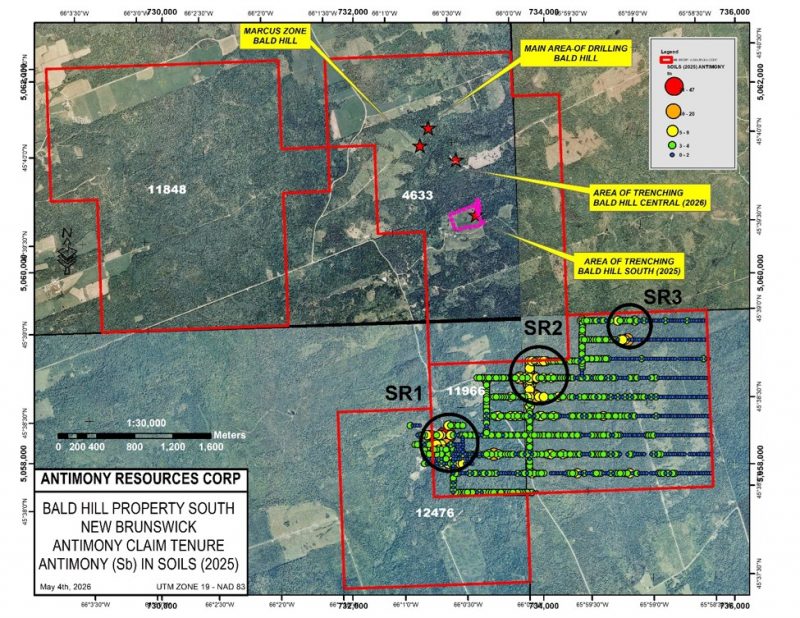
Beyond the Main Zone, exploration efforts have identified additional targets, including multiple “New Zones” defined through soil sampling, as well as expanded claim coverage to the west, south, and east. Notably, new targets have also been identified roughly 3 kilometres south of the Main Zone on the recently acquired Second Run claim.
Growing exploration footprint
The Central Zone results show what management describes as a growing exploration footprint at Bald Hill. The apparent geological continuity between the Central and Main Zones suggests the system could be larger than previously defined, with multiple parallel or connected structures hosting antimony mineralization.
Given global supply constraints and increasing interest in antimony—a critical mineral used in flame retardants, batteries, and defence applications—investor attention toward high-grade, North American projects has been rising.
Next phase of work
Looking ahead, Antimony Resources plans to advance the project through a combination of geophysical and geochemical programs. The next phase of exploration will include an airborne magnetic and electromagnetic survey aimed at refining structural targets across the property.
Additional fieldwork will involve expanded soil sampling, detailed geological mapping, and further surface sampling to delineate new zones of interest. Follow-up trenching is planned where anomalies are identified, along with continued drilling to test both extensions of known mineralization and newly defined targets.
As assay results from ongoing drilling programs are pending, investors will be watching closely for confirmation of grade continuity and scale at the Central Zone and beyond—key factors that could influence the project’s eventual resource potential value.
About Antimony Resources
Antimony Resources in a North American mineral exploration and development company focused on antimony backed by a leadership team with ample experience in exploration, development, mining and financing.
Antimony Resources stock (CSE:ATMY) opened trading at $0.56 and has risen 390 per cent since this time last year.
Join the discussion: Find out what everybody’s saying about this antimony miner on the Antimony Resources Corp. Bullboard and check out the rest of Stockhouse’s stock forums and message boards.