

No matter which way you look at it, investing in small-cap stocks is riskier than investing in an index fund that tracks the global stock market, because, while a single company can always fall on hard times, potentially go bankrupt and be delisted from exchanges, the stock market as a whole is unlikely to suffer such an existential fate, barring a Hollywood-level catastrophe where the foundations of life as we know it are turned on their heads.
This article is disseminated in partnership with small-cap stocks Alvopetro Energy and MustGrow Biologics. It is intended to inform investors and should not be taken as a recommendation or financial advice.
The only reason worth picking small-cap stocks is, no surprise, their potential for market-beating returns, expediting your journey towards fulfilling your financial goals, begging the question about how best to go about identifying companies that have what it takes to overcome the risk of permanently impairing your capital. A working profile built on common sense might include:
- Participating in industries with expected long-term growth, allowing you to own a stock over a long-term time horizon.
- Offering products aligned with demand trends within targeted industries that add tangible value to customers’ lives.
- Profitability, or evidence of a path towards it, gradually shifting expectations for shareholder value creation from speculation to a data-driven thesis.
In the latest edition of Stockhouse’s Weekly Market Movers, I’ll sketch out the value propositions behind two small-cap stocks that cozily fit this profile, with their bullish financial results, at different stages of maturity, ultimately determining their disconnect in terms of shareholder returns, despite otherwise high-quality operations.
Alvopetro Energy
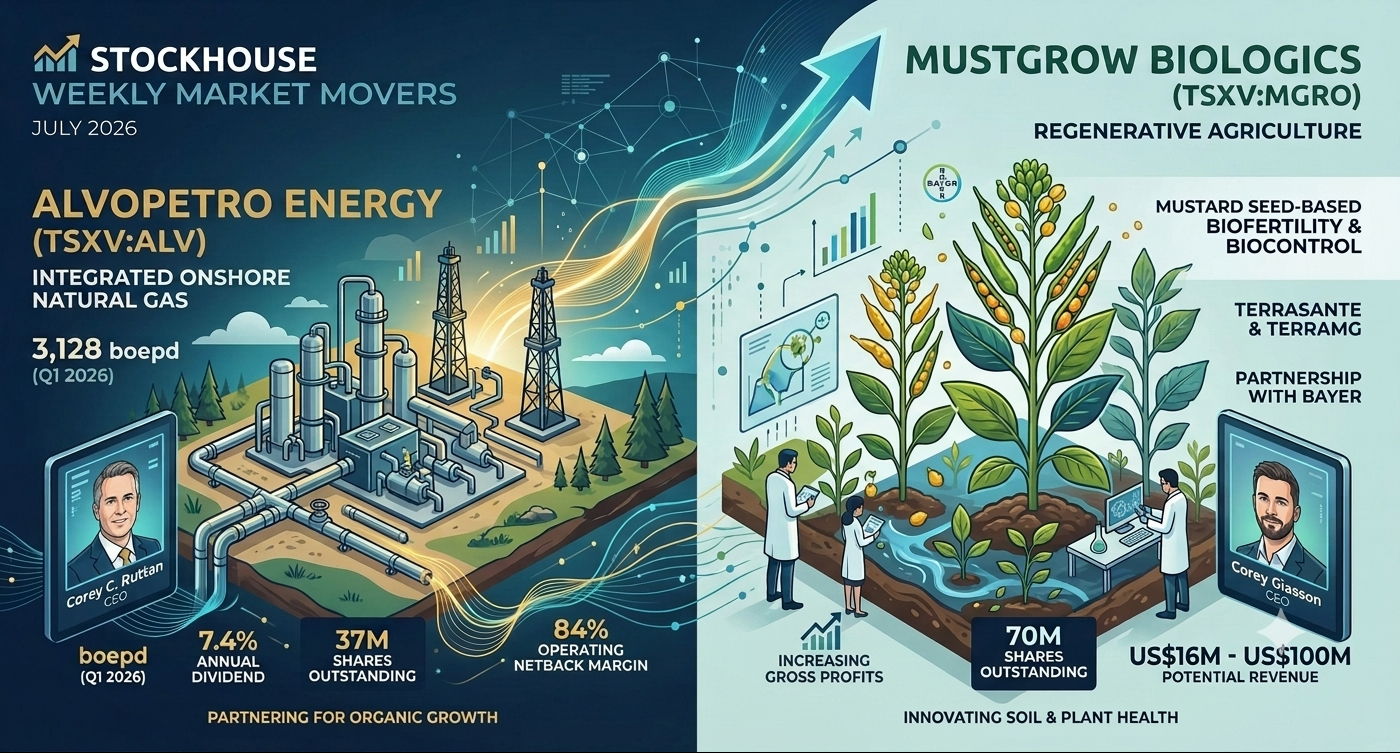
Our first small-cap stock of demonstrably high quality is Alvopetro Energy, market cap C$369.26 million, a natural gas explorer and producer advancing untapped assets in Brazil and Canada through a capital allocation model divided between organic growth and stakeholder returns, with an approximately 32 per cent dividend and 51 per cent CAPEX split since 2020 (see slide 6 of the company’s July 2026 investor deck).
Alvopetro is Brazil’s first integrated onshore natural gas producer, a differentiated position it has translated into consistent production growth, increasing average daily production from 1,794 barrels of oil equivalent per day (boepd) in 2024, to 2,523 boepd in 2025, to 3,128 boepd in Q1 2026 – stabilizing at 3,067 boepd in Q2 2026 according to internal estimates – all while trading below NAV with significant reserve and resource upside to be harvested across its portfolio.
Backed by C$393.6 million in proven and probable reserves, representing 12.5 years on the 2P reserve life index, the company has managed to deliver higher profits to justify growing production, earning net income of US$23.1 million in fiscal 2025, up by 42 per cent from 2024, and funds flow from operations of C$40.6 million, up by 22 per cent from 2024, thanks to a robust production ramp up.
Financial momentum accelerated in Q1 2026, including C$8.1 million in net income, up from C$2 million year-over-year (YoY), leveraging a 100-per-cent controlled gas plant and pipelines, enabling low-cost production and transportation expenses of C$5.46/boe, coupled with a strong pricing environment realizing C$61.77/boe – including natural gas sales of C$10.14/Mcf – helping the company to post an enviable 84 per cent operating netback margin.
Alvopetro is planning to drill multiple wells on its Brazilian assets through 2028, complemented by over 100 (50 net) Tier-1 drilling locations in inventory across its Canadian land holdings, vying to carry on generating high-margin revenue and building investor conviction.
These plans are propelled by a leadership team well-versed in its target markets, as highlighted by:
- Nanna Eliuk, Exploration Manager, a geologist for more than 23 years specializing in conventional and unconventional energy plays in basins around the world, including tenures at Husky Energy and Condor Petroleum in Kazakhstan.
- Corey C. Ruttan, Director, President and Chief Executive Officer (CEO), who previously served as President and CEO of Petrominerales from 2010 until it was acquired by Pacific Rubiales Energy in 2013, following more than a decade of executive experience marked by progressive responsibilities at Petrobank Energy and Resources, Lightstream Resources, Caribou Capital and Pacalta Resources.
Ruttan sat down with Stockhouse’s Ricki Lee to update investors on the company’s path forward. Watch the interview here.
Alvopetro Energy stock (TSXV:ALV) last traded at C$9.70, adding 65.53 per cent YoY and 223.33 per cent since 2021, and currently pays you a 7.4 per cent annual dividend to wait as the company leverages its only 37 million shares outstanding to break ground on its multi-year drilling plans.
MustGrow Biologics
Second in our pair of small-cap stocks making a solid case for portfolio inclusion is MustGrow Biologics, market cap C$26.42 million, a regenerative agriculture company innovating with mustard seeds, whose organic compounds form the basis of a proprietary portfolio of organic biofertility, biostimulant and biocontrol products that improve soil and plant health and reinforce global food security.
Targeting a global fertilizer and pesticide market expected to grow from US$141 billion in 2025 to US$220 billion by 2035, MustGrow is rolling out its flagship biofertility product, TerraSante, which delivers proteins and carbohydrates to nourish crops and stimulate microbial activity, leveraging ongoing sales in notable agricultural markets such as California, Arizona, Idaho, Oregon, Washington, Florida and Georgia.
The company boasts production capacity in place of 650 tons per year, representing US$16 million in revenue at a 20-40 per cent gross margin, which is scalable to 2,000-3,900 tons, representing US$50-$100 million in revenue at a 40-60 per cent gross margin (see slide 7 of the July 2026 investor deck), as it pursues fast-track registrations across the globe, including in Australia and the Netherlands.
Then there’s TerraMG, MustGrow’s biopesticide, whose active ingredient is designed to treat soil-borne diseases and pests, including nematodes, offering farmers a more efficient and targeted replacement to highly-toxic and widely used pesticides, including chloropicrin, used as a biological weapon in World War I, and metam sodium, which can cause severe respiratory, ocular and neurologic symptoms from prolonged exposure.
TerraMG’s path to market, supported by 2024 and 2025 trials demonstrating higher yields and revenue for canola and potato crops compared to untreated controls (see slide 9), benefits from a commitment from pharma giant Bayer to invest US$35-40 million to expand the product into Europe, Africa and the Middle East, building upon ongoing registration efforts in Canada and the United States.
As MustGrow strengthens its growth engine, including long-term initiatives focused on postharvest sprouting and disease control, bioherbicide and animal feed, the company has managed to provide investors with a glimpse into its ability to grow revenue in line with profitability. It posted TerraSante sales of C$600,000 in 2025, up by 377 per cent from just over C$100,000 YoY, at a gross margin of 20 per cent. It went on to improve this figure to 23.6 per cent in Q1 2026 from TerraSante revenue of about C$100,000, up from nil YoY, all while lowering expenses and net losses and increasing production capacity to meet expected demand growth, positioning operations to turn forecasts for higher gross margins into audited financial results.
To this end, MustGrow benefits from the advantages of only 70 million shares outstanding to tap the capital markets, plus a leadership team highly aligned with shareholders at 17 per cent insider ownership, incentivizing it to seek out global partners poised to contribute to and not merely take their cut of future value creation. Key members include:
- Corey Giasson, Director, President and CEO & Director, an entrepreneur with more than 20 years of experience in Saskatchewan’s agriculture, potash, oil and gas, mining and real estate industries. He is co-founder and director of Legacy Capital, a private equity company buying out sustainable cash-flowing businesses. He also co-founded Rallyemont Energy, an oil company he led until its eventual sale to Husky Energy in 2013. Before that, Giasson served as Vice President of Business Development and Investor Relations at Anglo Potash until its $284 million acquisition by joint venture partner, BHP Billiton, in 2008.
- Colin Bletsky, Director and Chief Operating Officer, who grew up in a multi-generational farming family in Saskatchewan and went on to serve as Vice President of Novozymes, devising the company’s overarching strategy and overseeing its global BioAg business. He also brings retail and seed experience with Pioneer and sales and marketing experience focused on crop protection with Syngenta.
Bletsky joined Ricki Lee to discuss all things Bayer and TerraSante, as well as to set investor bearings about upcoming company milestones and broader agriculture industry trends. Watch the interview here.
MustGrow Biologics stock (TSXV:MGRO) last traded at C$0.36, giving back 56.10 per cent YoY and 87.23 per cent since 2021, showing the market to be on the whole uninterested in expected near-term revenue growth, margin expansion and the potential rebound in investor sentiment this may unlock.
Thanks for reading! I’ll see you next Monday for a new edition of Weekly Market Movers, where I delve into companies that joined Stockhouse for an interview over the past week. Here’s the most recent article, in case you missed it.
Join the discussion: Find out what investors are saying about these small-cap stocks on the Alvopetro Energy Ltd. and MustGrow Biologics Corp. Bullboards and make sure to explore the rest of Stockhouse’s stock forums and message boards.