


BYD: Record exports meet a share price slump and EU headwinds
At first glance, everything at BYD looks almost picture-perfect, but its share price continues to crumble. In October, the group sold over 490,000 new energy vehicles, up 11% year on year. Overseas sales soared 102.8% to over 170,000 vehicles in October. At the same time, the Fangchengbao brand launched the six-seater Ti9 SUV.
At its core, BYD is about electric mobility, batteries and the leap into global markets. In the third quarter, revenue rose by almost 14% to CNY 221.5 billion, while net profit increased by around 28% to CNY 10.02 billion, yet still fell short of analysts’ estimates. In China, demand is weakening noticeably, and inventories have grown sharply. In addition, a court in The Hague temporarily halted EU sales and the planned production of the Ti7 in Hungary over disputes concerning Jaguar Land Rover’s design rights. However, BYD intends to challenge the decision.
After falling more than 30% since the start of the year, the share is trading close to its 52-week low of around EUR 7.00. The dividend yield is low at under 1%, while the forward P/E ratio looks moderate at just under 10. Analysts such as Daiwa and Bank of America lowered their price targets to HKD 100 and HKD 104 respectively, but maintained their Buy recommendations. As long as the share price struggles to find support around EUR 7.00, buying in remains a delicate proposition.
While BYD is being held back by legal hurdles in Europe, another major automaker is facing crises on entirely different fronts.
Stellantis: Caught between strikes, losses and a sluggish restructuring
The mood at Stellantis is currently frosty, and the share has lost over 60% since the start of the year. Strikes took place at the Opel plant in Eisenach and in Rüsselsheim. In addition, Canada is threatening legal action and potential subsidy clawbacks following changes to production in Brampton.
Operationally, the group behind brands such as Jeep, Opel, Peugeot and Fiat is under pressure. In the third quarter of 2026, revenue grew by just 1%, while the bottom line showed a net loss of EUR 453 million. Higher costs for raw materials and electronics are weighing on margins and making the planned EUR 6 billion cost-cutting programme through 2028 more difficult. At least the cooperation with Leapmotor on a new C-SUV in Zaragoza from 2028 provides a long-term building block.
With a share price of around EUR 3.06 and a dividend yield of 0.0%, the confidence of many market participants has been dented. Companies such as Oddo BHF, RBC and LBBW have recently lowered their price targets. Without a clear trend reversal on the chart and tangible progress on costs, the share remains one for patient observers for now.
After so many headwinds in the automotive industry, it is worth looking at a completely different market where fresh signals are currently emerging.
Standard Uranium: Fresh drilling results, fresh capital and chart potential
Standard Uranium is exploring for uranium in Canada’s Athabasca Basin, using modern geophysics and data-driven targeting. In early November, the company reported a doubling of the modelled width of the Thunderbird corridor to around 450 m at its flagship Davidson River project, as well as dravite and clay mineral alteration across several trends. In mid-November, initial drilling results from the Rocas project followed, showing weakly anomalous uranium and rare earths of up to 0.990% TREO.
As a pure explorer and project developer, Standard Uranium does not yet generate ongoing profits and pays no dividend, but has just raised fresh capital. The LIFE offering raised total gross proceeds of CAD 2,585,000 in two tranches, with 32,312,500 units issued at CAD 0.08 each. This bolsters cash reserves for further work, but also entails dilution and typical exploration risks.
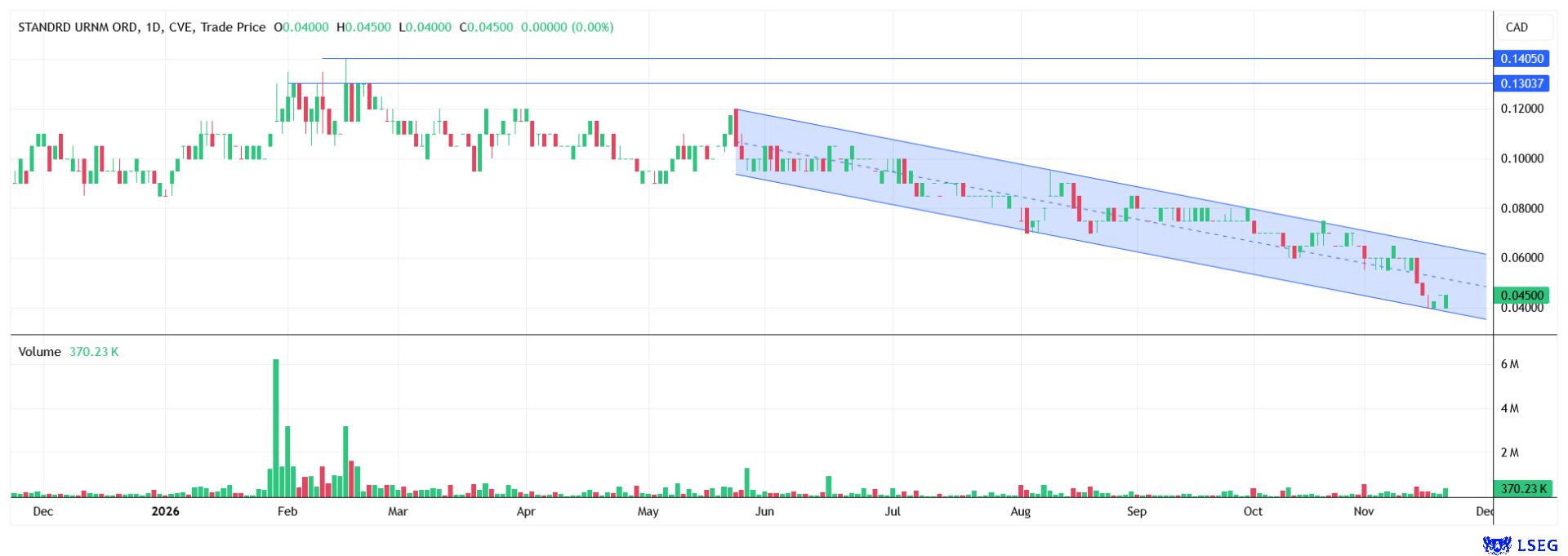
From a technical perspective, the share is in a shallow downward trend channel, and the price has currently reached its lower boundary at CAD 0.045. A rebound towards CAD 0.06 could start from here, and only above that level would CAD 0.13 to CAD 0.14 come into view as the next levels. If it also manages to break above CAD 0.14, the path to CAD 0.20 would be clear from a technical perspective, offering significant upside potential following the rapid several-fold increase in 2025 and the subsequent consolidation. Positive news such as new drill results or laboratory data could provide the catalyst. At the same time, the downside risk, although present, appears comparatively limited at this level, at least relative to the opportunity.
Conclusion
BYD is facing weak domestic demand, rising inventories and legal disputes in Europe, which may outweigh its strong export performance. For now, a wait-and-see approach may therefore be sensible. Stellantis must first demonstrate that it can get its cost-cutting targets, labour disputes and rising costs under control before its shares can regain their footing. Standard Uranium remains a speculative explorer with risks, but fresh capital, encouraging drilling results and a technical setup around CAD 0.045 offer an intriguing opportunity – potentially even for a multi-fold increase!
Conflict of interest
Pursuant to §85 of the German Securities Trading Act (WpHG), we point out that Apaton Finance GmbH as well as partners, authors or employees of Apaton Finance GmbH (hereinafter referred to as “Relevant Persons”) may hold shares or other financial instruments of the aforementioned companies in the future or may bet on rising or falling prices and thus a conflict of interest may arise in the future. The Relevant Persons reserve the right to buy or sell shares or other financial instruments of the Company at any time (hereinafter each a “Transaction”). Transactions may, under certain circumstances, influence the respective price of the shares or other financial instruments of the Company.
In addition, Apaton Finance GmbH is active in the context of the preparation and publication of the reporting in paid contractual relationships.
For this reason, there is a concrete conflict of interest.
The above information on existing conflicts of interest applies to all types and forms of publication used by Apaton Finance GmbH for publications on companies.
Risk notice
Apaton Finance GmbH offers editors, agencies and companies the opportunity to publish commentaries, interviews, summaries, news and the like on news.financial. These contents are exclusively for the information of the readers and do not represent any call to action or recommendations, neither explicitly nor implicitly they are to be understood as an assurance of possible price developments. The contents do not replace individual expert investment advice and do not constitute an offer to sell the discussed share(s) or other financial instruments, nor an invitation to buy or sell such.
The content is expressly not a financial analysis, but a journalistic or advertising text. Readers or users who make investment decisions or carry out transactions on the basis of the information provided here do so entirely at their own risk. No contractual relationship is established between Apaton Finance GmbH and its readers or the users of its offers, as our information only refers to the company and not to the investment decision of the reader or user.
The acquisition of financial instruments involves high risks, which can lead to the total loss of the invested capital. The information published by Apaton Finance GmbH and its authors is based on careful research. Nevertheless, no liability is assumed for financial losses or a content-related guarantee for the topicality, correctness, appropriateness and completeness of the content provided here. Please also note our Terms of use.
Stockhouse does not provide investment advice or recommendations. All investment decisions should be made based on your own research and consultation with a registered investment professional. The issuer is solely responsible for the accuracy of the information contained herein. For full disclaimer information, please click here.