


Consumers will play a leading role in tripling the value of the gaming industry from US$292.4 billion in 2025 to more than US$977.4 billion by 2035, but they are by no means the only driver behind expected exponential growth, given the enterprise space’s accelerating entry into the virtual world.
We see this tailwind in action with virtual reality (VR), a market expected to 7x from US$60 billion in 2022 to US$435 billion by 2030, supported by investments from major players, including Meta, Apple and Google. Here’s a handful of examples of enterprise use-cases, each of which offers multi-billion-dollar potential:
- Education, bringing the classroom to students.
- Virtual events and tradeshows, granting organizers theoretically infinite venue capacity.
- Employee training across industries, ensuring hands-on learning, as opposed to the limitations of a conventional slideshow presentation.
- Healthcare, including physical therapy.
- Tourism, from museums to attractions to famous streets.
- Design walkthroughs, from architecture to fashion to advertising.
Thanks to VR’s diversified use-cases, household names such as HTC, Samsung and Palantir are actively venturing beyond the consumer space and creating new demand. In so doing, they are incentivizing small-cap companies to think outside the box and bring technologies to market designed to advance VR utility, garner market share, reap the benefits of scale and create shareholder value through improvements on the income statement.
Introducing Virtuix
A newly-listed XR and AI market participant with a well-established business worth your fine-toothed comb is Virtuix (NASDAQ:VTIX), market capitalization US$212 million, a specialist in the hardware and software underlying movement within AI-generated virtual worlds, whether for consumer, enterprise or defense purposes.
This article is disseminated in partnership with Virtuix Inc. It is intended to inform investors and should not be taken as a recommendation or financial advice.
The company, founded in 2013 and based in Austin, Texas, is one of the top manufacturers of full-body VR systems, serving a global clientele spanning 45 countries and thousands of systems shipped to date.
Virtuix’s technology platform, backed by 25 issued patents (with 5 more pending), raised more than US$50 million in private capital from the likes of Mark Cuban, Maveron and Scout Ventures, which it parlayed into exponential growth from a US$6 million private valuation in 2014 to a US$200 million valuation as of June 2025.
To date, the company has amassed more than US$20 million in sales, supported by ~500,000 registered gaming accounts and ~3 million plays on its Omniverse gaming platform.
Virtuix has positioned itself to further expand its value-accretive trajectory, supported by the disclosure of strong financial results in 2024 and 2025, which we’ll discuss later in this article.
With momentum quickly accelerating, the company is keen to expand the reach of its dual-use strategy – targeting demand across the consumer, as well as the enterprise and defense sectors – by ramping up to full production capacity of 3,000 systems per month, representing approximately US$100 million in annual revenue, with eyes on growing cash flow, courting a broader investor base and leveraging existing global distribution across Asia, Europe and the Americas.
Virtuix’s path to exponential scale, firmly grounded in reality, relies on technology that sets itself apart from competitors, earning the company a leadership position in the growing VR marketplace. Let’s delve into why.
Omni
Virtuix’s founder and chief executive officer (CEO), Jan Goetgeluk, who we’ll get to know in the leadership section, followed a dream to walk naturally in VR, doing away with the need to sit and push buttons on a gamepad or keyboard, leading him to develop the Omni omni-directional treadmill in 2012. He went on to launch the system on Kickstarter in June 2013, raising over US$1.1 million, completing one of the most successful campaigns of its time.

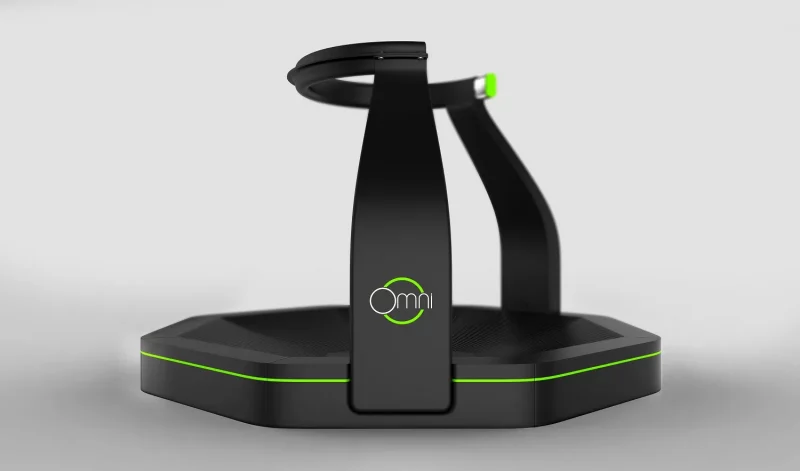
After Virtuix established the Omni’s wholistic value proposition in the consumer market, the company expanded its presence onto the commercial stage in 2016 with the Omni Pro, a now discontinued system that sold ~4,000 units to more than 500 entertainment venues across the world, earning more than US$6 million in revenue at a target gross margin of 50 per cent, eventually becoming the most widely distributed VR hardware outside of headsets of its time.

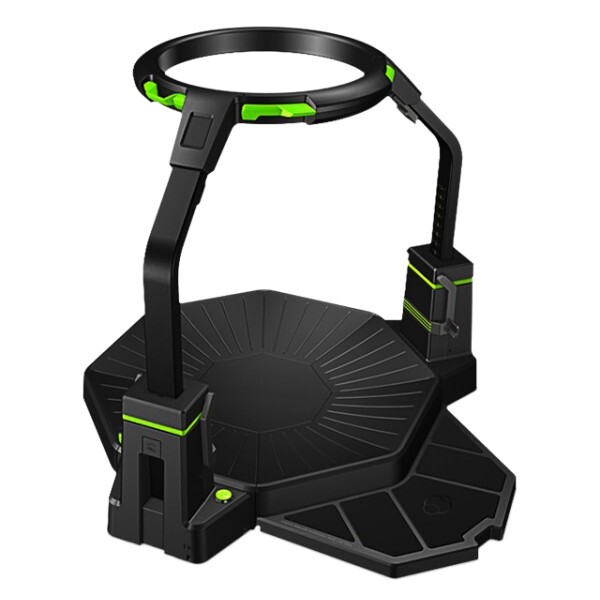
The company followed up the Omni Pro’s market validation in 2019 with the Omni Arena – composed of four Omni Pro units – catering to burgeoning esports demand with a combination of competitive gameplay and a full-body experience that quickly gained traction at high-end entertainment centres.

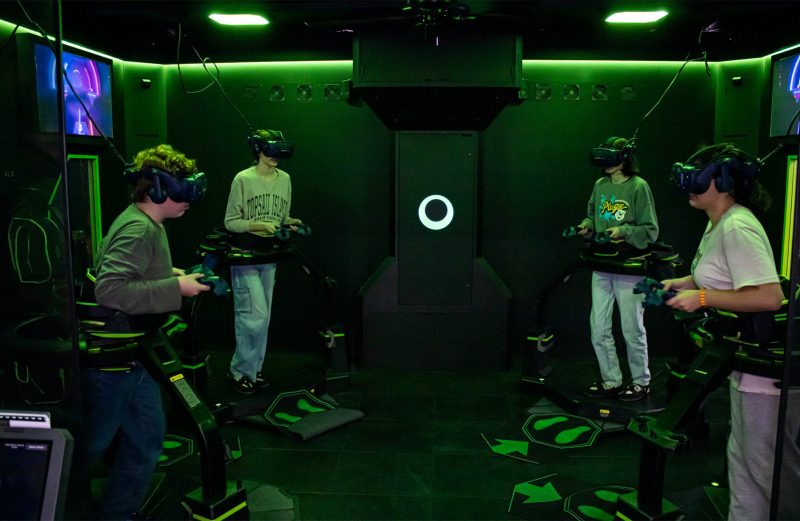
Virtuix has installed 80 Omni Arena systems to date, earning more than US$12 million in revenue at a targeted 70 per cent gross margin, backed by a growing number of positive testimonials that reinforce the company’s long-term value creation story.
Omni One
The latest chapter in this story began in 2024 with the debut of the home-optimized Omni One, evolving the technology into a robust step forward for a VR market plagued by limited mobility. Let’s take a look at the system’s specs, which are unmatched anywhere else in the industry:
- The Omni One can be set up or broken down in minutes with no tools, besting competing products, such as the Kat VR system out of China, which requires considerable technical expertise to put together.
- At a price of just US$2,595 (US$90/month through Affirm) for the Omni One Core model, Virtuix offers enthusiasts a massively discounted entry point into the virtual world versus competitors, representing a more than 95 per cent discount to the US$60,000 Infinadeck, whose hardware and software limitations make for a poorer-fidelity experience compared to what the Omni is able to provide.
The Omni One also introduced and embodies the concept of a Peloton for gamers, allowing users to leverage a full range of motion, enabled by a harness-based treadmill and customized standalone Pico 4 Ultra headset, to burn up to a reported 700 calories per hour and lose up to 40 pounds in just 4 months. To this end, users benefit from a wide selection of more than 100 compatible SteamVR games and more than 60 games carried through Virtuix’s online store, featuring high-profile IP such as Dr. Who, Ghostbusters and Peaky Blinders. Priced between US$19.99-$39.99, each game affords Virtuix a minimum 30 per cent margin.

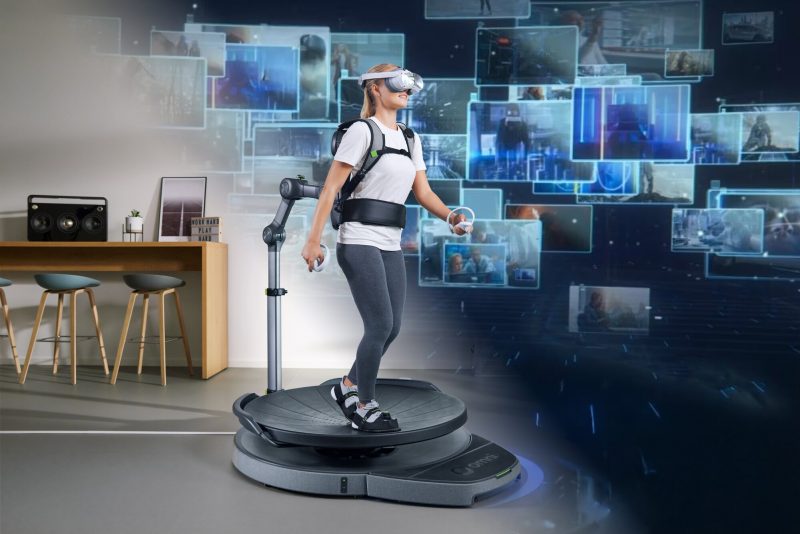
With more than 1,800 Omni One systems shipped to date, representing more than US$4 million in revenue at a 40 per cent target gross margin, Virtuix is ready to scale its operations into further growth. To that end, the company has diversified its Omni One offering across key segments, represented by the Core and Enterprise models.
The Omni One Core, priced at US$2,595, is a treadmill-only model designed for users with existing PC VR headsets and a SteamVR games library. The company’s PC app, Omni Connect, pairs the system with your PC via Bluetooth, transmitting your physical movements to the game, eschewing the need for a traditional controller.
The Omni One Enterprise, priced at US$4,995, targeting a robust 70 per cent gross margin, is vying to radically increase Virtuix’s exposure beyond the consumer market by serving commercial demand from private businesses to public institutions.
Within the Omni One Enterprise’s addressable market, Virtuix has developed an Educational variant of the product, including a one-year subscription to Omni Online, as well as a Defense variant featuring its AI-powered Virtual Terrain Walk (VTW) technology, introduced in 2025, which uses Gaussian Splatting to transform 360-degree camera footage into photorealistic, walkable 3D environments in a matter of hours for the purposes of mission planning and terrain reconnaissance.
VTW can accommodate 12 or more users – 2-3x what room-scale VR systems can offer – garnering the technology an increasing amount of attention from military and law enforcement interested in training personnel in geographically specific environments. Test units are in use at the Yokota Air Force Base and US Air Force Academy, demonstrating initial traction and de-risking the company’s pursuit of all major US defense departments.
The XR and AI technology company is also exploring new applications for Gaussian Splatting across the enterprise landscape, keen to set the stage for long-term, multi-pronged revenue growth.
Virtuix is actively advancing its commercial relationship pipeline and rolling out a direct consumer marketing campaign, including social media and influencer-created content, poised to further capitalize on its new standard for how gamers, as well as professionals, move within virtual spaces.
Virtuix’s clear strides towards profitability
Virtuix backs up its ambitions with a multi-year track record of improving financial health, growing revenue by 49 per cent from US$2.41 million in fiscal 2024 ended March 31 to US$3.59 million in fiscal 2025, marked by considerable decreases in selling and research and development expenses.
The company followed this up with 138 per cent growth from US$847,000 in revenue for the six months ended September 30, 2024, to US$2.01 million for the six months ended September 30, 2025, supported by:
- Improving gross profits from a loss of US$336,000 to a gain of US$584,000 over the respective six-month periods.
- Diminishing general and administrative expenses from US$6.93 million to US$2.36 million, reflecting efficiencies of scale.
- Diminishing net income losses from US$10.05 million to US$4.16 million, setting a prospective tone for positive cash flow over the coming quarters.
These early signs of a path to profitability, following a decade of explosive growth as a private company, are stabilized by recurring revenue, a high-margin product portfolio, a diversified addressable market, as well as a loyal customer base.
A leadership team with a 360-degree perspective
Virtuix’s vast expansion potential, funded by a recent US$11 million investment from Chicago Venture Partners and a US$50 million equity line of credit facility, is further de-risked by a leadership team, highly aligned with shareholders at 42 per cent insider ownership, rigorously qualified to maintain alignment between top and bottom-line growth thanks to more than 100 years of gaming, defense and hardware industry experience at distinguished organizations, including Unity, Flex, Corsair Gaming and the US Army. Let’s meet them now.
Management
- Founder, chairman and chief executive officer, Jan Goetgeluk, started Omni R&D in 2011 and founded Virtuix in 2013. He previously worked as an investment banking associate at J.P. Morgan from 2010 to 2013, and as a project engineer at Belgian logistics conglomerate Katoen Natie from 2006 to 2007.
- Director, president and chief operating officer, David Allan, brings more than 30 years of Asian manufacturing experience. Allan scaled ERP Power, a California based manufacturer of power supplies and LED light systems, from US$0 to US$50 million in annual sales from 2008 to 2012, including the establishment of Chinese manufacturing. From 2006 to 2008, he served as regional manager of a US$350 million Asian manufacturing operation under Flex, a Fortune 500 brand, producing for top-tier customers such as Apple and Dell.
- Chief financial officer, Thomas McGinnis, CPA, held the role of controller at Ammo from 2021 to 2025, where he oversaw financial reporting, supporting SEC disclose and the eventual sale of the business. McGinnis is also a former auditor with Durbin & Company specializing in financial statements.
- Head of marketing, Lauren Premo, was senior director of brand marketing at Turtle Beach from 2022 to 2023, leading global strategy for the Roccat gaming products brand. Before that, she worked at Corsair Gaming from 2014 to 2022, eventually ascending to director of marketing, scaling her team from 2 to 30 members, growing the company’s marketing budget from US$500,000 to US$20 million annually and developing strategic partnerships with leading technology and gaming companies.
Board
- Director, John Cunningham, founded and took on the role of CEO at Spatial Energy in 2023, where he provides technology consulting and services to help defense and manufacturing clients step into the digital age. This work includes the establishment of US operations for Virtualware, advising US defense integrators on development and go-to-market strategies, as well as spearheading the expansion of a medical AI company into the US defense healthcare space. From 2020 to 2023, Cunningham was head of government and aerospace at Unity Technologies. From 2017 to 2020, he served as chief revenue officer of The DiSTI Corporation, co-leading the company’s successful pivot from government-focused software licensing to a commercial SaaS model.
- Director, Ugo de Charette, was the general manager at Tous Contes Fees from 2005 to 2024, where he managed a catalogue of musical rights. He brings substantial experience managing media, technology and real estate investments to the table.
- Director, Parthkumar Jani, is the founder and CEO of JC Team Capital, a venture fund with a portfolio spanning entertainment, hospitality and real estate, making him a valuable resource for strategic growth insights across industries.
- Finally, director and chairman of the audit committee, Randolph Read, CPA, has been president and CEO of Nevada Strategic Credit Investments and International Capital Markets Group for more than five years. Since 2018, he has been an independent manager/director and chairman of New York REIT Liquidating, a successor to the publicly listed New York REIT (NYSE:NYRT), where he served as independent director from 2014 to 2018, including as chairman from 2015 to 2018. Read has held the roles of independent director at SandRidge Energy (NYSE:SD) since 2018, and independent chairman of Enzon Pharmaceuticals (OTCQX:ENZN) since 2020. He was independent director of Luby’s (NYSE:LUB) from 2019 to 2021.
From gaming to finance to branding to manufacturing, Virtuix’s executive team is built to expand private market success into the public realm, leveraging global experience and the Nasdaq’s unrivaled cache to optimize the reach of the company’s differentiated, market-proven technology.
An ideal setup for multiple expansion
That said, the broader market has yet to key into Virtuix’s complete-package investment thesis, marked by high-conviction leadership, technology and industry tailwinds, simply because the stock has only been trading since January 27.
As positive news continues to flow, dissipating selling pressure from initial investors, look for Virtuix to better reflect the robust value proposition we’ve delineated in this article. Here’s a recap:
- Production capacity capable of quintupling total historical revenue in a single year, from US$20 million to US$100 million.
- An existing global distributor base to jumpstart international expansion.
- An improving financial track record that de-risks the company’s ability to guide growth on a path to profitability.
In this way, Virtuix finds itself in full-growth mode, without losing sight of cash flow, putting it in an ideal position to advance software and hardware innovations, translate them into progress on the income statement and continue to prove to investors that its imaginary worlds are capable of delivering real shareholder value.
Join the discussion: Find out what investors are saying about this XR and AI technology stock on the Virtuix Holdings Inc. Bullboard and make sure to explore the rest of Stockhouse’s stock forums and message boards.
Stockhouse does not provide investment advice or recommendations. All investment decisions should be made based on your own research and consultation with a registered investment professional. The issuer is solely responsible for the accuracy of the information contained herein.
For full disclaimer information, please click here.