


BYD and XPeng: Conquering Europe Is on the Agenda
The automotive industry is undergoing a major transformation—and BYD and XPeng are right in the thick of it! XPeng co-founder and CEO He Xiaopeng recently emphasized that the highly competitive Chinese market is more challenging than ever for the startup, founded 10 years ago and working closely with Volkswagen, and that relief will not come for another 5 to 10 years. For the technology group, however, increased exports to Europe are not a short-term stopgap measure but rather an integral part of a global strategy to sell more than 1 million vehicles outside China by 2030.
Industry giant BYD is pursuing a similarly ambitious strategy; according to reports in Automobilwoche, the company aims to conquer the European market through massive expansion despite current margin issues in its home market. To skillfully circumvent the EU’s punitive tariffs set to take effect at the end of 2024, both companies are now actively exploring the expansion of local manufacturing in Europe. While XPeng is currently evaluating the acquisition of existing European production facilities or strategic partnerships, its manufacturing has so far focused primarily on the Chinese plants in Zhaoqing and Guangzhou, as well as the new locations in Indonesia and Malaysia.
According to research by Wirtschaftswoche, BYD is even going a step further and is already looking for a second European location in southern Europe, such as Spain, even though construction of its first factory in Szeged, Hungary, has been delayed until well into 2026. In addition, BYD has put its original plans for a production facility in Turkey on hold for the time being, as the country’s EU accession is no longer a political priority and local sales figures have plummeted. Beyond production logistics, both brands are heavily focused on technological innovations and clearly differentiating themselves from the competition. Europe, however, is at the top of the agenda for both BYD and XPeng; the two companies are taking different approaches, but each has grand ambitions of its own. The stocks of these companies must first consolidate after the euphoria of recent years, but they could very well make a splash over the next 3 years.
When the Electric Motor Roars Like a V8: Mercedes CEO Celebrates the Silent V8
But e-mobility can also be different! Mercedes brand chief Ola Källenius is currently sparking plenty of discussion in the internal combustion engine community with a bold statement. He bluntly described the brand-new, all-electric AMG models, such as the CLA 45 and the AMG GT Coupé, as the best V8 cars he has ever driven. To preserve the typical driving experience, these electric vehicles simulate incredibly realistic sounds and vibrations, providing drivers with the feedback they have been sorely missing. Having been with the company since 1993, Källenius knows exactly how a real eight-cylinder engine should sound. Technically speaking, these electric powerhouses already offer significantly more power and torque than their fossil-fueled predecessors. However, the CEO openly admits that many customers simply are not quite there yet emotionally when it comes to electric mobility. For many buyers, the abrupt switch from a gasoline-powered car to an electric vehicle still feels, at the moment, like the arduous process of learning a completely new language. That is why Mercedes is giving traditionalists time for now and continues to offer internal combustion engines as a reassuring option.
For investors, this emotional bridge-building underscores a flexible yet highly profitable transition strategy by the Stuttgart-based premium manufacturer. Mercedes-Benz is pursuing a dual-product strategy in which the ongoing electrification of the AMG fleet, driven by high-margin, high-performance models, helps preserve the core brand identity. The parallel sale of highly advanced internal combustion engines mitigates the financial risk of market fluctuations and maintains stable cash flow. In the long term, the group is investing heavily in software-defined, all-electric architectures with emotionally unique selling propositions (USPs) to secure technological leadership in the luxury segment and build brand loyalty among new customer groups. Analysts on the LSEG Refinitiv platform are taking a liking to Källenius’s new strategy and have set a 12-month price target of EUR 56.30, about 25% higher than the current trading price. On top of that, Mercedes-Benz has always paid a dividend that is unmatched in the DAX 40 index.
Strategic Resources: Three Metals, Two Continents, One Major Lever
Electric mobility, battery storage, and AI data centers have one thing in common: they are drastically shifting demand for raw materials and turning secure supply chains into a strategic competitive advantage. As Western economies seek to reduce their dependence on individual supplier countries, metals such as iron, vanadium, and titanium are increasingly taking center stage in industrial restructuring. This is where Strategic Resources comes into play. The Canadian company is addressing several bottlenecks in the energy transition at once—from high-quality iron ore for more climate-friendly steel production to vanadium for stationary battery storage. Instead of pouring billions into a traditional mining project, the company is initially pursuing a strategy that requires less capital: a merchant pelletizing plant with an annual capacity of 4.0 million metric tonnes is to be built at the deep-water port of Port Saguenay in Québec. The key advantage: Initially, purchased concentrate is to be processed, meaning Strategic Resources could generate revenue and margins significantly sooner than if it focused solely on developing its own mine.
IIF host Lyndsay Malchuk speaks with CEO Sean Cleary about the planned construction of the processing plant in Québec.
The project’s economic leverage is remarkable. The pre-feasibility study estimates processing costs of only about USD 16.31 per metric ton, while long-term EBITDA of approximately USD 173 million appears feasible. Québec’s relatively low-carbon hydroelectric power system is to be used to meet energy needs, with support from a publicly funded incentive program totalling approximately CAD 111 million. Additionally, Javelin Global Commodities, an international commodities player, is on board as a marketing and supply partner, which is also expected to facilitate working capital financing of up to USD 150 million. At the same time, the Finnish Mustavaara project is gaining strategic importance: the vanadium-bearing magnetite concentrate was selected for the EUR 17 million FutSteel program coordinated by the University of Oulu. In collaboration with SSAB, the entire industrial process chain, from iron reduction to hot rolling, will be investigated there through 2029. The goal is nothing less than to demonstrate that electric steel and hydrogen-based production processes can be integrated into existing steel structures without compromising quality or performance. If the decarbonization of a single large Finnish steel mill can reduce national CO₂ emissions by up to 7%, Mustavaara will gain technological relevance that extends far beyond the research collaboration itself.
The story becomes even more exciting when it comes to vanadium. This metal could become significantly more important for an independent North American battery value chain, particularly in large-scale energy storage, industrial applications, and military infrastructure. A memorandum of understanding with Tyfast Energy therefore aims to establish an independent vanadium battery supply chain. The focus is on vanadium redox flow batteries, which, due to their longevity and scalability, can play a key role in storing renewable energy and stabilizing increasingly volatile power grids. The combination of all these critical factors and existing infrastructure makes Strategic Resources a speculative commodity play with an unusually large number of value anchors and significant potential for revaluation if the projects get off to a successful start.

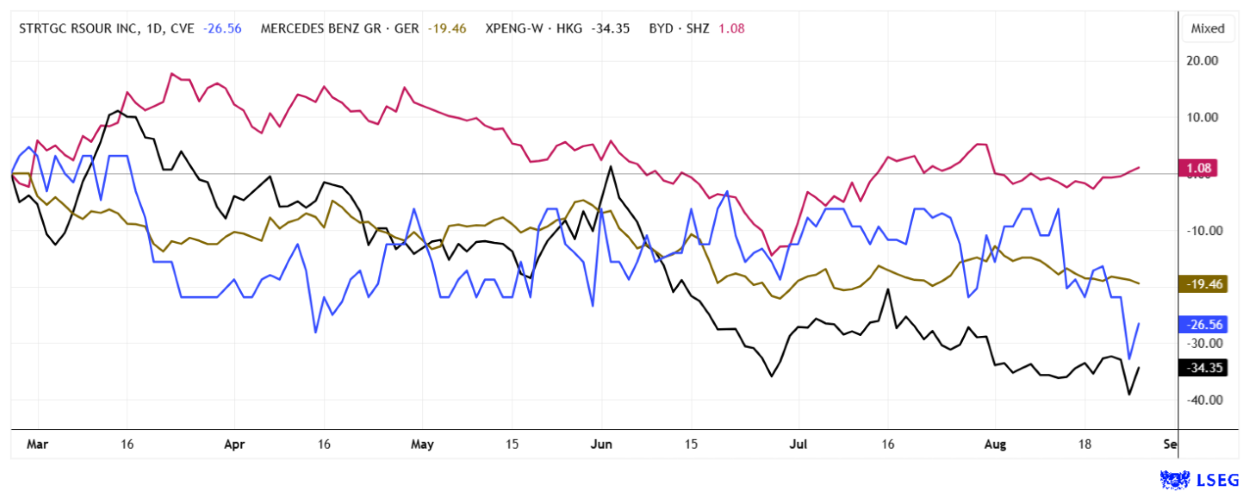
Anyone who thinks the global energy transition is just about simple wind turbines is missing out on the most exciting and profitable stock market story of our decade. After all, it is the clever interplay of various trends that really makes it special. While BYD and XPeng, as dynamic drivers of innovation, are bringing electrification and artificial intelligence to roads worldwide at record speed, Mercedes-Benz is impressively demonstrating that true luxury maintains its highly profitable niche even in the green age. But the real highlight behind the scenes remains Strategic Resources—without whose critical metals, not a single high-tech dream would ever get off the ground. A sensible diversification across sectors and themes reduces portfolio risk.
Conflict of interest
Pursuant to §85 of the German Securities Trading Act (WpHG), we point out that Apaton Finance GmbH as well as partners, authors or employees of Apaton Finance GmbH (hereinafter referred to as “Relevant Persons”) currently hold or hold shares or other financial instruments of the aforementioned companies and speculate on their price developments. In this respect, they intend to sell or acquire shares or other financial instruments of the companies (hereinafter each referred to as a “Transaction”). Transactions may thereby influence the respective price of the shares or other financial instruments of the Company.
In this respect, there is a concrete conflict of interest in the reporting on the companies.
In addition, Apaton Finance GmbH is active in the context of the preparation and publication of the reporting in paid contractual relationships.
For this reason, there is also a concrete conflict of interest.
The above information on existing conflicts of interest applies to all types and forms of publication used by Apaton Finance GmbH for publications on companies.
Risk notice
Apaton Finance GmbH offers editors, agencies and companies the opportunity to publish commentaries, interviews, summaries, news and the like on news.financial. These contents are exclusively for the information of the readers and do not represent any call to action or recommendations, neither explicitly nor implicitly they are to be understood as an assurance of possible price developments. The contents do not replace individual expert investment advice and do not constitute an offer to sell the discussed share(s) or other financial instruments, nor an invitation to buy or sell such.
The content is expressly not a financial analysis, but a journalistic or advertising text. Readers or users who make investment decisions or carry out transactions on the basis of the information provided here do so entirely at their own risk. No contractual relationship is established between Apaton Finance GmbH and its readers or the users of its offers, as our information only refers to the company and not to the investment decision of the reader or user.
The acquisition of financial instruments involves high risks, which can lead to the total loss of the invested capital. The information published by Apaton Finance GmbH and its authors is based on careful research. Nevertheless, no liability is assumed for financial losses or a content-related guarantee for the topicality, correctness, appropriateness and completeness of the content provided here. Please also note our Terms of use.
Stockhouse does not provide investment advice or recommendations. All investment decisions should be made based on your own research and consultation with a registered investment professional. The issuer is solely responsible for the accuracy of the information contained herein. For full disclaimer information, please click here.