


Microsoft and Broadcom: First Punished, Now Soaring
Now the tech giants are back on track! Software giant Microsoft experienced a historic correction on the stock market, during which USD 600 billion in market value was wiped out at one point. The sharp price drop was triggered primarily by Wall Street’s concerns about extremely high capital expenditures (CAPEX) for data centers and artificial intelligence. As the growth of the Azure cloud platform simultaneously showed slight signs of slowing, many investors doubted that these billion-dollar expenditures would quickly turn a profit. In addition, the AI assistant Copilot initially saw slower adoption among enterprise customers than the market had hoped for. Following this painful setback, however, the company is now successfully gaining momentum. A new restructuring of the partnership with OpenAI secures long-term licensing rights while simultaneously easing the strain on the balance sheet. Thanks to accelerating momentum in commercial Copilot subscriptions and an improved valuation, investors are now jumping back in with confidence. The stock has continued its powerful ascent from USD 380, surging back above USD 500 yesterday. At USD 569.50, the consensus analyst price target compiled by LSEG is now only around 15% above the current share price.
Semiconductor specialist Broadcom also came under unexpected heavy selling pressure after reaching new record highs. The main cause of the temporary slump was a projected decline in the gross margin in Q2. Paradoxically, this margin pressure resulted from the massive growth of the AI division, as hardware system sales have lower profit margins than the highly profitable traditional software business. In addition, management disappointed short-term traders by initially maintaining its long-term revenue forecasts for AI chips at a cautious level, despite strong quarterly results. A slight revenue shortfall in the infrastructure software division temporarily reinforced analysts’ skepticism. However, the fundamental tailwind has long since taken hold and is driving the stock back up. Key to this are new, groundbreaking chip deals for custom AI processors with major, well-known clients, which impressively confirm the long-term growth story. The stock has since added another USD 50, pushing its year-to-date gain to nearly 40%. But analysts on the LSEG platform still see another USD 100 or so of upside. Well then!
Miivo AI: AI Evolves from a Tool into the Digital Operating System for SMBs
Artificial intelligence is now entering its next stage of development: it is no longer the most sophisticated technology that matters, but the ability to turn AI into measurable productivity gains and revenue growth in day-to-day business. Agile investors are turning their attention to the Canadian AI specialist Miivo AI, whose solutions target a market where digital transformation has so far progressed significantly more slowly than among large corporations. The company is building a growing portfolio of specialized AI solutions that do more than analyze financial data, sales activity, and customer feedback — they turn these insights into concrete actions and actionable recommendations.
In the first half of 2026, Miivo launched three key applications: Business Intelligence for real-time insights into operational metrics, Lead Finder for automated B2B lead generation, and Customer Insights for analyzing reviews and customer sentiment on popular online platforms. The growth of the user base is particularly noteworthy, as the company reports that since the product launch, it has acquired more than 3,000 users, significantly increased the time spent on the platform, and expanded the number of recurring revenue customers. This marks an important step from a software product to a scalable SaaS business. This also shifts the strategic approach. Miivo is no longer relying on a single large application but is creating multiple entry points into a shared AI ecosystem, through which customers can gradually access additional features.
The self-service model is particularly compelling, as it is designed to enable integrations with existing systems such as Xero or QuickBooks within minutes, thereby bypassing the traditional, expensive, and time-consuming software implementation process. At the same time, Miivo remains flexible through its managed services offering, allowing the company to connect ERP, CRM, POS, and accounting systems for more complex requirements, build custom dashboards, and turn AI insights into directly actionable measures. This approach is supported by a recent OECD study based on a survey of more than 5,000 SMBs in Europe, Canada, and Asia, which examines how generative AI is already being used to address labor shortages and skill gaps. For Miivo, this is particularly relevant because the study confirms a structural trend: SMBs are increasingly viewing AI not as a novelty, but as a tool for making better use of scarce human resources and improving productivity.
At the same time, Miivo’s own market analysis reveals the scale of the playing field. In the US alone, approximately 4.2 million new SMBs are founded each year, while nearly half fail within 5 years. Miivo addresses this critical issue and aims to help companies identify problems earlier and capitalize on opportunities faster through early warning signals, real-time analytics, and operational intelligence. The story becomes even more exciting due to the planned distribution through strategic SaaS partners. An integration with a regional provider that has already been completed potentially opens the door to more than 14,000 SMBs. It could turn every additional integration into a recurring, cost-effective sales channel. When it comes to security and trust, Miivo does not intend to play catch-up but rather to operate at an enterprise level from the outset, including through SOC 2 compliance, external cybersecurity audits, encrypted data transmission, and its own Cybersecurity Committee. Several positive case studies, in which margins and customer retention were increased, demonstrate that this approach works beyond just PowerPoint presentations.
It is also of interest to investors that, despite its ambitious growth strategy, Miivo maintains a relatively lean capital structure. The 39.35 million shares currently outstanding have a total market capitalization of just under CAD 19 million. While this means Miivo remains a speculative small-cap stock, it is precisely the combination of a growing user base, recurring revenue, multiple AI products, and scalable distribution partnerships that makes the stock an attractive early-stage investment opportunity in the booming AI-SaaS market.
SoftBank: A Visionary Investor with a Keen Instinct
Japan’s SoftBank Group is one of the world’s most influential and aggressive investment holding companies in the technology sector. The group became best known for the “Vision Fund,” launched by founder Masayoshi Son, which is the world’s largest tech investment fund. Through this multi-billion-dollar vehicle, the company is investing heavily in forward-looking trends such as artificial intelligence, robotics, and the Internet of Things. Among the best-known successes in the company’s history is its early and extremely lucrative investment in the Chinese e-commerce giant Alibaba. In addition to purely financial investments, SoftBank also holds strategically significant majority stakes, such as in the British chip designer ARM Architecture. However, due to its focus on highly valued, often still unprofitable tech startups, the business model is considered comparatively risky and volatile. During periods of market corrections, the holding company has therefore had to absorb heavy losses and drastic write-downs of its portfolio on multiple occasions. Nevertheless, founder Masayoshi Son is regarded as an unwavering visionary who uses setbacks to make an even bigger splash in the next wave of AI. Today, SoftBank is strategically positioning itself as a key catalyst for the global AI revolution and is driving the convergence of capital and artificial intelligence. 15 out of 20 analysts have issued a “Buy” rating and set the 12-month target price at an astonishing JPY 8,680, or the equivalent of EUR 47.50. If the experts are to be believed, there is still plenty of room to grow from the current price of EUR 30 per share.

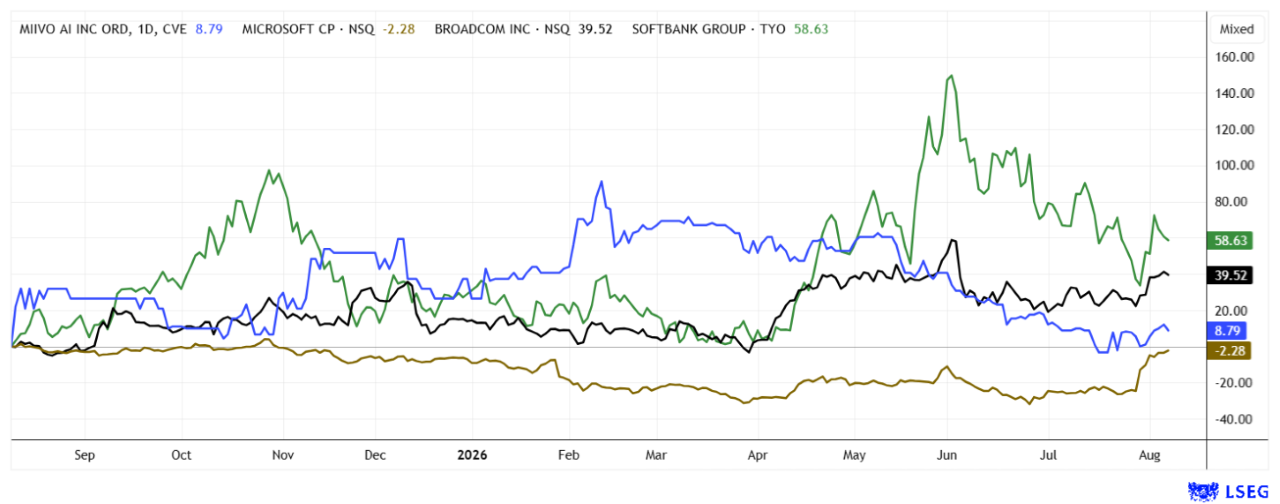
Many investors are banking on endless growth in the new megatrend of “artificial intelligence”. The charts of our peer group show that this is by no means a one-way street. Even the slightest disappointment in quarterly earnings can result in a 25% drop. That is just how it is during a phase of sky-high valuations. Microsoft is continuing its recovery, while Broadcom and SoftBank are building on their success stories. Miivo AI’s innovative business model looks promising—with a market capitalization of around CAD 20 million and no debt, the company still has significant scope to create additional value as it scales.
Conflict of interest
Pursuant to §85 of the German Securities Trading Act (WpHG), we point out that Apaton Finance GmbH as well as partners, authors or employees of Apaton Finance GmbH (hereinafter referred to as “Relevant Persons”) currently hold or hold shares or other financial instruments of the aforementioned companies and speculate on their price developments. In this respect, they intend to sell or acquire shares or other financial instruments of the companies (hereinafter each referred to as a “Transaction”). Transactions may thereby influence the respective price of the shares or other financial instruments of the Company.
In this respect, there is a concrete conflict of interest in the reporting on the companies.
In addition, Apaton Finance GmbH is active in the context of the preparation and publication of the reporting in paid contractual relationships.
For this reason, there is also a concrete conflict of interest.
The above information on existing conflicts of interest applies to all types and forms of publication used by Apaton Finance GmbH for publications on companies.
Risk notice
Apaton Finance GmbH offers editors, agencies and companies the opportunity to publish commentaries, interviews, summaries, news and the like on news.financial. These contents are exclusively for the information of the readers and do not represent any call to action or recommendations, neither explicitly nor implicitly they are to be understood as an assurance of possible price developments. The contents do not replace individual expert investment advice and do not constitute an offer to sell the discussed share(s) or other financial instruments, nor an invitation to buy or sell such.
The content is expressly not a financial analysis, but a journalistic or advertising text. Readers or users who make investment decisions or carry out transactions on the basis of the information provided here do so entirely at their own risk. No contractual relationship is established between Apaton Finance GmbH and its readers or the users of its offers, as our information only refers to the company and not to the investment decision of the reader or user.
The acquisition of financial instruments involves high risks, which can lead to the total loss of the invested capital. The information published by Apaton Finance GmbH and its authors is based on careful research. Nevertheless, no liability is assumed for financial losses or a content-related guarantee for the topicality, correctness, appropriateness and completeness of the content provided here. Please also note our Terms of use.
Stockhouse does not provide investment advice or recommendations. All investment decisions should be made based on your own research and consultation with a registered investment professional. The issuer is solely responsible for the accuracy of the information contained herein. For full disclaimer information, please click here.