


The widespread attraction of dividend stocks isn’t hard to understand. When it comes to collecting a satisfactory long-term return, who wouldn’t want part of it to be paid out on a regular basis, whether monthly or quarterly, as opposed to having to wait years or decades to sell shares and have cash in hand? If your due diligence process is able to determine that a company deserves high conviction for delivering such a return, the investment is a no-brainer, right?
This article is a journalistic opinion piece on the best Canadian dividend stocks written based on independent research. It is intended to inform investors and should not be taken as a recommendation or financial advice.
Well, not so fast. Because what if the company had invested the earnings it pays out as a dividend into a growth initiative instead, such as a new service or product line, and it turns out to not only increase profits, but also become the next revolutionary vaccine, streaming service or AI application that shaves hours off of a legacy process for which no replacement was thought possible?
In this case, supposing the growth initiative takes hold in its target market, isn’t it conceivable that both return on capital and shareholder return stand a good chance of being higher compared to simply handing you cash?
The realization we’re working towards here is this: The optimal dividend stock should strike a balance between business development and cash returns, ideally generating earnings in excess of working and growth capital requirements to incentivize investors. This framework, in turn, offers us a direction to follow as we attempt to identify the best Canadian dividend stocks.
Our methodology for choosing the best Canadian dividend stocks
If the ideal dividend stock has both earnings to draw on and growth ahead of it, a logical way to narrow down our investable universe is to screen for a combination of earnings and dividend growth.
We can take our de-risking efforts a step further by limiting ourselves to a five-year period, in this way weeding out stagnant companies whose best compounding days are behind them – as is the case for many dividend aristocrats – as well as companies in early development, which require that all available capital be invested back into the business.
Here’s what the setup looks like using The Globe and Mail’s free screening tool:

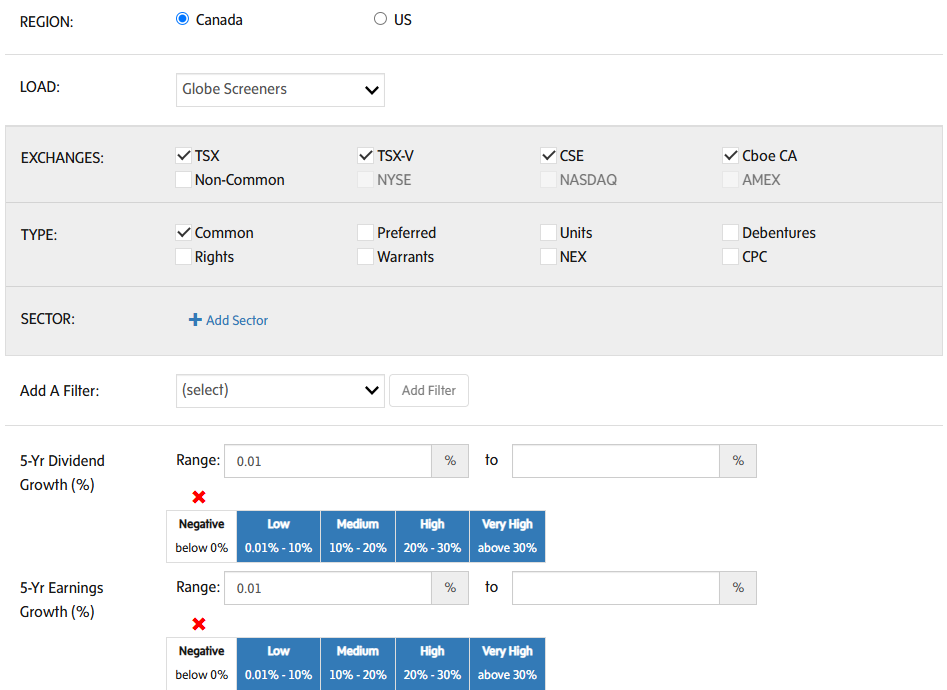
Once the list is populated with prospective dividend stocks, the next step is to rearrange it based on which names offer the highest combination of earnings and dividend growth, making sure you’re only analyzing companies that take a balanced view between expanding market share, making money and dishing out some of that money to reward investor conviction.
From there, your due diligence process should take the reins, leading you to scan press releases, earnings reports, official websites and investor decks for red flags that immediately disqualify a company from a long-term spot in your portfolio.
Situations to look out for include excessive debt that current earnings cannot adequately cover, strong earnings growth that masks a period of sustained unprofitability, and faltering revenue indicating the erosion of a company’s market share, in essence anything that fades the line between a company’s present state and the next stage in its evolution.
The best Canadian dividend stocks for 2026
After working my way down the list, combing through available literature, here are the five healthiest companies I turned up, ordered by five-year earnings and dividend growth:
- Linamar: 17.91% earnings growth, 25.48% dividend growth.
- E-L Financial: 23.51% earnings growth, 25.79% dividend growth.
- Dynacor Group: 35.37% earnings growth, 20.92% dividend growth.
- PrairieSky Royalty: 44.10% earnings growth, 22.63% dividend growth.
- TWC Enterprises: 124.68% earnings growth, 35.10% dividend growth.
Let’s delve into each company’s operations to illuminate why they deserve serious consideration for your dividend portfolio.
5. Linamar
Rounding off our top five is Linamar, market cap C$5.67 billion, a global manufacturing company founded in 1966 specializing in casting, forging, metal forming, machining and engineering for a diversity of essential sectors including mobility, water, energy, defense, mobility and robotics. With more than 37,000 employees active across 19 countries and four continents, the company stands as one of the crown jewels of Canada-based manufacturing.
According to Linamar’s Q2 2026 investor deck, the company has compounded sales at 11.2 per cent annually over the past 30 years as of fiscal 2025, delivering positive free cash flow since 2013. Net debt-to-EBITDA, meanwhile, has fallen by two thirds from 1.5x in 2019 to about 0.5x as of Q2 2026, demonstrating an ability to balance profitability with prudent capital management, leaving the company with C$1.27 billion in cash and C$725 million in credit to pursue growth initiatives.
With more than 90% of revenue being tariff free, Linamar’s long-tenured leadership team is leaning into the company’s diversified market presences through investments in innovation, including recently acquired high-precision gear manufacturing facilities in Germany, while returning cash to shareholders in the form of an ongoing stock buyback program, plus a quarterly dividend whose yearly payout has increased by 3.2x from C$0.40 in 2016 to C$1.16 today, representing a 10.13% payout ratio and a 2.62% yield, with cash in excess of the company’s growth plans earmarked for future shareholder returns.
Linamar stock (TSX:LNR) last traded at C$96.21, adding 26.09% year-over-year and 45.57% since 2021.
4. E-L Financial
E-L Financial, market cap C$6.04 billion, is another dividend stock tracking an underlying company with a good head on its shoulders, splitting its focus between its bottom line and investors who require an income stream to put capital to work.
The company offers exposure to two operating segments, including E-L Corporate, encompassing its investments in stocks and fixed income, and Empire Life, a group life and health insurance, investment and retirement products provider active since 1923 with C$22 billion in assets under management (as of Q2 2026).
Revenue has grown from C$2.32 billion in 2021 to C$3.91 billion over the trailing twelve months, while net income went from C$1.13 billion to C$1.82 billion, respectively, with the company’s lone losses of C$189 million in 2022 attributable to market volatility, as inflation and rising interest rates ate into investment portfolio returns, headwinds leadership swiftly lifted operations out of with C$933 million in net income in 2023.
E-L’s quarterly dividend has been climbing over the past decade from C$0.05 per year in 2016 to C$0.16 per year presently, entailing a 0.94% yield and a sustainable payout ratio of 3.12%.
E-L’s ability to generate future shareholder value is supported by a net equity value per share of C$27.37 as of June 30, 2026, significantly above the stock price quoted below. This is in addition to Empire Life’s Life Insurance Capital Adequacy Test ratio of 159%, up from 153% as of December 31, 2025, comfortably above the threshold of 90% set by the Office of the Superintendent of Financial Institutions Canada. Taken together, these metrics position the company to scan its investable universe for attractive opportunities from a position of strength and encourage a re-rating towards fair value.
E-L Financial stock (TSX:ELF) last traded at C$17.46, adding 8.31% year-over-year and 86.74% since 2021.
3. Dynacor Group
Dynacor Group, market cap C$213.10 million, defends its place among the best Canadian dividend stocks as the world’s only publicly traded processor of artisanal gold.
Established in 1996, Dynacor has built a traceable supply chain of more than ~750 artisanal miners to date, leveraging its flagship Veta Dorada plant in Arequipa, Peru, whose capacity stands at 500 tons per day.
According to the company’s latest investor deck, output from Veta Dorada has translated into rising gold sales, climbing from US$195.9 million in 2021 to an estimated midpoint of US$555 million in 2026.
Dynacor pairs its rising market share with consistent net income growth from US$11.78 million in 2021 to US$21.29 million in 2025, plus US$8.45 million through Q2 2026, demonstrating strong sales despite declining gold prices.
The company’s glimmering income statements have allowed it to put its monthly dividend on a similarly upward trajectory, increasing it from C$0.02 in 2018 to C$0.12 in 2026, working out to a 3.5% yield and a conservative 23.65% payout ratio.
Looking ahead, the company’s industry-honed leadership team, familiar with the full mining lifecycle, is targeting a more than 50% production increase from 2025 to 2027, leveraging an international expansion strategy on track to deliver initial gold pours at new facilities in Ecuador and Senegal before the year comes to an end.
Dynacor Group stock (TSX:DNG) last traded at C$5.04, adding 6.33% year-over-year and 83.94% since 2021.
2. PrairieSky Royalty
PrairieSky Royalty, market cap C$7.60 billion, grounds its dividend-paying prowess in oil and natural gas royalty revenue, currently holding the largest independently-owned fee mineral title position in Canada.
The company’s 18.6 million acres of royalty lands across Western Canada, tripled from 5.2 million acres at IPO in 2014, boast an established history of production growth and cash flow generation stemming from a current roster of 325 lessees, including industry leaders Baytex Energy, Tourmaline Oil and Canadian Natural Resources.
Energy production has risen from 8.53 million barrels of oil equivalent (boe) in 2016 to 9.43 million boe in 2025, with proved and probable reserves growing from 19.91 million to 34.5 million boe, respectively.
From a gross profit perspective, this trajectory has resulted in growth from C$202.6 million in 2021 to C$384.20 million over the trailing twelve months, with net income of C$123.3 million and C$241.5 million, respectively.
PrairieSky’s earnings power is supported by a strong balance sheet, sitting at 0.4x debt-to-EBITDA according to the July 2026 investor deck, and an even stronger business model, achieving a 90% operating margin over the first six months of 2026 thanks to its royalty partners shouldering all operating and development costs. Furthermore, the company’s unhedged portfolio offers investors pure-play exposure to oil and natural gas prices.
The company’s profitability and low costs have allowed it to return significant capital to investors from IPO to June 30, 2026, including C$2.2 billion in dividends and C$413 million in share buybacks at an average price of C$17.81 per share.
Dividend investors have enjoyed exponential increases from a COVID pandemic low of C$0.31 in 2021 to C$1.06 in 2026, translating into a 3.23% yield, while maintaining a conservative payout ratio of 54% year to date.
Looking ahead, PrairieSky is keen to continue its history of strategic acquisitions and buybacks, especially during moments of energy market weakness – marked by average WTI prices as low as US$38 per barrel – taking advantage of its robust financial position and a leadership team, highly aligned with shareholders, equipped with comprehensive experience across the oil, natural gas and royalty businesses.
PrairieSky Royalty stock (TSX:PSK) last traded at C$33.18, adding 29.91% year-over-year and 141.84% since 2021.
1. TWC Enterprises
Taking the top spot in our suggestions for best Canadian dividend stocks is TWC Enterprises, market cap C$652.14 million, Canada’s largest owner and operator of golf courses.
TWC’s 48.5 courses, operated under the ClubLink brand, are spread across 34 clustered locations in Ontario, Quebec and Florida, strategically chosen for their resort appeal and dense metropolitan populations.
The company keeps customers coming back thanks to a diversified offering, including membership and daily fee options, as well as resort, social event and business meeting opportunities, strengthening revenue generation through cross-selling, while leveraging operating synergies and economies of scale to keep costs low.
TWC’s flexible membership model, enhanced by the family atmosphere of its golf courses, has yielded robust gross profit growth from C$155.73 million in 2022 to C$181.69 million for the year ending in Q2 2026, paired with net income of C$18.76 million and C$58.94 million, respectively. Earnings of C$89.94 million in 2021 are anomalous, reflecting asset sales and gains on investment.
Dividend investors have seen their quarterly payments rise considerably over the period, climbing from a pandemic low of C$0.08 per year in 2021 to C$0.38 per year currently, representing a 1.99% yield at a sustainable 15.64% payout ratio.
Over the coming years, TWC is eyeing both organic and inorganic opportunities to foster cash flow and shareholder value, including debt and equity investments, underlined by a sizable position in Automotive Properties REIT, acquisitions such as its 2025 purchase of Deer Creek in Ajax, Ontario, one of Canada’s largest golf and event complexes, as well as a continual focus on efficiencies across its operating business.
TWC Enterprises stock (TSX:TWC) last traded at C$27.03, adding 10.33% year-over-year and 53.58% since 2021.
Takeaway
The temptation to succumb to a dividend’s ability to sooth your stock market anxiety is as strong as it is dangerous, with many investors mistakenly choosing companies based on highest yield alone, shaking off any concerns about future revenue and earnings, or the fact that no dividend is set in stone, relying instead on board approval for every single payment.
To protect against companies that will likely fall short of providing you with the income stream you need, the only course of action is to hold your positions accountable, limiting your investable universe to companies whose income statements are proof of a balance between cash returns and the long-term fostering of shareholder value.
To this end, you should run our screen at minimum on a yearly basis, careful to rotate out of stocks whose underlying companies fall on hard times, replacing them with names that rise up the list that pass your due diligence process with flying colours.
Join the discussion: Find out what investors are saying about the best Canadian dividend stocks on the Linamar Corp., E-L Financial Corporation Ltd., Dynacor Group Inc. and TWC Enterprises Ltd. Bullboards, and make sure to explore the rest of Stockhouse’s stock forums and message boards.