


SAP: Digital Tools for Greater Success in Corporate Groups
The Walldorf-based software giant SAP is resolutely driving forward sustainable transformation. With the SAP Sustainability Control Tower, the company provides a central platform that integrates sustainability data directly into operational business processes. The application runs on the SAP Business Technology Platform and seamlessly links financial metrics with greenhouse gas emissions in accordance with the GHG Protocol. This protocol is the world’s most important and widely used standard for measuring, accounting for, and managing greenhouse gas emissions. The software enables highly automated reporting in accordance with strict European regulations. Integrated assistants such as SAP Joule also support management teams in AI-driven analysis of strategic initiatives in the energy sector. Although SAP is not a provider of renewable energy, its solutions benefit from the green transformation. Recurring SaaS revenues generate predictable cash flows—and this also applies to sustainability-related software.
Siemens Energy Benefits from Restructuring
Siemens Energy operates in a completely different area of value creation, where the company has finally turned things around after years of turbulence. Following problems at its wind power subsidiary Siemens Gamesa, the Grid Technologies segment is now boosting the Group’s earnings as a profit driver. In the second quarter of fiscal year 2026, order intake climbed to EUR 17.75 billion. The total order backlog reached a record level of EUR 154 billion. As a result of these figures, management raised its annual revenue growth forecast to 14 to 16% and now expects an earnings margin of 10 to 12% for 2026, excluding one-time items. In addition to the boom in substations and high-voltage grids, the upswing at Siemens Energy is also driven by the boom in AI data centers. To underscore its independence from the parent company and save on licensing fees, Siemens Energy plans to rebrand as Omterra soon.
RE Royalties: License Revenue from Green Projects as a Source of Returns
Away from the major tech and industrial conglomerates, RE Royalties occupies an innovative niche. The Canadian project financier consistently applies the principle of license financing, familiar from the commodities sector, to the renewable energy sector. Instead of giving up equity, project operators receive cash, while RE Royalties secures gross revenue royalties in return over terms ranging from 15 to 25 years. Since traditional banks often overlook projects in the CAD 10 million to CAD 30 million range, RE Royalties reports strong demand from project operators. The company’s existing portfolio includes approximately 135 projects in solar, wind, hydropower, biogas, and energy storage worldwide. The operating figures underscore the strength of the model. In 2025, the business generated revenue of CAD 6.2 million, offset by manageable costs due to the asset-light model. For new projects, RE Royalties’ management is targeting a double-digit internal rate of return. This shows that the business model works.

RE Royalties Focusing on New Partnerships or a Potential Exit Scenario
Details from past transactions demonstrate how dynamically the model scales in practice. For the Jackson Center solar project in the US state of Pennsylvania, the company financed the construction of a 27-MW solar plant and, in return, secured tiered royalty payments from the gross proceeds. A deal with Revolve Renewable Power provides a secured loan of USD 8.0 million for a wind farm, offering 12% interest and a 5% gross revenue royalty through 2046. Even in the Maldives, RE Royalties is providing a CAD 10 million facility for solar plants. This broad regional diversification has enabled shareholders to enjoy a consistently stable dividend yield of around 10%—meaning RE Royalties is not only a growth stock but also offers compelling arguments for more conservative investors.
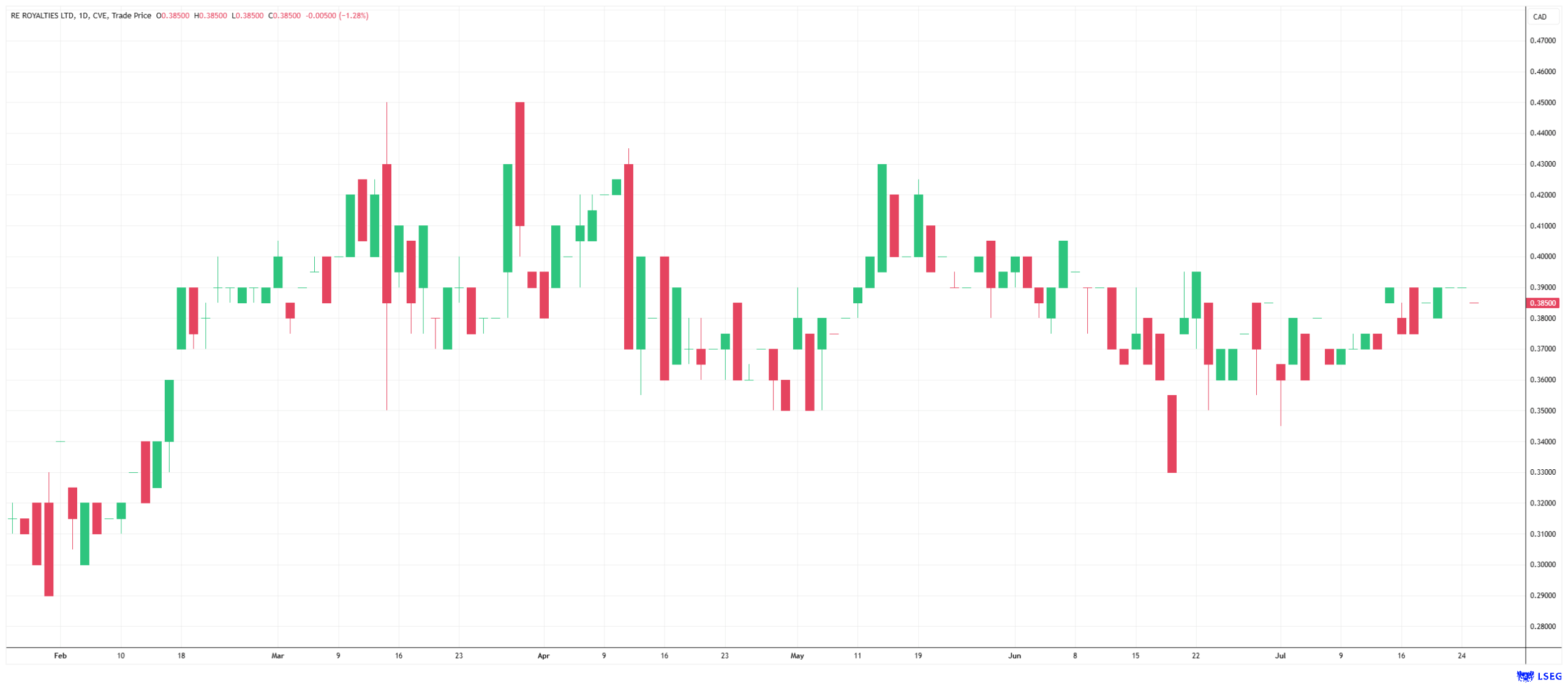
However, although RE Royalties repeatedly highlights its extensive deal pipeline, the company’s valuation has not really moved forward and currently stands at just under CAD 20 million. To address what RE Royalties’ management views as a valuation discount, in the best interests of shareholders, the company has engaged PricewaterhouseCoopers to conduct a strategic review to evaluate options, including partnerships or a sale of the company. Indeed, with its expertise and track record spanning more than 100 projects, RE Royalties appears to be in a promising position. However, the business is not entirely without risk—if project developers slip into insolvency, there is a risk of lost revenue. With demand for renewable energy remaining strong and RE Royalties benefiting from a highly agile, asset-light business model, the stock deserves a closer look from investors.

Conflict of interest
Pursuant to §85 of the German Securities Trading Act (WpHG), we point out that Apaton Finance GmbH as well as partners, authors or employees of Apaton Finance GmbH (hereinafter referred to as “Relevant Persons”) may hold shares or other financial instruments of the aforementioned companies in the future or may bet on rising or falling prices and thus a conflict of interest may arise in the future. The Relevant Persons reserve the right to buy or sell shares or other financial instruments of the Company at any time (hereinafter each a “Transaction”). Transactions may, under certain circumstances, influence the respective price of the shares or other financial instruments of the Company.
In addition, Apaton Finance GmbH is active in the context of the preparation and publication of the reporting in paid contractual relationships.
For this reason, there is a concrete conflict of interest.
The above information on existing conflicts of interest applies to all types and forms of publication used by Apaton Finance GmbH for publications on companies.
Risk notice
Apaton Finance GmbH offers editors, agencies and companies the opportunity to publish commentaries, interviews, summaries, news and the like on news.financial. These contents are exclusively for the information of the readers and do not represent any call to action or recommendations, neither explicitly nor implicitly they are to be understood as an assurance of possible price developments. The contents do not replace individual expert investment advice and do not constitute an offer to sell the discussed share(s) or other financial instruments, nor an invitation to buy or sell such.
The content is expressly not a financial analysis, but a journalistic or advertising text. Readers or users who make investment decisions or carry out transactions on the basis of the information provided here do so entirely at their own risk. No contractual relationship is established between Apaton Finance GmbH and its readers or the users of its offers, as our information only refers to the company and not to the investment decision of the reader or user.
The acquisition of financial instruments involves high risks, which can lead to the total loss of the invested capital. The information published by Apaton Finance GmbH and its authors is based on careful research. Nevertheless, no liability is assumed for financial losses or a content-related guarantee for the topicality, correctness, appropriateness and completeness of the content provided here. Please also note our Terms of use.
Stockhouse does not provide investment advice or recommendations. All investment decisions should be made based on your own research and consultation with a registered investment professional. The issuer is solely responsible for the accuracy of the information contained herein. For full disclaimer information, please click here.