

- An undervalued alternative to AI bubble hype: Amid growing skepticism over debt-fueled mega-cap AI spending and high valuations, nanocap Telescope Innovations (CSE: TELI) offers a value-added alternative with shares down over 67% since 2021.
- Proven efficiency and blue-chip adoption: Telescope’s AI-powered Self-Driving Laboratories and automated chemical analysis tools deliver measurable time, cost and energy savings validated by 15 of the top 20 global pharmaceutical firms.
- Strong revenue growth and a path to profitability: Fiscal 2026 revenue surged 60% YoY – and more than 15x since 2021 – while net losses widened due to growth investments. That said, the conclusion of a C$2 million investor awareness campaign and an expanding commercial pipeline position the company for improved operating efficiency.
There’s no denying it. At present, the financial media has eyes only for AI, its major players’ high valuations and whether or not they’re caught in a bubble about to pop.
Broadly speaking, investors are right to worry, given the trillions of dollars Alphabet, Amazon, Meta and Microsoft, among others, are pumping into data centers and AI model development, much of it financed through debt, with no profits to show for it.
This article is a journalistic opinion piece on nanocap AI company Telescope Innovations written based on independent research. It is intended to inform investors and should not be taken as a recommendation or financial advice.
When we look closer, the picture doesn’t get any brighter, with Anthropic (NASDAQ:ANT), the sector’s newest trillion-dollar entrant to the public markets, slipping below its IPO price just five days after listing, adding fuel to investor doubt.
Additionally, the return of Jensen Huang as CEO of NVIDIA (NASDAQ:NVDA), whose chips are powering the scaling of global AI infrastructure, follows allegations of a liaison with a Chinese spy and numerous extra-marital affairs with subordinates, adding an unshakeable asterisk to his leadership moving forward.
Given these glaring worries, the intelligent investor might ask whether or not there are any AI companies operating in the shadows of their mega-cap counterparts, putting the technology to value-added use, whose growth runways are arguably only beginning to unfold, offering investors attractive options to compound their way through all this bubble talk.
Vancouver-based Telescope Innovations (CSE: TELI), market cap C$23.44 million as of November 24, 2026, a developer of automated platforms for the pharmaceutical, chemical and mining industries, is worth weighing in on thanks to its strong revaluation potential backed by time, cost and energy-saving technology, expected progress on a path to profitability, and a stock that has given back more than 67% since 2021.
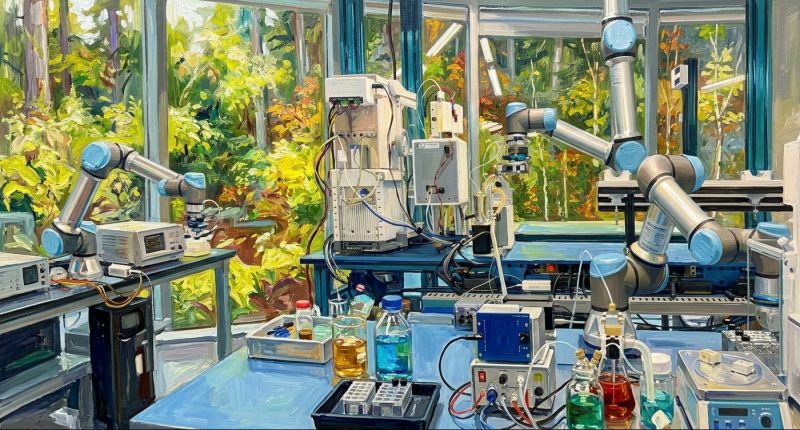
Telescope’s products and services suite is highlighted by its Self-Driving Laboratories (SDL), which combine robotics, AI and real-time analytics to conceptualize, execute and draw conclusions from chemistry experiments exponentially faster and more efficiently than working by hand.
A case study by Pfizer, one of the nanocap AI company’s major clients, puts figures onto this accelerated development from lab to market, finding SDL to deliver a 40x reduction in energy usage, a 4x reduction in time spent and a 6x improvement in space efficiency to its process chemistry playbook (see slide 5 of the June 2026 investor deck). Telescope signed a multi-year collaborative research agreement with Pfizer in 2024.
Another example is the company’s novel process for purifying battery-grade lithium
carbonate, shown to cut plant capital expenditures by 15% and reagent use by 30-50% (see slide 16), which is being licensed for commercial use.
Telescope complements SDLs with contract process development services and enabling technologies, including its DirectInject-LC automated chemical analysis system – currently used by 15 of the top 20 pharmaceutical companies in the world ranked by revenue – combining into a multi-pronged revenue model that has achieved promising, albeit, early-stage, results.
Unaudited financial results for fiscal 2026, ending August 31, include revenue of C$9.3 million, up from C$5.8 million year-over-year (YoY), spurred on by rising demand across the business, rising from C$4.4 million in 2024, C$2.8 million in 2023 and C$595,000 in 2022. This growth is paired with expenses reflective of a company prioritizing market share over profitability:
- Operating expenses were C$13.9 million, up from C$7.3 million YoY, including C$2 million for marketing and investor awareness programs, which concluded during the fiscal year.
- Net losses more than tripled to C$4.6 million, up from C$1.5 million YoY.
- Adjusted EBITDA losses magnified to C$2.7 million, up from C$400,000 YoY.
That being said, Telescope is showing clear signs of scaling, suggesting more efficient operations are around the corner:
- The company installed a second SDL at Pfizer in fiscal 2026, further validating the technology with the major pharma brand.
- Leadership sold and delivered its third SDL platform, as part of an autonomous crystallization system, to another major pharmaceutical company for its European business.
- Subsequent to the fiscal year, Telescope also announced firm orders for two additional SDLs destined for top pharmaceutical companies in Europe and the United States slated for delivery over the coming weeks.
Telescope’s ability to deliver positive outcomes for clients is catalyzed by a global distribution agreement signed in 2024 with Mettler Toledo (NYSE: MTD), a leading supplier of analytical precision instruments in more than 100 countries, positioning it to efficiently expand and license its product portfolio and pursue a path to profitability.
The nanocap AI company’s R&D optimizing mission is under the care of an award-winning leadership team, guided by 18% insider ownership, responsible for ~US$1.7 billion in value creation (see slide 20). Key members include:
- Barry Sharpless, Senior Advisor, a 2-time winner of the Nobel Prize in Chemistry.
- Jason Hein, Director and Chief Technology Officer, leader of one of the largest academic chemistry research groups in Canada.
- Henry Dubina, Chairman and Chief Executive Officer, whose more than 35 years of managerial experience in the scientific instrument industry include a tenure as President and Global Head of Mettler Toledo AutoChem.
As Telescope continues to grow its customer base and commercial pipeline, leveraging multiple revenue streams, partnerships with pharmaceutical leaders, and a lower cost basis following its investor awareness push, look for the scientific and investment communities to pay closer attention to the tangible value the company’s AI-powered technology can bring.
Shares of Telescope Innovations last traded at C$0.28.
Join the discussion: Find out what investors are saying about this nanocap AI stock on the Telescope Innovations Corp. Bullboard and explore the rest of Stockhouse’s stock forums and message boards.