


Evotec: The Bad News Just Keeps Coming
The Evotec story is getting a bit stale, as one might colloquially put it. That is because the German drug discovery company just cannot seem to stay out of the headlines and is suffering one stock market debacle after another. Following a drastic profit warning in July, the company was forced to revise its financial targets downward for the current year. Management has abandoned its original profit expectations and is instead bracing for an EBITDA loss of up to EUR 105 million. The main reasons for the financial disaster are significant delays and revised timelines for key milestone payments from existing partnerships. The final half-year results, presented in mid-August, underscored the operational crisis, with revenue down over 16% from the same quarter last year. As a result, the stock plummeted to a dramatic 10-year low of just over EUR 3.30. Investors are deeply unsettled, as the costs of the necessary corporate restructuring and internal job cuts are also weighing heavily on the balance sheet. Compounding the operational problems is the ongoing disappointment that earlier takeover bids and informal offers worth billions failed to turn the company around. Despite the company’s leading technological position as a research service provider, analysts on the LSEG Refinitiv platform are downgrading the stock in droves and radically lowering their price targets to an average of EUR 4.51. Even with this low target, that still represents nearly 40% upside potential for the Hamburg-based company.
BioNxt Solutions: The Countdown to the Clinical Phase Is Underway
BioNxt Solutions is approaching a major turning point in 2026, as its leading cladribine program, BNT23001, has cleared a key regulatory hurdle by completing the Investigational Medicinal Product Dossier (IMPD). The comprehensive dossier brings together formulation, GMP manufacturing, analytical testing, quality control, and preclinical data. It is currently undergoing final review for the planned submission of the European Clinical Trial Application. This brings the first human bioequivalence study with the reference product Mavenclad significantly closer. This approach is particularly attractive because BioNxt does not need to develop a new active ingredient but rather is repositioning the established active ingredient, cladribine, via a patented sublingual thin film. The film dissolves in the mouth without water and could offer a practical advantage, particularly for MS patients who suffer from difficulty swallowing.
The preclinical pharmacokinetic data form the scientific foundation for this, as a significantly higher systemic bioavailability of the active ingredient was observed in a large-animal model compared to the conventional tablet. Should this advantage be confirmed in humans, it could potentially lead to lower dosages, greater cost-effectiveness, and possibly better tolerability. The planned crossover bioequivalence study is now intended to show whether BNT23001 achieves the required drug exposure compared to Mavenclad. At the same time, BioNxt is expanding the platform beyond multiple sclerosis and investigating other autoimmune neurological indications such as myasthenia gravis. Even more important for the long-term assessment, however, is the technology’s transferability to other established drugs.
With everolimus and, in particular, semaglutide, additional development avenues are already emerging, with the latter leading BioNxt into the multi-billion-dollar GLP-1 market. The appeal of the semaglutide program lies less in the drug itself than in whether a complex peptide can be administered via a convenient sublingual thin film. According to Morgan Stanley, the GLP-1 market could grow to approximately USD 190 billion by 2035, offering a significantly larger addressable market than today’s niche for cladribine. At the same time, a scientific review on transmucosal drug delivery confirms the growing research focus on systems that can improve bioavailability, drug absorption, and patient comfort. For BioNxt, this creates a potentially scalable business model in which experience gained from one development program can be applied to other high-value active ingredients. The investment case is thus becoming increasingly concrete. If the company succeeds in making the leap from preclinical data to a successful human trial, the cladribine story could evolve into an internationally protected drug delivery platform with multiple independent value drivers. At just CAD 0.33 a share and a market capitalization of just under CAD 48 million, this is extremely exciting!
Eli Lilly and Novo Nordisk: The Battle in the Obesity Market Continues
The billion-dollar market for weight-loss drugs has long since evolved into an epic duel between Eli Lilly and Novo Nordisk. Danish pioneer Novo Nordisk, which kickstarted the hype in the first place with its blockbusters Ozempic and Wegovy, is now feeling the hot breath of US competitor Eli Lilly on its neck. The Americans have staged a rapid comeback with their drugs Mounjaro and Zepbound and have at times secured market leadership in strategically important regions such as the US. The duel is no longer confined to pharmacy shelves; it is also intensifying in the legal arena, with mutual lawsuits alleging unfair competition and misleading advertising.
At the same time, the battle is shifting away from traditional injections toward the market for convenient oral medications, such as Eli Lilly’s new weight-loss pill, Foundayo. Novo Nordisk, however, is fighting back vigorously with its own high-dose version of the Wegovy tablet in an effort to reclaim lost market share. Massive price pressure in the US market, as well as the emergence of low-cost generics, for example from India, is forcing both pharmaceutical giants to offer strategic discounts and come up with new marketing ideas. New medical studies that attest to the active ingredients’ substantial additional benefits for cardiovascular diseases and sleep apnea underscore that the market remains large enough for both players. There is no end in sight for this rivalry, as analysts forecast a global market volume of well over USD 100 billion by 2030. Ultimately, the biggest winner in this race for innovation is the patient, who benefits from ever-better, more diverse, and more affordable treatment options.

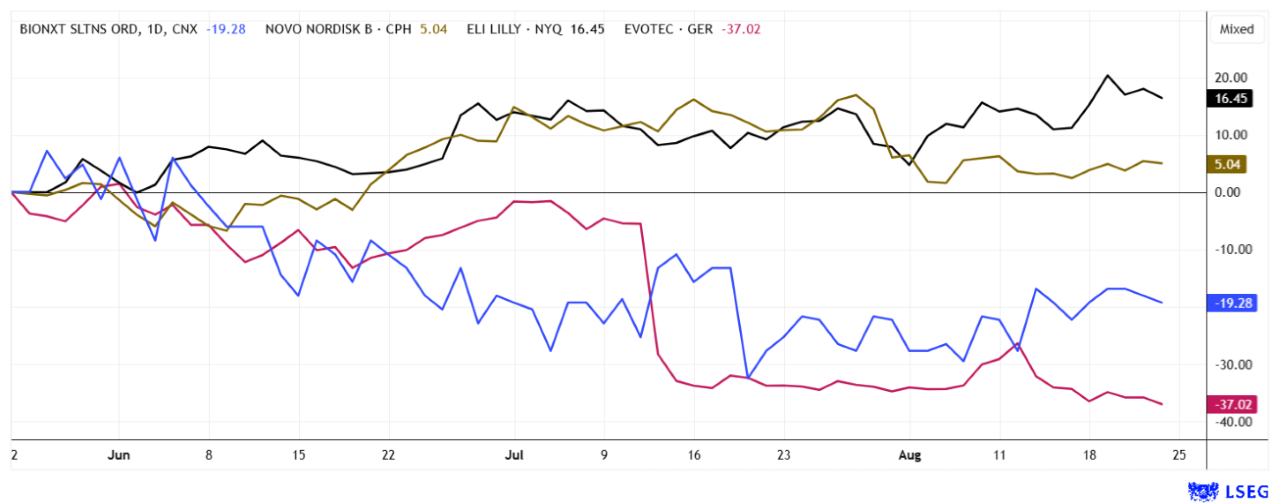
The stock markets have entered rough waters. This is due to the never-ending geopolitical tensions and the ongoing debate over interest rates. So far, the action has been concentrated primarily among the highly valued NASDAQ heavyweights, which are, however, increasingly stuttering at record levels. The life sciences sector continues to lead a shadowy existence, but it is precisely there that takeover speculation is now growing. Therefore, risk-conscious investors should remain vigilant and keep an eye on the momentum!
Conflict of interest
Pursuant to §85 of the German Securities Trading Act (WpHG), we point out that Apaton Finance GmbH as well as partners, authors or employees of Apaton Finance GmbH (hereinafter referred to as “Relevant Persons”) currently hold or hold shares or other financial instruments of the aforementioned companies and speculate on their price developments. In this respect, they intend to sell or acquire shares or other financial instruments of the companies (hereinafter each referred to as a “Transaction”). Transactions may thereby influence the respective price of the shares or other financial instruments of the Company.
In this respect, there is a concrete conflict of interest in the reporting on the companies.
In addition, Apaton Finance GmbH is active in the context of the preparation and publication of the reporting in paid contractual relationships.
For this reason, there is also a concrete conflict of interest.
The above information on existing conflicts of interest applies to all types and forms of publication used by Apaton Finance GmbH for publications on companies.
Risk notice
Apaton Finance GmbH offers editors, agencies and companies the opportunity to publish commentaries, interviews, summaries, news and the like on news.financial. These contents are exclusively for the information of the readers and do not represent any call to action or recommendations, neither explicitly nor implicitly they are to be understood as an assurance of possible price developments. The contents do not replace individual expert investment advice and do not constitute an offer to sell the discussed share(s) or other financial instruments, nor an invitation to buy or sell such.
The content is expressly not a financial analysis, but a journalistic or advertising text. Readers or users who make investment decisions or carry out transactions on the basis of the information provided here do so entirely at their own risk. No contractual relationship is established between Apaton Finance GmbH and its readers or the users of its offers, as our information only refers to the company and not to the investment decision of the reader or user.
The acquisition of financial instruments involves high risks, which can lead to the total loss of the invested capital. The information published by Apaton Finance GmbH and its authors is based on careful research. Nevertheless, no liability is assumed for financial losses or a content-related guarantee for the topicality, correctness, appropriateness and completeness of the content provided here. Please also note our Terms of use.
Stockhouse does not provide investment advice or recommendations. All investment decisions should be made based on your own research and consultation with a registered investment professional. The issuer is solely responsible for the accuracy of the information contained herein. For full disclaimer information, please click here.