

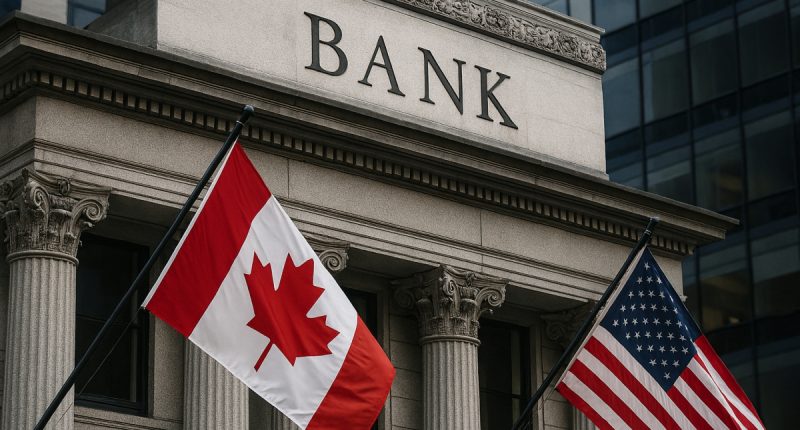
The Bank of Canada held rates steady for the rest of the year, but the trade war has cast doubt on what comes next in 2027.
The Bank of Canada left its benchmark overnight lending rate unchanged at 2.25 per cent on Wednesday, keeping a wait-and-see approach as policymakers balance a broadening domestic economic recovery against inflation risks and growing uncertainty tied to U.S. trade tensions.
This article is a journalistic opinion piece that has been written based on independent research. It is intended to inform investors and should not be taken as a recommendation or financial advice.
In a media release, the central bank outlined how it also kept the Bank Rate at 2.5 per cent and the deposit rate at 2.20 per cent.
In its policy decision, the Bank said the Canadian economy has evolved largely in line with expectations outlined in its July Monetary Policy Report, supporting the Governing Council’s decision to leave interest rates unchanged. However, officials noted that upside risks to inflation have increased due to persistently high energy prices, while new U.S. tariffs and Canadian countermeasures have clouded the outlook for economic growth.
Global economic conditions remain mixed. The Bank said U.S. economic growth continues to be supported by strong consumer spending and investment related to artificial intelligence, while economic activity in the euro area exceeded expectations in the second quarter. China’s economy, meanwhile, slowed. Despite geopolitical challenges, overall global growth has kept consistent with the Bank’s previous forecasts.
The ongoing conflict in the Middle East has continued to support higher oil prices, with elevated refining margins also contributing to inflationary pressures worldwide. The Bank noted that inflation remains elevated in many countries as a result.
Financial conditions have tightened since July, with long-term bond yields rising globally, including in Canada. The Canadian dollar has also strengthened modestly against the U.S. dollar.
Domestically, Canada’s economy gained momentum during the second quarter. Gross domestic product expanded at an annualized rate of 3.3 per cent, rebounding from very weak growth in the first quarter. While the Bank said some of the improvement reflected temporary factors, growth was broad-based across several sectors.
Consumer spending posted solid gains, housing activity recovered after several weak quarters, and both exports and business investment increased sharply. Labour market conditions also improved, with the unemployment rate edging down to 6.4 per cent in July. However, policymakers said demand for workers remains subdued and indicators continue to point to excess supply within the economy.
The Bank said recent economic data reinforce its view that Canada’s recovery is becoming more widespread. Even so, officials cautioned that uncertainty remains elevated, particularly as trade relations between Canada and the United States have deteriorated following the collapse of trade negotiations and the announcement of new tariffs on both sides.
Inflation has remained near 3 per cent in recent months, largely reflecting higher gasoline prices. Excluding gasoline, inflation was 2.2 per cent in July, while measures of core inflation stayed close to the Bank’s 2 per cent target.
Still, policymakers warned that inflation risks are increasing. The Bank said prolonged disruptions in the Middle East and limited progress toward reopening the Strait of Hormuz could keep energy prices elevated for longer, raising the likelihood that higher costs spread more broadly through the economy. New tariffs and retaliatory measures could also increase costs for businesses and eventually contribute to higher consumer prices.
Looking ahead, the Governing Council said it will continue to assess whether Canada’s economic rebound is sustainable and monitor the outlook for inflation. The Bank reiterated that it is prepared to adjust monetary policy if necessary and remains committed to maintaining price stability amid ongoing global economic and geopolitical uncertainty.
The Bank of Canada’s benchmark interest rate has remained steady at 2.25 per cent for nearly a year. Until trade discussions between Canada and the United States collapsed earlier this month, economists and investors largely anticipated that the central bank would keep rates unchanged for the rest of 2026 and into 2027.
That outlook has shifted following the latest tariff dispute. The United States imposed 50 per cent duties on about five per cent of Canadian exports on Aug. 22, while Canada is set to respond with counter-tariffs starting Sept. 8. In addition, U.S. President Donald Trump has threatened to introduce higher tariffs on automobiles and auto parts beginning Jan. 1, 2027.
Join the discussion: Find out what the Bullboards are saying about the banks and check out Stockhouse’s stock forums and message boards.