


Geopolitical risk is re‑pricing assets again
A renewed wave of geopolitical flashpoints has been rippling through markets, lifting traditional havens and pushing up energy benchmarks. Gold set a string of fresh record highs into late January as investors rotated toward safety on mounting policy and security risks, with analysts flagging central‑bank buying and persistent macro uncertainty as key supports. Energy has moved in tandem: Brent crude has oscillated between the mid‑$60s and low‑$70s in the past few sessions as traders embedded a “risk premium” tied to tensions in the Middle East and headlines around U.S.–Iran diplomacy, before partly retracing on de‑escalation signals.
What the “Buzz”
Our Bullboards have up to 2 million pageviews a day. Get the inside scoop on conversations around the most significant trends and stock appreciations in our weekly wrap up.
Get “Buzz on the Bullboards” delivered to your inbox every third Thursday!
Buzz on the Bullboards | Sign Up Here
That macro backdrop matters for stock selection: cyclicals tied to oil and gas, aerospace/defense, and dual‑use space technologies can see sentiment shift quickly as risk premia ebb and flow.

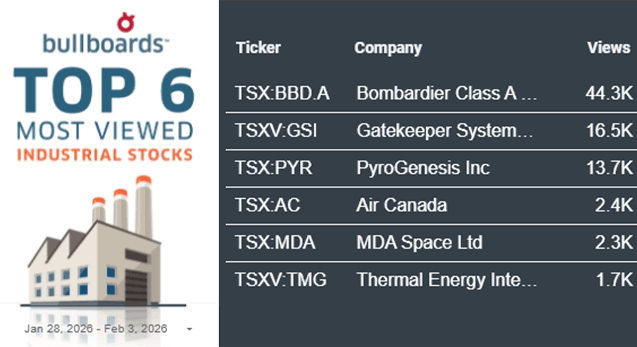
Aviation flashpoint: Trump threatens tariffs and “decertification” of Canadian aircraft
On Thursday, U.S. President Donald Trump escalated a trade dispute with Canada’s aviation regulator, posting on Truth Social that the U.S. would “decertify” Bombardier (TSX:BBD, Forum) Global Express jets — “and all aircraft made in Canada” — unless Canada certifies Gulfstream’s G500/600/700/800, and warned of a 50 per cent tariff on Canadian aircraft sold into the U.S.
Key uncertainties: What “decertification” means in practice remains unclear. Under U.S. law, the FAA — not the president — controls aircraft certification, and revocations are typically tied to safety, not trade policy. A White House official later told Reuters that the threat would not target aircraft already in operation, narrowing the scope to future deliveries.
Why it matters: The U.S. is Bombardier’s largest market by far. Data reported by Bloomberg show that more than half of Bombardier’s ~5,200‑aircraft global fleet operates in the United States, with roughly two‑thirds of sales coming from U.S. customers versus ~3 per cent from Canada — underscoring the stakes if new‑aircraft approvals were disrupted.
Bombardier’s response: The company said it had “taken note” of the President’s post, emphasized its 3,000+ U.S. employees and 2,800 American suppliers, and noted that its aircraft and technicians are fully certified to FAA standards; it is continuing to invest in the U.S., including an expansion in Fort Wayne, Indiana.
Industry view: Aviation experts have questioned whether decertifying aircraft for non‑safety reasons is feasible or precedented, warning that politicizing certification would set a dangerous template for other countries to retaliate and could disrupt regional airline operations and business aviation that rely on Canadian‑built fleets.
Investor takeaway: Until there’s a formal agency action, this remains a headline/legality risk more than an operational change. But Bombardier’s supply chains, aftermarket services, and backlog visibility could be sensitive to any protracted regulatory standoff.
Dual‑use tailwinds from alliances and U.S. SHIELD access
What’s new:
- Hanwha Systems MOU (Korea): MDA Space (TSX:MDA, Forum) signed an MOU with Hanwha Systems to explore collaboration on Korea’s sovereign K‑LEO defense constellation, leveraging MDA’s AURORA software‑defined digital satellites. The aim: secure, resilient communications for national defense and a path to scalable, reconfigurable LEO assets.
- U.S. Missile Defense Agency — SHIELD IDIQ: MDA Space also disclosed selection to the MDA’s Scalable Homeland Innovative Enterprise Layered Defense (SHIELD) IDIQ — a multi‑award vehicle with an up‑to‑$151B ceiling across land, sea, air, cyber, and space — positioning MDA Space to compete for future task orders over the coming years.
Why it matters: The K‑LEO MOU isn’t a booked order, but it opens a gateway to a major allied defense program and validates AURORA’s flexibility for sovereign networks. The SHIELD slot is strategically valuable: although funds are obligated at task‑order level, inclusion in the qualified pool lets MDA bid across mission areas that demand rapid innovation and scalability — exactly where software‑defined payloads and LEO architectures shine.
Risks and watch‑items: MOU outcomes depend on program scope and funding in Korea; SHIELD tasking will be competitive and episodic. Still, in a market re‑pricing defense resilience, MDA screens as a structural beneficiary of allied space modernization.
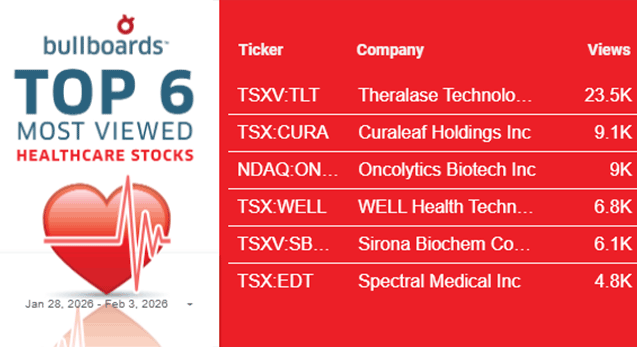
Next phase bladder‑cancer study hits enrollment; interim durability emerging
What’s new: Theralase Technologies (TSXV:TLT, Forum) completed enrollment (90 patients) in its Phase II registrational study for BCG‑unresponsive NMIBC (CIS) using light‑activated Ruvidar. Interim readouts show:
- Primary endpoint (CR at any time): 64.4 per cent (56/87 evaluable); Total Response (CR+IR): 73.6 per cent.
- CR durability at 450 days: 40.4 per cent (19/47); Safety: 100 per cent (78/78) SAEs assessed unrelated or unlikely related to study drug/device.
- Long‑tail durability (interim subset): 21.3 per cent CR sustained at 2 and 3 years, 2.1 per cent at 7 years.
The company plans to compile data in 2026 and target regulatory submissions to Health Canada and FDA with an expected approval in 2027 (company guidance).
Why it matters: In BCG‑unresponsive NMIBC, bladder‑sparing options are limited and guidelines often steer patients toward cystectomy. The interim metrics exceed the International Bladder Cancer Group’s benchmarks (≥50 per cent CR at 6 months; ≥30 per cent at 12 months) referenced by the company, though final adjudication and regulator views will be key.
Risks and watch‑items: As with any single‑arm oncology study, external comparability and durability signal will be heavily scrutinized, and timelines are contingent on data lock and regulator feedback. For investors, the next catalysts are full Phase II data assembly in 2026 and clarity on filing packages.
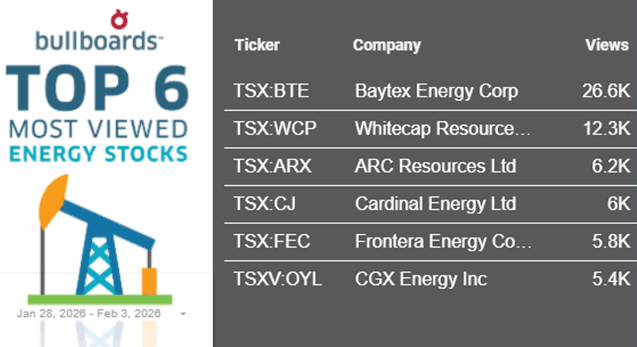
Refocused Canadian producer with reserves growth, net cash, and buybacks
What’s new: Baytex Energy Corp. (TSX:BTE, Forum) reported year‑end 2025 reserves and a 2026 plan following its December 19, 2025 divestiture of U.S. assets. Highlights:
- Balance sheet: Entered 2026 in net cash (~$857M) after repaying credit facilities and redeeming a large portion of USD senior notes; share repurchases restarted (17.1M shares for $78M through Jan 30, 2026) while maintaining a $0.09 annual dividend.
- Reserves (Canada): PDP +12 per cent to 69 MMboe; 1P +15 per cent to 151 MMboe; 2P +9 per cent to 282 MMboe; 2P RLI ~11.5 years; F andD (incl. FDC) $16–$17/boe; recycle ratios ~2.0x–2.1x on a $34.61/boe 2025 operating netback.
- Operations: Q4/25 Canadian production 67,295 boe/d (88 per cent liquids); 2026 target 67–69 mboe/d, capex $550–$625M, with Duvernay output expected to rise ~35 per cent and a robust heavy‑oil and Viking program. Hedging covers portions of 1H/26 WTI and WCS differentials.
Why it matters: With the U.S. exit, Baytex is now a concentrated Canadian E andP with lower leverage, line‑of‑sight to shareholder returns, and a plan for 3–5 per cent growth. In a tape where oil’s risk premium is fluctuating, capital efficiency and balance‑sheet strength are differentiators.
Risks and watch‑items: Commodity‑price volatility (WTI/WCS basis), execution in the Duvernay/heavy‑oil program, and the cadence of buybacks versus organic reinvestment remain focal points for 2026.
Broader trade and aviation implications to monitor
- Regulatory authority: Industry veterans stress that aircraft certification is a safety function, not a trade lever — using it as retaliation would be unprecedented and could invite reciprocity, complicating cross‑border aerospace supply chains and air‑service continuity.
- Scope of any action: The White House signal that in‑service aircraft would be excluded, if maintained, would limit near‑term operational disruption but still affect new deliveries, valuations, and residuals if uncertainty lingers.
Bottom line for investors
- MDA Space (MDA): Exposure to allied defense space and software‑defined satellites with optionality on K‑LEO and U.S. SHIELD tasking. Watch for contract task orders and any programmatic milestones with Hanwha.
- Theralase (TLT): A binary‑leaning clinical catalyst story with encouraging interim CR/durability signals. The 2026 data compilation and regulatory path are the next major de‑risking events.
- Baytex (BTE): A leaner, Canada‑focused E andP with reserves growth, net cash, and active buybacks, positioned to benefit from any sustained oil strength while carrying hedges into 1H/26.
In a market being whipsawed by geopolitics — from record gold to energy risk premia — newsmaking stocks can pivot fast. Before reallocating capital, deepen your due diligence: read the filings and press releases, track regulator commentary (FAA/Transport Canada; Health Canada/FDA), and stress‑test your thesis against multiple macro scenarios so your portfolio stays truly up to date.
Get “Buzz on the Bullboards” delivered to your inbox every other Thursday!
Buzz on the Bullboards | Sign Up HereFor previous editions of Buzz on the Bullboards, click here.
Join the discussion: Find out what everybody’s saying about these stocks on Stockhouse’s stock forums and message boards.
Stockhouse does not provide investment advice or recommendations. All investment decisions should be made based on your own research and consultation with a registered investment professional. The issuer is solely responsible for the accuracy of the information contained herein. For full disclaimer information, please click here.