


Global equities have lurched from rally to rout since the U.S.–Israel strikes on Iran ignited a fast‑escalating regional war and a de‑facto shutdown of the Strait of Hormuz, one of the world’s most critical energy chokepoints. Oil and gas benchmarks jumped sharply as tanker traffic slowed to a trickle and insurers withdrew coverage, with Brent briefly pushing into the low‑$80s and analysts warning that a sustained disruption could embed a higher geopolitical risk premium in crude.
Within hours of the initial strikes, Iran’s Revolutionary Guard broadcast warnings over maritime channels that “no ship” would be allowed through the strait, prompting widespread pauses in transits and leaving more than a hundred vessels loitering on either side of the corridor. While not always legally “closed,” the passage became functionally impassable for many shippers as war‑risk premiums spiked and several tankers were damaged in reported attacks. The result: a sudden squeeze on flows that normally carry roughly a fifth of the world’s oil and significant volumes of LNG—precisely the kind of tail risk energy traders have modelled for decades.
What the “Buzz”
Our Bullboards have up to 2 million pageviews a day. Get the inside scoop on conversations around the most significant trends and stock appreciations in our weekly wrap up.
Get “Buzz on the Bullboards” delivered to your inbox every third Thursday!
Buzz on the Bullboards | Sign Up Here
In this environment of violent price swings, three very different, news‑making names offer a useful cross‑section of how conflict risk ricochets through energy, defence/space, and politically exposed media platforms.
This article is a journalistic opinion piece that has been written based on independent research. It is intended to inform investors and should not be taken as a recommendation or financial advice.

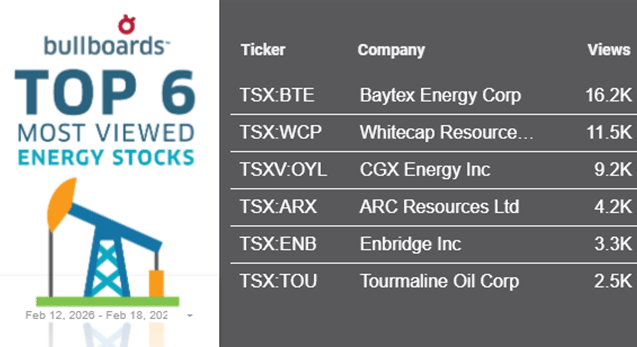
Scale, reserves, and option‑value to oil volatility
Why now: With oil’s war premium resurfacing, upstream producers that combine scale, low costs, and long‑life reserves can act as portfolio shock absorbers—exhibiting operating leverage to price but with balance‑sheet discipline and hedge books to dampen drawdowns. Whitecap Resources’ (TSX:WCP, Forum) freshly reported results check many of those boxes.
What they reported: On February 23, 2026, Whitecap posted record 2025 production of 307,245 boe/d (62 per cent liquids), up 76 per cent year‑over‑year, and funds flow of $2.9 billion ($2.95 per share)—the second‑highest per‑share result in company history. Free funds flow approximated $900 million after $2.0 billion of capex. Net debt ended the year at $3.4 billion, under 1.0x annualized Q4 funds flow, while Q4 production set a record at 379,606 boe/d with an operating netback of $28.25/boe. The reserve report underscored depth: 2P reserves of ~2.2 billion boe, an RLI > 16 years, conservative bookings (only 21 per cent of identified unconventional and 35 per cent of conventional locations booked), and 2P F&D of $17.17/boe with a 1.7x recycle ratio (2P FD&A $15.81/boe, 1.9x recycle). Management kept 2026 guidance at 370–375 mboe/d on $2.0–$2.1 billion capex and noted roughly 25 per cent of oil and 29 per cent of gas hedged in 2026
Why it matters amid Hormuz risk: In a scenario where seaborne Middle East supply is constrained or repriced higher, North American producers linked to continental egress become relatively more valuable. Canada’s pipeline network has just expanded with TMX, improving access to tidewater and global pricing for Western Canadian barrels—an incremental tailwind if the Gulf remains impaired. While not a panacea, TMX improves optionality precisely when differentials and routing matter most.
Investment takeaways:
- Quality of growth: Whitecap’s step‑change scale stems partly from the Veren combination and is pairing with measurable synergy capture and type‑curve improvements in Montney/Duvernay—supportive of sustainable margins if oil remains range‑bound and accretive upside if prices break higher.
- Downside buffers: Sub‑1x leverage on run‑rate cash flow, active hedging, and multi‑basin inventory help in volatile tapes where daily headlines can move crude several dollars.
- What to watch next: Execution on a ~255‑well 2026 program without cost creep; liquids mix stability; and whether OPEX/transport per boe continues trending favorably as integration synergies mature—key if Brent volatility fades but never fully disappears given Hormuz risk.
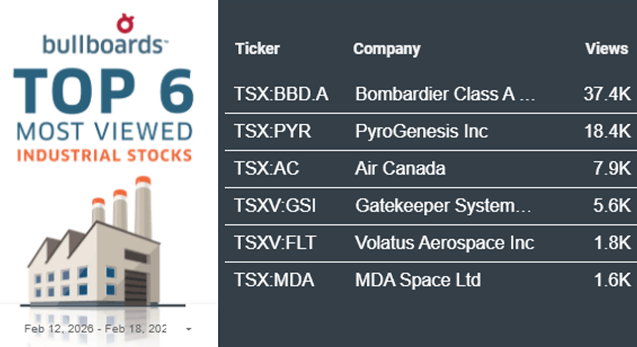
Dual‑use space as a defence beta
Why now: Conflicts tend to accelerate budgets for satellite communications, Earth observation, and missile‑defence‑adjacent technologies. MDA Space (TSX:MDA, Forum) has leaned into that militaristic potential, moving from heritage space robotics into full satellite systems, sensors, and space‑grade chips—exactly where allied demand is rising.
What they reported:
- Backlog: $4.0B, offering visibility into 2026 (down from $4.4B in 2024 as execution converted orders to revenue).
- Revenue: Record $1.633B in 2025, up 51 per cent YoY, with Q4 at $499.1M (+44 per cent).
- Profitability: Adjusted EBITDA $323.9M (19.8 per cent margin) for 2025; Q4 adjusted EBITDA $96.2M (19.3 per cent margin). Adjusted net income $189.9M for the year. Net leverage 0.4x at year‑end after the SatixFy acquisition.
- 2026 outlook: Revenue $1.7–$1.9B, adjusted EBITDA $320–$370M (18–20 per cent margin), capex $225–$275M, and free cash flow neutral to negative due to working‑capital swings and expansion investments.
Where the conflict linkage shows up: Governments are prioritizing resilient comms, ISR (intelligence, surveillance, reconnaissance), and missile‑defence cueing—capabilities that lean on LEO/MEO constellations, digital payloads, and synthetic aperture radar. MDA highlighted defense‑tilted pipeline momentum and specific wins (e.g., military satcom support for Canadian forces in the Arctic; U.S. Missile Defense Agency IDIQ participation), suggesting a structurally higher bid for dual‑use space.
Investment takeaways:
- Secular + cyclical: The firm sits at the intersection of secular space expansion and cyclical defence upswings. Backlog and a $40B pipeline (company‑stated) set the stage, but investors should underwrite program‑timing risk and the cash‑conversion cadence—management already guides FCF to neutral/negative in 2026 as it scales capacity.
- Margin durability: 19–20 per cent adjusted EBITDA margins through rapid growth are encouraging; watch for mix effects as satellite systems (high‑volume) dominate. The SatixFy chip vertical integration could protect margins, but also increases execution complexity.
- Conflict hedge: In portfolios exposed to energy shock and transport dislocation from Hormuz, defence/space names can diversify risk while participating in increased allied spending triggered by the same geopolitical catalyst.
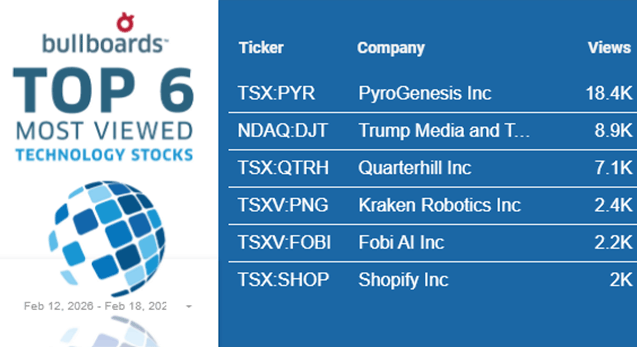
Politics, platforms, and portfolio volatility
Why now: In a news cycle dominated by geopolitical escalation and the actions of U.S. President Donald Trump, Trump Media & Technology Group (NASDAQ:DJT, Forum) (operator of Truth Social, Truth+, and Truth.Fi) has become a sentiment barometer for political risk and a lightning rod for retail flows. That can create outsized volatility around headlines—both opportunity and hazard for investors.
What they reported:
- Financial assets: Approximately $2.5B as of year‑end 2025 (cash, investments, digital assets, pledged digital assets, etc.), up sharply from $776.8M a year earlier.
- Revenue: $3.7M for 2025—still early‑stage on commercialization.
- Net loss: $712.3M consolidated, driven largely by non‑cash, unrealized fair‑value losses tied to digital assets and related securities (~$403.2M and ~$178.8M, respectively), plus non‑cash stock‑based comp ($59.2M) and non‑cash interest ($27.0M). Company‑reported adjusted EBITDA loss of $(664.4)M.
- Cash flow nuance: Management pointed to positive operating cash flow of $14.8M for 2025 and $44M in cash proceeds from a bitcoin options strategy—figures that can mask underlying operating scale but are relevant for liquidity runway.
How the conflict tie‑in matters: In crises, attention aggregates on political leaders and their media ecosystems. That can catalyze user engagement and download spikes—but revenue translation remains modest relative to the balance sheet. Moreover, the company’s exposure to digital asset price swings introduces a second volatility vector—one that can amplify market stress if risk assets sell off broadly on higher oil and inflation fears.
Investment takeaways:
- Speculative profile: DJT trades more on positioning, identity, and optionality than on fundamentals at this stage. The $2.5B financial‑asset base provides oxygen, but GAAP losses are dominated by mark‑to‑market swings—a feature, not a bug, of an investment‑heavy model intertwined with crypto.
- Catalysts vs. cash economics: Newsflow can move the stock far more than incremental ARPU or ad monetization would justify; that asymmetry cuts both ways in a conflict‑charged environment.
- Risk framing: If you’re seeking portfolio ballast against oil shocks, DJT is not it; if you’re seeking a beta on U.S. political news velocity, it arguably functions as one—just with significant drawdown risk.
The macro backdrop investors can’t ignore
The Hormuz choke point is small on a map and enormous in macro consequence. Roughly 20 per cent of global oil and a large chunk of Qatar’s LNG normally move through this narrow channel; partial or de‑facto closure—even for days—reorders shipping lanes, spikes insurance, and embeds a risk premium into energy curves. That feeds back into inflation expectations, central‑bank reaction functions, and equity multiples. It’s why Brent can rise despite bearish inventory prints: the market prices probability, not just barrels.
Meanwhile, policy responses—from potential U.S. naval escorts to OPEC+ production decisions—may stabilize sentiment at the margin without solving the geometric problem of a chokepoint under threat. The difference between a transitory scare and a structural repricing will hinge on duration, infrastructure damage, and insurer behavior—three levers to monitor day by day.
Positioning ideas (not investment advice)
- Barbelled energy exposure: Pair high‑quality, low‑cost upstreams (e.g., Whitecap) with midstream/logistics that benefit from rerouting premiums. The barbell aims to capture upside to war‑premium oil while buffering against a swift de‑escalation that could fade prices quickly.
- Defence/space as a hedge: Select dual‑use space names (e.g., MDA) can act as uncorrelated hedges when geopolitical risk rises, though program timing and working‑capital cycles argue for patience and diversification.
- Treat political‑media platforms as trading vehicles, not anchors: For names like DJT, size positions with the understanding that fundamentals currently lag headline sensitivity and crypto‑linked fair‑value swings.
Bottom line
War rarely moves in straight lines—and neither do markets. The U.S.–Iran conflict has already reshaped oil logistics, repriced energy risk, and re‑routed capital toward defence-adjacent technologies. In that new regime:
- Whitecap offers operating leverage to crude with scale, reserves, and risk management.
- MDA Space is a pure‑play on the accelerating militarization of orbit and allied resilience spending.
- Trump Media is a headline‑driven proxy for political attention and digital‑asset sentiment—powerful, but volatile.
As the situation around the Strait of Hormuz evolves, keep updating your thesis as fast as the facts change. Read primary company documents, track tanker flows and insurance developments, and map how oil’s risk premium is bleeding into inflation and rates. Then calibrate position sizes accordingly.
Your next step: dig deeper. Rebuild models with the latest inputs, revisit scenario trees (base / upside / downside), and stress‑test your portfolio for a world where chokepoints—and the companies exposed to them—drive returns. In an age when geopolitics can rewrite earnings in a weekend, continuous due diligence on news‑making stocks is the best way to keep your portfolio truly up to date.
Get “Buzz on the Bullboards” delivered to your inbox every other Thursday!
Buzz on the Bullboards | Sign Up HereFor previous editions of Buzz on the Bullboards, click here.
Join the discussion: Find out what everybody’s saying about these stocks on Stockhouse’s stock forums and message boards.
Stockhouse does not provide investment advice or recommendations. All investment decisions should be made based on your own research and consultation with a registered investment professional. The issuer is solely responsible for the accuracy of the information contained herein. For full disclaimer information, please click here.