


TSX whipsaws since Monday.
Canada’s benchmark S&P/TSX Composite has done its best roller‑coaster impression this week: a sharp +1.0 per cent rally Monday, a flat‑to‑modest gain Tuesday, and mixed sessions around those moves as intraday highs and lows widened on oil‑headline volatility. By the end of Tuesday (Mar. 17), the index closed 32,929, up +0.16 per cent on the day after a +1.03 per cent pop Monday; last week included a ‑0.84 per cent slide Thursday and a ‑0.91 per cent drop Friday, underscoring the “up, down, then flat” cadence investors have been feeling.
What the “Buzz”
Our Bullboards have up to 2 million pageviews a day. Get the inside scoop on conversations around the most significant trends and stock appreciations in our weekly wrap up.
Get “Buzz on the Bullboards” delivered to your inbox every third Thursday!
Buzz on the Bullboards | Sign Up Here
Macro backdrop: Oil spikes on the Strait of Hormuz crisis
Energy headlines have dominated risk sentiment. Shipping through the Strait of Hormuz—the world’s most important oil chokepoint—has slowed to a crawl amid the Iran war, pushing Brent over $100 and WTI into the $90s. Over the last ten days, multiple outlets have tallied disrupted tanker traffic and attacks on commercial vessels, while the IEA coordinated a record 400 million‑barrel strategic release to smooth supply.
Analysts warn that even a de facto closure (in which insurers and captains avoid transits) can keep a risk premium embedded in crude for weeks. Visual analyses show transits “near standstill,” and reporting has documented attacks on ships, with authorities and maritime watchers corroborating the operational risk to vessels.
The IEA has called the current disruption the largest supply shock in history, estimating ~8 mb/d of global supply affected in March as Gulf producers curtail output or seek alternative routes. Meanwhile, daily price prints have reflected the tug‑of‑war between security headlines and policy responses: Brent ~US$103 and WTI ~US$96 at points this week.
Why it matters for Canadian equities: The TSX’s heavy commodity weighting transmits oil volatility into index swings. Energy producers with Canadian‑weighted portfolios can see different risk/return profiles than peers with Middle East exposure, a theme that surfaces in our first company below.

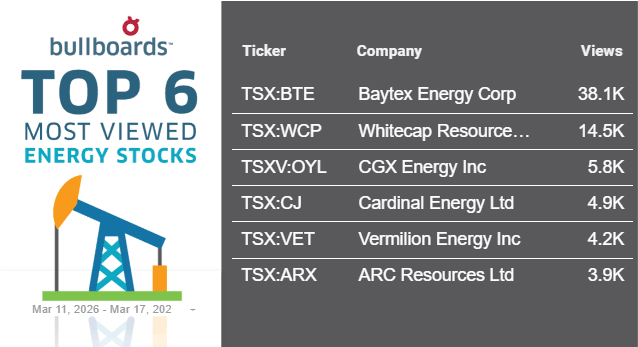
Refocused, cash‑generative, and leaning into Canada
Baytex Energy (TSX:BTE, Forum) released fourth‑quarter and full‑year 2025 results, marking a clean break with its U.S. footprint and a pivot to a Canada‑focused growth plan. Highlights: C$3.0B net proceeds from the Eagle Ford divestiture (Dec. 19, 2025); C$857M cash (net of remaining Senior Notes); 2025 Canadian production 65,528 boe/d (89 per cent oil & NGL), up 6 per cent organically YoY; Q4/25 Canada production 67,295 boe/d (88 per cent oil & NGL).
Despite reporting a 2025 net loss of C$604M (‑$0.78/sh), management attributes it to non‑cash, one‑time items tied to the Eagle Ford sale and a Viking impairment—no impact to cash flow. Operating cash flow reached C$1.5B in 2025; adjusted funds flow also C$1.5B (~C$1.97/sh); free cash flow C$275M (~$0.36/sh). Capital returns resumed with 30M shares repurchased (≈3.9 per cent of float) for C$141M and $0.09/sh total 2025 dividends.
Why investors care now: In a week where Middle East supply risk is repricing energy, Baytex screens as a domestic‑weighted oil levered name with a lower sustaining breakeven (~US$52 WTI) and a balance sheet fortified by the Eagle Ford sale. Management also disclosed CEO succession to Chad Lundberg after the May 7, 2026 AGM, a governance detail that can matter as the company allocates cash between growth and buybacks/dividends in a volatile tape.
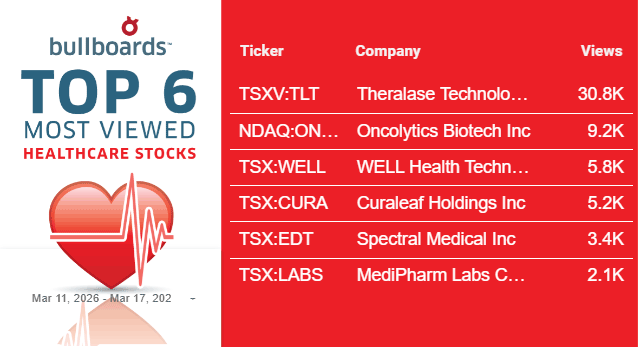
Mechanism adds to the herpes treatment story
Theralase Technologies (TSXV:TLT, Forum) announced the discovery of an additional mechanism of action (MOA) explaining how Ruvidar (TLD‑1433) inactivates HSV‑1. Researchers measured zeta potential (surface charge) in aqueous solutions and observed that positively charged Ruvidar binds to negatively charged HSV‑1, neutralizing its surface charge and blocking cell entry—effectively rendering the virus non‑infectious in the experiments.
This builds on earlier company‑reported and independently published preclinical work showing Ruvidar’s superiority to acyclovir (standard of care) in certain models and its activity against acyclovir‑resistant HSV‑1 mutants—even without light activation. A 2025 MDPI Viruses paper by Coombs et al. outlined these findings and combinational effects with acyclovir; Theralase summarized similar outcomes in April and September 2025 updates.
Market context: HSV‑1 prevalence is enormous globally, and the HSV treatment market is expected to expand this decade. While Theralase is clinical‑stage (i.e., not a revenue story yet) and Ruvidar’s HSV program remains preclinical, the electrostatic‑binding MOA offers a plausible, testable explanation for observed antiviral effects—useful for future trial design and partnering conversations. As always with micro‑caps, investors should weigh execution, funding, IP, and regulatory milestones.
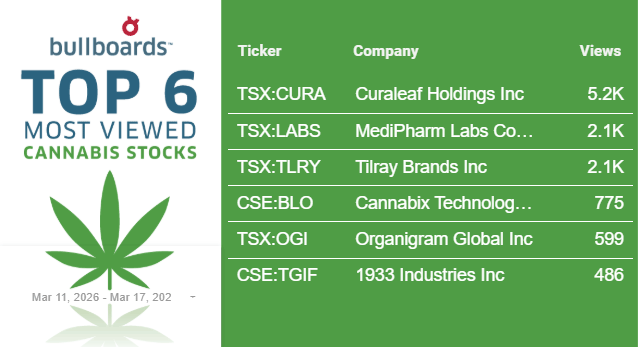
Commercial rollout of a marijuana breath test
Cannabix Technologies (CSE:BLO, Forum) has begun commercial rollout of its Marijuana Breath Test platform, shipping breath collection units (BCUs) and single‑use Breath Cartridges to early customers across law enforcement and safety‑sensitive industries. The test targets the first ~4 hours post‑consumption, aiming to detect Δ9‑THC in breath at >5 pg/L, a window most closely associated with peak impairment—and a gap not well served by urine/saliva/hair tests that mostly capture historical use.
The scientific underpinnings received a boost this month: the Journal of Analytical Toxicology (Oxford University Press) published a peer‑reviewed validation study led by partner Omega Laboratories titled “Simultaneous Analysis of Δ9‑THC, Δ8‑THC, CBD, and CBN in Breath Aerosols Collected Using Cannabix Technologies’ Breath Collection Unit.” The paper validates the analytical method for cannabinoids in breath samples collected via Cannabix hardware—key evidence for customers and regulators evaluating fitness‑for‑duty programs.
Business model signal: Management has telegraphed a recurring revenue approach: BCUs as required hardware and cartridges for each test. For investors, adoption curves (law enforcement pilots, enterprise safety programs), throughput per site, and regulatory acceptance will determine scale. The Omega partnership provides lab capacity and credibility as deployments ramp.
What this week’s news means for your portfolio
- Energy beta cuts both ways. With Hormuz risk elevated, Canadian oil producers with domestic asset bases (like Baytex post‑divestiture) may screen as relatively less exposed to physical shipping disruptions—even as prices lift cash flows. But price spikes can fade quickly if shipping security improves, so capital return discipline and breakeven levels matter.
- Early‑science biotech is binary. Theralase’s MOA update adds mechanistic color and aligns with prior preclinical data, but investors should anchor expectations on clinical milestones, financing runway, and peer‑reviewed human data in due course.
- Picks‑and‑shovels for compliance. Cannabix’s breath test addresses a practical testing problem—recent use—with a consumables model that naturally scales if adoption sticks. Watch for pilot conversions, policy endorsements, and cost‑per‑test economics.
Bottom line
It’s been a week of excessive highs, lows, and even flat sessions on the TSX as oil headlines whiplash risk assets. Against that backdrop, Baytex (refocused and cash‑generative), Theralase (mechanism‑rich preclinical antiviral story), and Cannabix (commercializing a breath‑based THC test) are three Canadian names squarely in the news—and each taps a different part of the current market narrative. Use the headlines as a starting point, not a decision. Deepen your due diligence (filings, trial registries, adoption metrics, and valuation vs. peers) to keep your portfolio up to date and aligned with your risk budget.
If you want, I can turn this into a briefing deck with charts (index moves, oil curve, each company’s milestones) for your next investor note.
Get “Buzz on the Bullboards” delivered to your inbox every other Thursday!
Buzz on the Bullboards | Sign Up HereFor previous editions of Buzz on the Bullboards, click here.
Join the discussion: Find out what everybody’s saying about these stocks on Stockhouse’s stock forums and message boards.
Stockhouse does not provide investment advice or recommendations. All investment decisions should be made based on your own research and consultation with a registered investment professional. The issuer is solely responsible for the accuracy of the information contained herein. For full disclaimer information, please click here.