

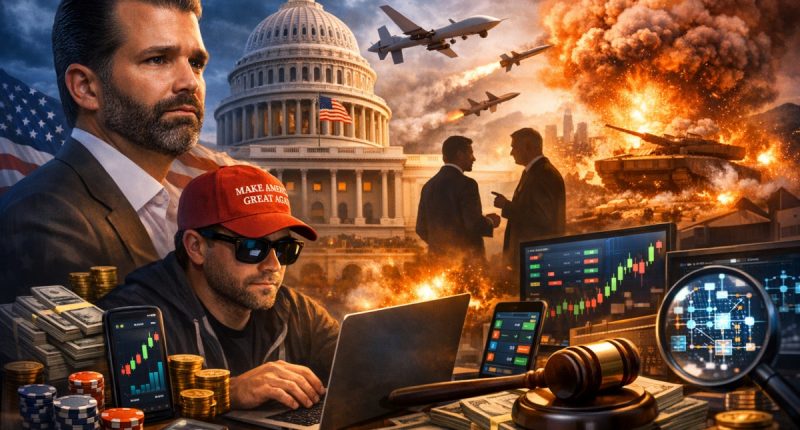
- Lawmakers on Capitol Hill are pushing to regulate prediction markets after reports that US$529 million was traded on Polymarket contracts tied to the timing of U.S. strikes on Iran
- A Polymarket user known as “Magamyman” earned more than half a million dollars from bets placed just over an hour before the Iran strike became public, echoing similarly timed wagers on U.S. operations in Venezuela
- Donald Trump Jr. sits on Polymarket’s advisory board, and his VC firm has invested heavily in the company; federal investigations into Polymarket by the DOJ and CFPB ended after Donald Trump returned to the White House
- Reports of newly created accounts making well‑timed profits have fueled accusations of potential insider trading, prompting lawmakers to consider legislation limiting or banning such geopolitical betting
Growing scrutiny from lawmakers, regulators, and market participants is converging on a once‑niche corner of the crypto economy: online prediction markets. Platforms such as Polymarket—long pitched as tools for forecasting geopolitical and economic risk—are now at the center of a political and regulatory storm following a series of extraordinarily well‑timed bets on U.S. military actions.
This article is a journalistic opinion piece that has been written based on independent research. It is intended to inform investors and should not be taken as a recommendation or financial advice.
A half‑billion‑dollar bet on war
The latest controversy erupted after Bloomberg data revealed that approximately US$529 million was traded on Polymarket contracts tied to the timing of U.S. military strikes against Iran. The scale of the trading alone raised eyebrows among lawmakers, but what triggered deeper concern were the trading patterns themselves.
One user, trading under the handle “Magamyman,” reportedly made more than half a million dollars on the Iran contract—placing the first bet just over an hour before the news broke publicly, according to Democracy Now! reporting. CBS News likewise reported that the account made “nearly $600,000” on the timing of U.S. and Israeli strikes, citing Polymarket data and blockchain‑analysis firm Bubblemaps.
These transactions are not isolated. Similar suspiciously timed wagers have appeared surrounding other U.S. military actions—including operations in Venezuela—on Polymarket and competitors like Kalshi.
“Insider trading in broad daylight,” Senators say
Lawmakers are treating the matter with increasing urgency. Sen. Chris Murphy (D‑CT) publicly condemned the trades as “insane this is legal” and promised legislation to restrict or ban speculative markets tied to government or military actions. Sen. Ruben Gallego (D‑AZ) went further, calling the behavior “insider trading in broad daylight.”
Investigators and analysts have noted a recurring pattern: newly created accounts, funded rapidly, making concentrated bets on single geopolitical outcomes—often within hours of subsequent real‑world events. Snopes confirmed that six new Polymarket accounts made nearly US$1.2 million from well‑timed Iran‑strike wagers placed hours before the attack. Blockchain analytics from Bubblemaps and others indicate strong circumstantial evidence of advance knowledge, though definitive proof of insider involvement remains unverified.
For investors in crypto‑prediction ecosystems, the implications are significant: platforms could become vectors for illicit trading, legal liability, reputational damage, or future federal restrictions.
Political connections deepen controversy
The political dimensions of the story further heighten market risk. Donald Trump Jr. sits on Polymarket’s advisory board, and his venture capital firm has invested tens of millions of dollars into the company.
Even more notable: both the Justice Department and the Consumer Financial Protection Bureau reportedly ended active investigations into Polymarket after Donald Trump returned to the White House last year, according to Democracy Now!’s reporting. For regulators, investors, and policymakers, the timing has raised questions about political influence over enforcement in an already‑opaque sector.
Echoes of Venezuela and a pattern of “predicting” U.S. operations
The Iran‑related trades resemble earlier episodes involving alleged advance knowledge of U.S. operations in Venezuela. Democracy Now! reports that similar suspicious trades were placed on Polymarket and Kalshi ahead of the U.S. military operation there—reinforcing concerns about systemic gaming of prediction markets around sensitive national‑security events.
Snopes separately documented rumours—still unverified—that bettors close to the administration profited from timely wagers tied to the January 2026 capture of former Venezuelan President Nicolás Maduro.
Whether or not insider knowledge fueled these trades, the recurrence of the pattern is increasing pressure on Washington.
Regulatory momentum builds
Capitol Hill is now seriously examining whether prediction markets should:
- Be regulated like derivatives platforms,
- Face prohibitions on trading contracts tied to military or intelligence actions, or
- Be shut down altogether if they enable profitable speculation on death or national‑security events.
In parallel, members of Congress—including Rep. Ritchie Torres (D‑NY)—have begun advancing legislation to bar federal employees from participating in markets tied to U.S. government actions.
With prediction markets now attracting levels of liquidity rivalling mid‑cap equities, investors should expect substantial rule‑making activity in 2026.
Risks and opportunities for investors
For institutional investors and allocators, the growing market for event‑driven crypto derivatives presents both opportunity and risk:
Opportunities
- Prediction platforms offer real‑time sentiment data, potentially valuable for macro‑trend analysis.
- Rising demand for speculative geopolitical hedging could bolster revenue for compliant platforms.
Risks
- Heightened regulatory scrutiny could lead to suspensions, enforcement actions, or delistings.
- Platforms with political exposure may face volatile enforcement risk.
- Any confirmed instance of insider trading tied to military operations could trigger sweeping bans across the industry.
A Crossroads for prediction markets
The convergence of geopolitics, crypto trading, and Washington power dynamics has vaulted prediction markets into a national controversy. With over half a billion dollars changing hands on contracts tied to military strikes—and at least one account earning six‑figure profits minutes ahead of global news—lawmakers are under pressure to act.
For investors, the sector now represents a high‑volatility regulatory battleground. The next moves on Capitol Hill will determine whether prediction markets mature into a regulated alternative‑data industry—or become cautionary tales of speculative excess in the shadow of war.
Stockhouse does not provide investment advice or recommendations. All investment decisions should be made based on your own research and consultation with a registered investment professional. The issuer is solely responsible for the accuracy of the information contained herein. For full disclaimer information, please click here.