


VW and BYD – Two rivals vie for the green customer
The latest United Nations analyses of the global emissions gap make it unequivocally clear that climate protection measures to date fall woefully short. To avert the looming climate collapse, governments around the globe see themselves forced to pour immense sums into the green transformation of infrastructure. Mobility is seen as the area offering the greatest leverage. The irreversible shift away from fossil-fuel powertrains towards electric mobility powered by renewables guarantees forward-looking technology groups reliable growth drivers and rising revenues for years to come. The timing for investors could hardly be better. The climate conference in Antalya is likely to act as a powerful lever, channelling targeted financial flows into CO₂-free mobility solutions and triggering a special boom in equity markets.
Amid this political wrangling, a bitter battle for European supremacy has erupted, pitting the long-established Wolfsburg-based group Volkswagen against the Chinese challenger BYD under entirely different starting conditions. While VW can still rely on a vast loyal customer base and a dense dealer network in Europe, the Lower Saxony-based company is struggling with high production costs and a sluggish transformation of its model range. The Wolfsburg-based group already has 50,000 jobs and 3 entire plants earmarked for cuts in order to finally reverse the negative trend. The technology giant from Shenzhen is now exploiting this vulnerability, having even overtaken the US pioneer Tesla in late summer 2026 with almost 30,000 new registrations per month in Europe. BYD is demonstrating impressive agility. The Chinese company is responding to the EU’s protectionist barriers by focusing on highly advanced plug-in hybrids, skilfully sidestepping tariffs on fully electric vehicles. The simultaneous construction of a plant in Hungary is intended to eliminate tariffs from mid-2027.
BYD’s real systemic advantage lies in its radical vertical integration, as the group manufactures its batteries entirely in-house and thereby exercises relentless price control, putting established Western automakers such as VW under significant margin pressure. Despite this fundamental strength, BYD shares are trading near their three-year low at around EUR 8 due to geopolitical concerns. Analysts’ figures on the LSEG platform speak volumes. With an estimated 2027 P/E ratio of just 9.4, the Chinese industry leader is as cheaply valued as it has been in years. Nevertheless, VW can boast a P/E ratio of 3.7 for the same year and a dividend yield of around 5%. For long-term investors, this creates a highly compelling entry opportunity in both automotive giants, benefiting from the tailwinds of the COP31 resolutions.
dynaCERT – Good ideas for decarbonisation
The gathering of politicians in Antalya emphatically highlights that governments internationally must drastically ramp up their infrastructure investments to close the acute CO₂ gap in transport as quickly as possible. In Canada, too, air pollution control and reducing harmful greenhouse gases feature on Prime Minister Mark Carney’s agenda. Canadian environmental technology pioneer dynaCERT is benefiting from this policy direction, as its hydrogen-based retrofit systems for optimising internal combustion engines fit perfectly into the required decarbonisation strategy. The company is already reporting significant sales successes in Europe and Asia. While a major French customer has placed a substantial follow-up order after successful initial tests, the first commercial fleet order in Vietnam is imminent. Through the strategic sales channel IPMD, the cleantech company is also driving forward promising pilot projects in CO₂-intensive key industries such as logistics, shipping and mining. The technology’s tremendous performance under extreme conditions was recently impressively demonstrated at the renowned truck event in Le Mans using a modified Dakar racing truck.
At the heart of the innovation is the patented retrofit HydraGEN™ technology, which uses on-demand electrolysis to generate hydrogen and oxygen directly onboard the vehicle and significantly increases the combustion efficiency of conventional diesel engines. This optimised fuel utilisation noticeably reduces both overall consumption and pollutant emissions, while the integrated HydraLytica software platform precisely documents all emissions data. A decisive economic lever is the official Verra accreditation, which enables fleet operators to convert verified CO₂ reductions into certified carbon credits and monetise them. This modular retrofit approach offers haulage companies a highly efficient bridging technology to make existing transport fleets more climate-friendly immediately, without having to make capital-intensive new purchases.
The greatest growth potential for this technology lies in the booming Southeast Asian economic region, where well over 10 million heavy-duty commercial vehicles are currently in use. Vietnam serves as a strategic springboard here, where, following excellent test runs, not only logistics companies but also one of the world’s leading terminal operators have equipped their first container-handling machines with the Canadian technology. If dynaCERT were to achieve even minimal market penetration of 1 to 5% in this region, this would, purely arithmetically, equate to sales volumes of 100,000 to half a million systems. These estimates highlight the enormous scalability of the business model in the context of global climate protection requirements.
dynaCERT’s management explains the planned rollout in the EU and emerging markets in an interview with IIF host Lyndsay Malchuk.

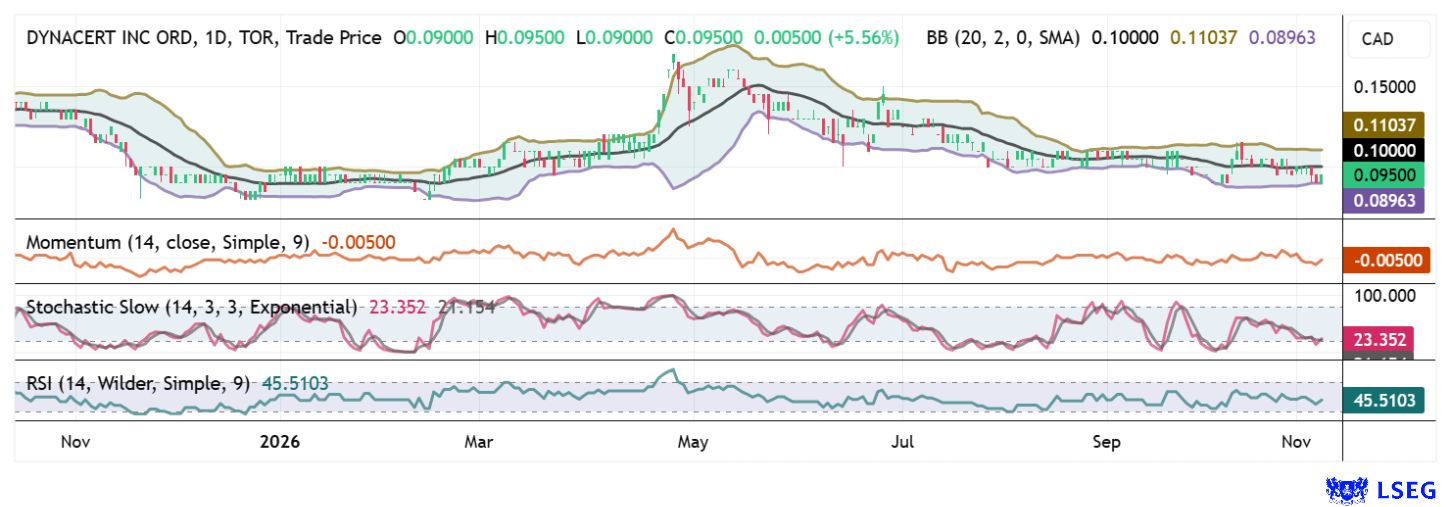
The decisive trigger for the forthcoming stock market revaluation is the transition from trial phases to binding large-scale orders through the new global distribution partners. Following many years of development, dynaCERT now stands on the threshold of the commercial harvesting phase, which could give the stock entirely new momentum. Analysts at research firm GBC have evaluated the growth prospects in detail and see the share’s fair value at a price target of CAD 0.75. Compared with the current price of just CAD 0.09 to 0.10, this fundamental assessment implies exceptional upside potential of around 680% for risk-aware investors. Highly exciting!

SpaceX – Does the innovative group also have climate targets?
The space industry is also a transport business! Given the massive emissions from rocket launches, these are increasingly being questioned critically by younger generations, and climate targets are under scrutiny. So far, however, SpaceX’s statutes and internal guidelines show a clear regulatory divergence from the global goals of COP31. In its official sustainability reports, the company led by Elon Musk largely refrains from making specific net-zero commitments or setting transparent climate targets. Instead, in its statutes, SpaceX primarily points to the environmental benefits of rocket reusability as a key lever for conserving resources. Furthermore, management is strategically positioning itself against strict environmental requirements and actively advocating exemptions from regulatory environmental reviews under the current US administration. According to its own statements, the company’s mission focuses primarily on technological scaling and humanity’s long-term interplanetary sustainability. Following the recent IPO, rating agencies such as MSCI consequently assigned this defensive climate policy the worst ESG grade, CCC. Unsurprisingly, genuine alignment with UN climate goals remains absent at SpaceX. The tech giant operates largely outside a global ESG consensus. Investors are not bothered by this. Since its IPO in June 2026 at USD 135, prices have already reached over USD 200, with a market value of USD 2.4 trillion. Consolidation is also underway here. According to the analysts on the LSEG platform, prices around USD 142 are clear buying levels, as they expect an average price target of USD 250 in 12 months. Well then!
Conclusion
For forward-looking investors, the political tailwind from the climate summit is an ideal filter for identifying long-term opportunities in the early stages of the global wave of electrification. While established automotive giants such as Volkswagen and BYD are facing gruelling, cut-throat competition as they pursue green strategic objectives, Canadian retrofitting specialist dynaCERT offers an immediately deployable, highly cost-efficient bridging technology for global heavy-duty transport. In stark contrast to these closely watched players, space and communications company SpaceX largely evades the global ESG consensus, yet still inspires a large following despite a critical sustainability rating.
Conflict of interest
Pursuant to §85 of the German Securities Trading Act (WpHG), we point out that Apaton Finance GmbH as well as partners, authors or employees of Apaton Finance GmbH (hereinafter referred to as “Relevant Persons”) currently hold or hold shares or other financial instruments of the aforementioned companies and speculate on their price developments. In this respect, they intend to sell or acquire shares or other financial instruments of the companies (hereinafter each referred to as a “Transaction”). Transactions may thereby influence the respective price of the shares or other financial instruments of the Company.
In this respect, there is a concrete conflict of interest in the reporting on the companies.
In addition, Apaton Finance GmbH is active in the context of the preparation and publication of the reporting in paid contractual relationships.
For this reason, there is also a concrete conflict of interest.
The above information on existing conflicts of interest applies to all types and forms of publication used by Apaton Finance GmbH for publications on companies.
Risk notice
Apaton Finance GmbH offers editors, agencies and companies the opportunity to publish commentaries, interviews, summaries, news and the like on news.financial. These contents are exclusively for the information of the readers and do not represent any call to action or recommendations, neither explicitly nor implicitly they are to be understood as an assurance of possible price developments. The contents do not replace individual expert investment advice and do not constitute an offer to sell the discussed share(s) or other financial instruments, nor an invitation to buy or sell such.
The content is expressly not a financial analysis, but a journalistic or advertising text. Readers or users who make investment decisions or carry out transactions on the basis of the information provided here do so entirely at their own risk. No contractual relationship is established between Apaton Finance GmbH and its readers or the users of its offers, as our information only refers to the company and not to the investment decision of the reader or user.
The acquisition of financial instruments involves high risks, which can lead to the total loss of the invested capital. The information published by Apaton Finance GmbH and its authors is based on careful research. Nevertheless, no liability is assumed for financial losses or a content-related guarantee for the topicality, correctness, appropriateness and completeness of the content provided here. Please also note our Terms of use.
Stockhouse does not provide investment advice or recommendations. All investment decisions should be made based on your own research and consultation with a registered investment professional. The issuer is solely responsible for the accuracy of the information contained herein. For full disclaimer information, please click here.