

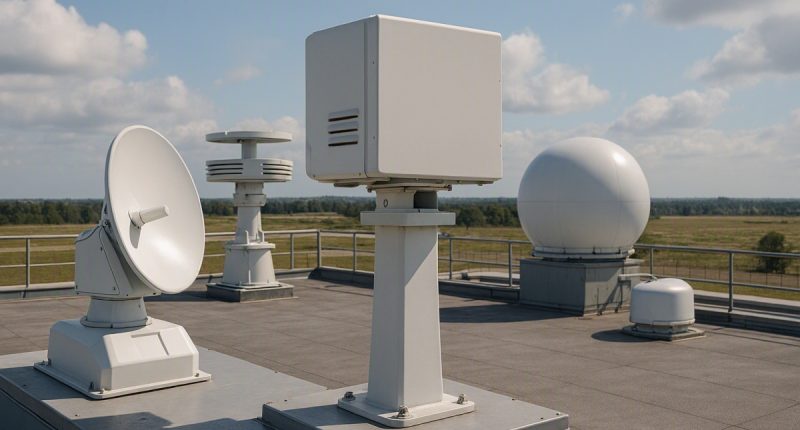
- Counter-drone systems are shifting from niche tools into essential national and civilian security infrastructure
- Rapid market growth is being driven by rising drone threats and integration into broader defence architecture
- Governments and enterprises are accelerating procurement, creating sustained demand and recurring revenue models
- The sector is attracting investment through strong growth, dual-use applications, and increasing consolidation activity
The global defence landscape is undergoing a structural shift as counter-drone technologies—once niche battlefield tools—rapidly evolve into essential infrastructure. For investors, the transformation is reshaping procurement priorities, opening multi-decade growth avenues, and redefining competitive dynamics across defence and adjacent sectors.
From emerging threat to structural demand
The proliferation of low-cost unmanned aerial systems (UAS) has emerged as one of the defining security challenges of the 2020s. Commercial drones—widely accessible and increasingly sophisticated—are now routinely adapted for surveillance, smuggling, sabotage, and battlefield attacks, forcing governments to reassess airspace security frameworks.
This evolving threat environment is accelerating demand for counter-UAS (C-UAS) solutions, including radar, radio-frequency detection, electronic warfare tools, and directed-energy systems designed to detect, track, and neutralize hostile drones.
Recent conflict dynamics and drone swarm capabilities have further exposed the limitations of traditional air defence systems. As a result, counter-drone capabilities are increasingly viewed not as optional add-ons but as foundational layers within broader air and missile defence architectures.
This article is a journalistic opinion piece that has been written based on independent research. It is intended to inform investors and should not be taken as a recommendation or financial advice.
A market already in hypergrowth
The investment case for counter-drone technology is underpinned by strong growth forecasts across multiple datasets. Industry estimates suggest the global C-UAS market will expand from roughly US$6.6 billion in 2025 to over US$20 billion by 2030, implying a compound annual growth rate of about 25 per cent.
Longer-term projections indicate sustained expansion, with some forecasts placing the market’s trajectory toward tens of billions annually as adoption spreads across both military and civilian sectors.
Importantly, growth is not limited to defence budgets alone. Commercial end-markets—including airports, utilities, energy infrastructure, and large public venues—are emerging as key adopters, driven by regulatory changes and rising liability around airspace security.
The result is a rare convergence: a high-growth segment within defence that also benefits from dual-use commercial applications, broadening the total addressable market and investor appeal.
Counter-drone as infrastructure
One of the most notable shifts in 2025–2026 is the reclassification of counter-drone capabilities from tactical procurement to long-term infrastructure investment.
Governments are increasingly embedding C-UAS into permanent national security frameworks. In the United States, legislation such as the Safer Skies Act (FY2026) is enabling wider deployment of counter-drone systems at state and local levels, expanding the customer base beyond federal agencies.
Meanwhile, Europe is advancing coordinated programmes and funding initiatives aimed at protecting borders, critical infrastructure, and public events.
This infrastructure framing has several implications for investors:
- Recurring procurement cycles rather than one-off contracts
- Integration into multi-layer defence networks alongside missile systems and sensors
- Expansion into civilian infrastructure budgets, including smart cities and critical energy assets
As one industry analysis notes, “the counter-drone market isn’t a trend anymore—it’s infrastructure,” reflecting its transition into embedded national security architecture.
Procurement momentum and deal flow
Contract activity across 2025–2026 underscores the momentum shift from pilot programs to scaled deployment.
Recent examples include:
- A US$490 million U.S. Air Force counter-drone contract involving Trust Automation and radar supplier Echodyne.
- Poland’s US$1.7 billion order for counter-UAS batteries from Kongsberg Gruppen.
- Belgium’s €50 million urgent procurement of AI-enabled interceptor systems, alongside a longer-term €500 million programme.
- Motorola Solutions’ planned US$1.5 billion acquisition of D-Fend Solutions, signalling consolidation and strategic positioning around airspace security.
In parallel, large-scale events such as the 2026 FIFA World Cup are triggering dedicated procurement waves for counter-drone systems to secure urban airspace.
These developments highlight a broader pattern: procurement timelines are compressing, and deployment is accelerating across both military and civilian environments.
Technology stack: From sensors to autonomous defence
The modern counter-drone ecosystem is built on multi-layered architecture, combining detection, identification, and mitigation capabilities.
Key technology segments include:
- Detection: radar, RF sensors, electro-optical systems
- Command and control (C2): software platforms integrating data across systems
- Mitigation: electronic jamming, spoofing, kinetic interceptors, directed-energy weapons
- AI integration: automated classification and response
Advances in artificial intelligence and sensor fusion are particularly significant, enabling systems to autonomously detect and classify threats while minimizing false positives.
Directed-energy systems—such as high-energy lasers and microwave weapons—are also gaining traction as scalable, cost-effective solutions against drone swarms.
Competitive landscape: Primes vs. disruptors
The counter-drone sector is characterized by a hybrid competitive landscape:
- Established defence primes (Lockheed Martin, RTX, Thales, Saab) leveraging scale and integration capabilities
- Specialized firms (Dedrone, DroneShield, D-Fend) focusing on agile, software-driven solutions
- Dual-use technology players entering via AI, sensors, and communications
This dynamic is part of a broader shift in the defence industry, where digital-native companies are challenging incumbents with faster innovation cycles and software-centric approaches.
For investors, this creates both opportunity and complexity—particularly around identifying long-term winners in a rapidly evolving technology stack.
Defence spending tailwinds
The counter-drone boom is unfolding against a backdrop of rising global defence spending. Military expenditures reached approximately US$2.3 trillion in 2024, with continued growth driven by geopolitical tensions in Europe, the Middle East, and the Indo-Pacific.
A new defence spending “supercycle” is emerging, with governments prioritizing next-generation capabilities such as drones, AI-enabled systems, and layered air defence.
Counter-drone technologies sit squarely at the intersection of these priorities, benefiting from both increased budgets and shifting procurement focus.
Investment outlook
For investor audiences, the counter-drone sector offers a combination of structural growth drivers:
- Persistent threat environment ensuring long-term demand
- Cross-sector adoption spanning defence, homeland security, and commercial infrastructure
- Rapid technological evolution supporting premium margins and differentiation
- M&A and consolidation opportunities as larger players acquire specialized capabilities
However, risks remain. Regulatory frameworks, interoperability challenges, and the need for proven effectiveness in real-world environments could shape adoption timelines.
Conclusion
The counter-drone market is transitioning from a reactive capability to a foundational pillar of modern defence infrastructure.
As governments and enterprises seek to secure increasingly contested airspace, investment is shifting toward integrated, layered systems that combine detection, data, and response into cohesive networks.
For investors, the key takeaway is clear: counter-drone technology is no longer a peripheral niche—it is becoming a central component of 21st-century security architecture, with growth potential to match.
Join the discussion: Find out what the Bullboards are saying about aerospace and defence stocks, then check out Stockhouse’s stock forums and message boards.