


Kobo Resources – Drilling Successes, New Financing, Resources in Sight!
Capital markets are currently pricing in a rising risk of recession. For investors, this often marks the start of the search for alternatives. In Africa, there could be opportunities in the precious metals sector. West Africa is increasingly emerging as a strategically significant gold region, with Côte d’Ivoire boasting stable growth rates of around 6% per year and a gross domestic product of approximately USD 94.5 billion, ranking among the region’s most economically robust markets. The mining sector is steadily gaining importance, as several neighboring mines now hold resources in the range of over 10 million ounces of gold, thereby confirming the geological attractiveness of the area. This combination of macroeconomic stability and mineral potential creates a favorable foundation for growth-oriented exploration companies.
Against this backdrop, Kobo Resources is positioning itself as an early-stage player in an established gold belt with a clear scaling strategy. The company pursues a development approach aimed at systematically advancing exploration projects into defined resources and, in the long term, into economically viable deposits. A key factor here is proximity to existing infrastructure, which enables potentially lower capital costs and faster development.
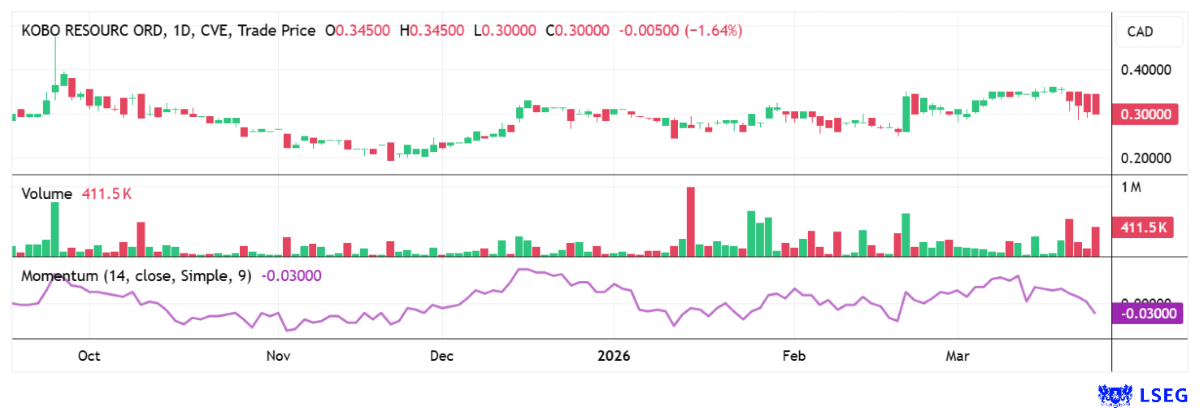
The core Kossou project forms the operational center of activities and already boasts a substantial exploration base. Since 2023, over 40,000 m of drilling have been completed in more than 200 drill holes, supplemented by approximately 7,000 m of trenching along a mineralized structure over 9 km long. The latest drill results confirm continuous gold mineralization with intervals such as 13 m at 1.77 g/t gold, as well as high-grade sections of 2 m with more than 26 g/t gold. A key value driver is the planned first resource estimate for mid-2026, which often triggers a change in valuation from a capital markets perspective. In parallel, the company is expanding its pipeline through the Kotobi project, where four large-scale gold anomalies have already been identified, and an initial drilling program is being prepared. This multi-project strategy statistically increases the probability of additional discoveries and reduces dependence on a single asset.
Financially, the company plans to raise up to approximately CAD 5.5 million to fund further drilling programs and regional expansion. With approximately 118 million outstanding shares and a market capitalization of around CAD 35 million, Kobo Resources remains in an early valuation phase where exploration successes can have a disproportionately large impact on the company’s value. Highly interesting over the next 12 to 18 months, as drill results are pending, followed by a resource definition!
IIF host Lyndsay Malchuk in conversation with CEO Edward Gosselin about the outlook for Kobo Resources in Côte d’Ivoire.

SAP – Far Too Much of a Decline
The German IT flagship company SAP, based in Walldorf, has endured a long series of declines. As recently as June 2025, the stock was trading at just under EUR 275; by the start of this week, it had fallen to EUR 146, with almost no resistance. While international investors welcome the fairly strong financial results, they criticize the far too modest growth in the cloud sector. Similarly, SAP’s AI development is struggling to keep pace with the current market momentum. Nevertheless, with an estimated 2026 earnings per share of EUR 7.19, up from EUR 6.14 in 2025, this currently implies a P/E ratio of just 20.8, with revenue and earnings growth of 10% and 17%, respectively. SAP will present its first-quarter figures as early as April 23. By then, it should also be clear whether expectations for 2026 can be met. 26 out of 37 analysts on the LSEG platform are bullish and expect a 12-month average target price of EUR 239, a full 60% above the current level!
Oracle – High Debt Slows Profit Momentum
After a rapid surge fueled by artificial intelligence, Oracle investors are now facing a rude awakening – the stock price has plummeted by a whopping 60%. Yet Larry Ellison’s software empire had actually reported strong cloud figures. But massive investments and the resulting growing debt burden are increasingly casting a shadow over the balance sheet. As recently as 2025, Oracle was considered one of the big winners of the global AI boom. The boom was driven primarily by demand for cloud capacity and generative AI—the technology that can independently create text, images, or code rather than just analyzing data. Oracle seemed predestined for this trend, positioning itself as a high-end provider for data-intensive AI applications and offering customers a one-stop shop. Concentrated computing power, storage, networks, and GPU power—all embedded in a stable ecosystem of databases and business software.
By fall 2025, the stock had surged by over 200% to USD 345, then sentiment shifted. Enthusiasm over growth gave way to concern that Oracle was overextending itself with its massive cloud projects. Demand was barely manageable, forcing the company to build data centers costing billions. And infrastructure on this scale simply doesn’t come at a bargain price. Over three years, expenditures totaled around USD 80 billion—one-fifth of the company’s total market capitalization. At the same time, net debt rose to USD 125 billion, and risk premiums in the bond market surged sharply. Consequently, analysts issued a barrage of downgrades. But now the first optimists are returning: the average price target is back at USD 249.50, about USD 100 above the current level, and 31 out of 44 analysts now recommend buying. For Larry Ellison, the passionate sailor and eternal optimist, this may be a glimmer of hope, but patience remains essential.

Gold reached record highs of over USD 5,400 in January, who would have thought! Driven by geopolitical uncertainties and the physical scarcity of its little brother, silver, it rose by over 25% in 2026 alone. Now, with the Iran crisis, other factors are coming into play, namely liquidity. Professionals are therefore not surprised by the pullback to around USD 4,200 at the start of the week. High-tech stocks also took a beating. Those who now add new stocks to their portfolios could emerge as winners in 2027, as Kobo Resources, SAP, and Oracle are analytically very attractively valued.
Conflict of interest
Pursuant to §85 of the German Securities Trading Act (WpHG), we point out that Apaton Finance GmbH as well as partners, authors or employees of Apaton Finance GmbH (hereinafter referred to as “Relevant Persons”) currently hold or hold shares or other financial instruments of the aforementioned companies and speculate on their price developments. In this respect, they intend to sell or acquire shares or other financial instruments of the companies (hereinafter each referred to as a “Transaction”). Transactions may thereby influence the respective price of the shares or other financial instruments of the Company. In this respect, there is a concrete conflict of interest in the reporting on the companies.
In addition, Apaton Finance GmbH is active in the context of the preparation and publication of the reporting in paid contractual relationships. For this reason, there is also a concrete conflict of interest.
The above information on existing conflicts of interest applies to all types and forms of publication used by Apaton Finance GmbH for publications on companies.
Risk notice
Apaton Finance GmbH offers editors, agencies and companies the opportunity to publish commentaries, interviews, summaries, news and the like on news.financial. These contents are exclusively for the information of the readers and do not represent any call to action or recommendations, neither explicitly nor implicitly they are to be understood as an assurance of possible price developments. The contents do not replace individual expert investment advice and do not constitute an offer to sell the discussed share(s) or other financial instruments, nor an invitation to buy or sell such.
The content is expressly not a financial analysis, but a journalistic or advertising text. Readers or users who make investment decisions or carry out transactions on the basis of the information provided here do so entirely at their own risk. No contractual relationship is established between Apaton Finance GmbH and its readers or the users of its offers, as our information only refers to the company and not to the investment decision of the reader or user.
The acquisition of financial instruments involves high risks, which can lead to the total loss of the invested capital. The information published by Apaton Finance GmbH and its authors is based on careful research. Nevertheless, no liability is assumed for financial losses or a content-related guarantee for the topicality, correctness, appropriateness and completeness of the content provided here. Please also note our Terms of use.
Stockhouse does not provide investment advice or recommendations. All investment decisions should be made based on your own research and consultation with a registered investment professional. The issuer is solely responsible for the accuracy of the information contained herein. For full disclaimer information, please click here.