


DroneShield – Digital Defense Systems at the Heart of Modern Warfare
Today’s theaters of war no longer resemble the battlefields of the Napoleonic era. Instead of thousands of soldiers, highly sensitive digital systems now face off against one another, using maximum reconnaissance and data consolidation to identify military targets and define the corresponding electronic chains of command for their elimination – a combination of state-of-the-art defense technology and well-trained soldiers who operate the equipment accordingly. Since the invasion of Ukraine, defense systems against drones have come into the spotlight.
The Australian manufacturer DroneShield has developed technology to counter enemy drones in the sky or redirect them. The technology is based on a multi-stage approach to countering enemy drones, combining the steps of detection, identification, and neutralization. First, various sensor systems, such as radio frequency scanners, radar, and optical and infrared cameras, detect potential flying objects in the monitored airspace. The collected data is then consolidated and analyzed using software and AI to classify drone types and minimize false alarms. After identification, the system tracks the drone in real time and can often also determine the operator’s location. The actual neutralization is primarily achieved through electronic measures, specifically by selectively jamming the radio connection between the drone and the pilot. If this connection is interrupted, many drones automatically respond by landing or returning to their launch point. Additionally, the GPS signal can be jammed, causing the drone to lose its orientation and preventing it from continuing its mission. This so-called “soft kill” approach makes it possible to effectively stop threats without causing physical destruction or collateral damage.
DroneShield’s stock has been on a rollercoaster ride. After peaking at around EUR 3.80, there was a sharp drop to below EUR 1 in November 2025. Since then, confidence has been restored thanks to the acquisition of major NATO contracts, and the rally toward EUR 2.50 is back in full swing. What has not entirely disappeared is the mismatch between revenue and valuation. Fundamentally, estimated revenue of EUR 315 million stands against a market value of EUR 2.35 billion – a factor of 7.5. The defense stock Rheinmetall comes in at 5.3. This means DroneShield is likely only interesting during correction phases.
NEO Battery Materials Positions Itself at the Center of the Drone Boom
Without an adequate power supply, a drone cannot stay in the air for long or achieve long ranges. Energy storage specialist NEO Battery Materials Ltd. has increasingly emerged as a key player in the drone sector in recent months by consistently advancing its technology from materials research to operational system solutions. Through the use of NEO technologies, the flight time of commercial drones has nearly doubled in real-world tests under demanding conditions, representing significant operational value. This performance boost is based on silicon-enriched anodes, which enable a significantly higher energy density compared to traditional graphite solutions.
At the same time, the company is moving forward with the expansion of its production capacities in South Korea and has secured a 3.2-acre site for industrial manufacturing. The targeted production capacity of approximately 500 MWh per year is mathematically equivalent to powering about 66,000 ISR drones or over 300,000 drone munitions annually. NEO is thus targeting a market that, according to expert estimates, is expected to grow from approximately USD 9.1 billion in 2025 to over USD 29 billion by 2032. Of particular note is the strategic decision to source all raw materials outside of China in order to comply with regulatory requirements such as the US NDAA. This positioning increases the likelihood of being integrated into Western defense programs and securing long-term supply contracts.
IIF moderator Lyndsay Malchuk in an interview with NEO Battery Materials.
At the same time, scaling the company’s proprietary silicon anode technology strengthens vertical integration and potentially improves the future margin structure. Investors should take note, as the combination of technological differentiation, a growing production base, and geopolitical relevance creates a perfect investment profile for dynamic portfolios. With a valuation of around CAD 110 million, the market does not yet fully reflect the company’s highly professional positioning and the progress made in recent months. Added to this is the scaling potential in the drone and defense segments. Now is the time to get in!
Airbus – Drones and Eurofighters in Synergy
Airbus is also involved in the drone business. Currently, the international aerospace group is specifically driving forward the development of unmanned combat aircraft to meet the Air Force’s demand for so-called Uncrewed Collaborative Combat Aircraft (UCCA) starting in 2029. At the center of this effort is the integration of the Valkyrie drone, which is being further developed technologically in collaboration with US partner Kratos Defense & Security Solutions. Airbus is supplementing the platform with its own MARS mission system, which uses AI-based software not only to control individual drones but also to coordinate entire formations. This ability to network manned and unmanned systems is considered a decisive step toward modern, digitized combat operations within NATO.
With a range of over 5,000 km, high operational altitude, and flexible payload, the Valkyrie drone itself provides a robust foundation for reconnaissance and combat missions. Particularly relevant is the planned integration into the Eurofighter Typhoon, which is set to serve as a command platform for drone swarms in the future. This creates a hybrid system that offloads risky missions while simultaneously increasing the efficiency of existing combat aircraft. For investors, this opens up another market in the field of networked defense systems, as autonomous drone solutions are considered a cost-effective complement to traditional air forces. Should Airbus successfully scale the technological integration, the company could establish itself in the long term as a key provider of European drone solutions within the NATO environment. Airbus shares have corrected sharply to EUR 169 from their high of EUR 221 in January, but 17 out of 21 analysts on the LSEG platform believe the stock will return to prices around EUR 219 within the next 12 months.

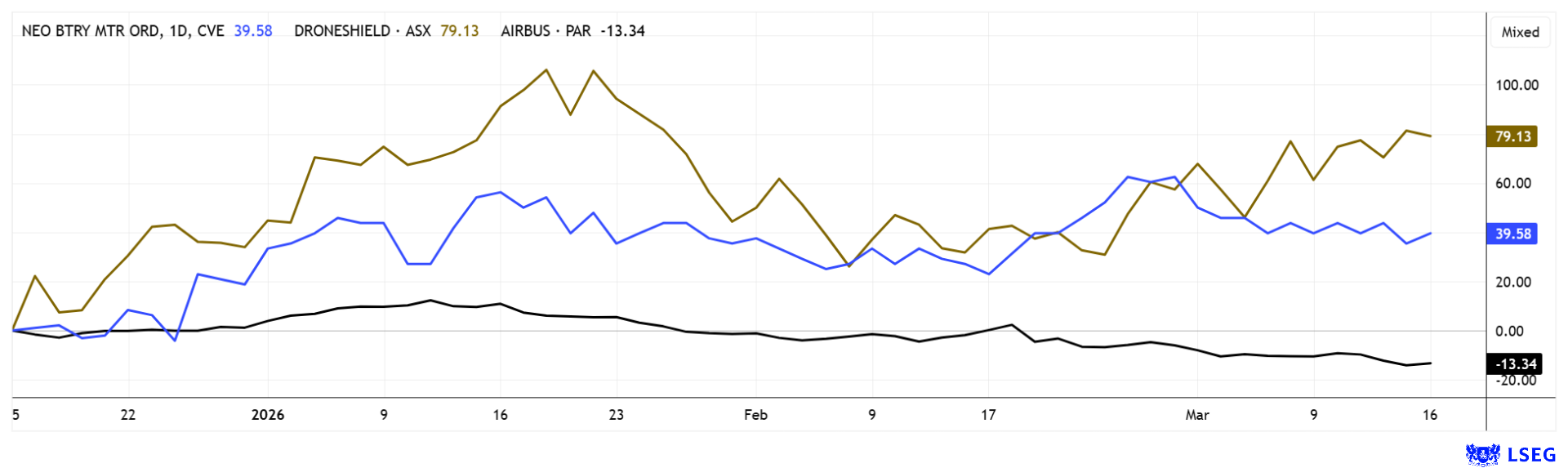
Wars no longer take place on the ground these days, as aggressors use highly technical, unmanned systems to avoid sending their soldiers unnecessarily into enemy territory. This new form of digital warfare requires technology in the areas of drones, AI software, storage, and highly sensitive sensors. DroneShield, NEO Battery Materials, and Airbus form a solid investment trio to represent this sector in a portfolio.
Conflict of interest
Pursuant to §85 of the German Securities Trading Act (WpHG), we point out that Apaton Finance GmbH as well as partners, authors or employees of Apaton Finance GmbH (hereinafter referred to as “Relevant Persons”) currently hold or hold shares or other financial instruments of the aforementioned companies and speculate on their price developments. In this respect, they intend to sell or acquire shares or other financial instruments of the companies (hereinafter each referred to as a “Transaction”). Transactions may thereby influence the respective price of the shares or other financial instruments of the Company.
In this respect, there is a concrete conflict of interest in the reporting on the companies.
In addition, Apaton Finance GmbH is active in the context of the preparation and publication of the reporting in paid contractual relationships.
For this reason, there is also a concrete conflict of interest.
The above information on existing conflicts of interest applies to all types and forms of publication used by Apaton Finance GmbH for publications on companies.
Risk notice
Apaton Finance GmbH offers editors, agencies and companies the opportunity to publish commentaries, interviews, summaries, news and the like on news.financial. These contents are exclusively for the information of the readers and do not represent any call to action or recommendations, neither explicitly nor implicitly they are to be understood as an assurance of possible price developments. The contents do not replace individual expert investment advice and do not constitute an offer to sell the discussed share(s) or other financial instruments, nor an invitation to buy or sell such.
The content is expressly not a financial analysis, but a journalistic or advertising text. Readers or users who make investment decisions or carry out transactions on the basis of the information provided here do so entirely at their own risk. No contractual relationship is established between Apaton Finance GmbH and its readers or the users of its offers, as our information only refers to the company and not to the investment decision of the reader or user.
The acquisition of financial instruments involves high risks, which can lead to the total loss of the invested capital. The information published by Apaton Finance GmbH and its authors is based on careful research. Nevertheless, no liability is assumed for financial losses or a content-related guarantee for the topicality, correctness, appropriateness and completeness of the content provided here. Please also note our Terms of use.
Stockhouse does not provide investment advice or recommendations. All investment decisions should be made based on your own research and consultation with a registered investment professional. The issuer is solely responsible for the accuracy of the information contained herein. For full disclaimer information, please click here.