


Vonovia – Plans for nationalisation in Berlin leave housing giants cold
The initiative by the party Die Linke to bring large Berlin housing companies into public ownership marks a sharp unilateral political move that exposes the tension between social policy ambitions and economic reality. While the party is pushing ahead with the transfer of around 240,000 homes into common ownership under Article 15 of the Basic Law as a solution for affordable housing, economists and the federal government warn of a significant loss of investor confidence. In fact, Berlin’s housing market urgently needs capital to build almost 60,000 homes and carry out costly energy-efficiency renovations. However, persistent inflation and higher interest rates have drastically increased financing costs for public and private construction projects. Assuming borrowing rates of around 4%, the interest and principal repayments alone on the billions in compensation would exceed ongoing rental income, making further rent increases inevitable, even according to party leader Ines Schwerdtner. At the same time, political uncertainty is deterring private developers and leading to a noticeable flight of capital from the German property sector.
Vonovia firmly rejects Berlin’s plans to bring housing into public ownership as “unconstitutional” and “irresponsible” and says it will seek judicial review if they go ahead. CEO Luka Mucic stresses that expropriation would not create a single new home, even though Germany faces a shortage of around 1.4 million homes and urgently needs more construction. The group also points out that the planned compensation averaging around EUR 100,000 per home is far below its own carrying value and would therefore lead to significant losses running into billions. As a “partner of the City of Berlin”, Vonovia argues that, with an average rent across its portfolio of around EUR 8.40 per sqm, it already provides affordable housing and the staff and capital needed for renovations. While ongoing construction projects, such as the roughly 1,000 homes already started in the capital, will still be completed, Mucic announced that future investment decisions will be reassessed in light of the political uncertainty.
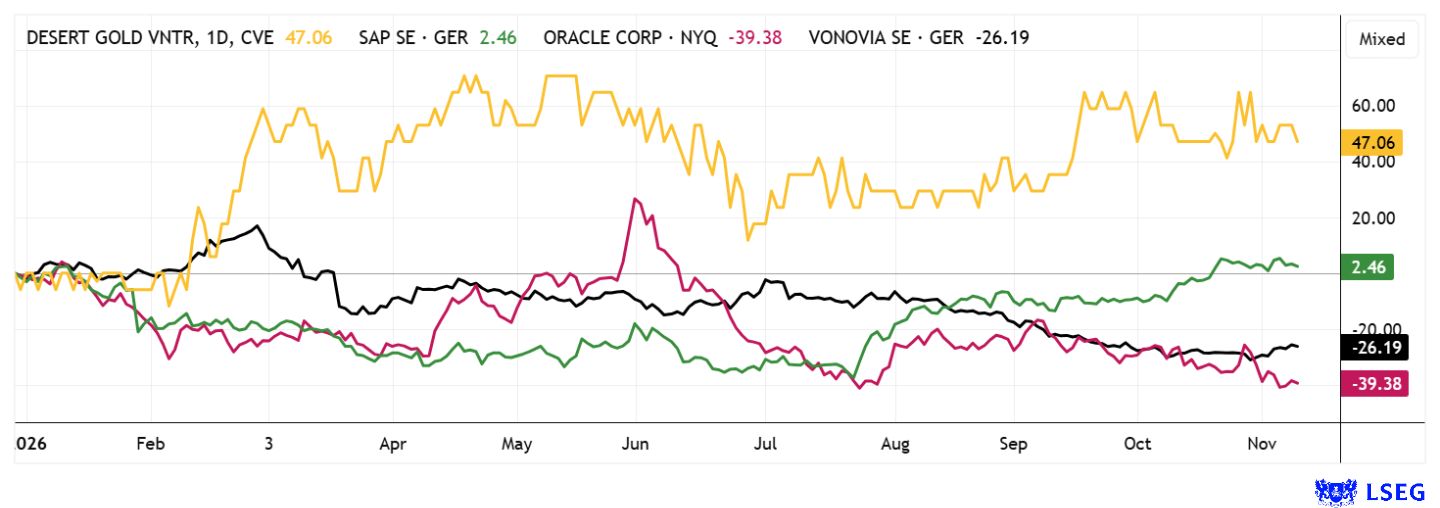
For investors in Vonovia shares, the current environment nevertheless remains a burden. Mortgage rates are at a 20-year high and the propensity to invest is low. Despite the share price losing more than 60% over the past 5 years, analyst recommendations remain relatively cautious, with only 10 out of 22 analysts on the LSEG Refinitiv platform recommending the stock. The average 12-month price target stands at around EUR 23. That still represents upside potential of 35%, plus a 5% dividend yield!
SAP and Oracle – The problem with high investment
In the current AI correction, the paths of the two software heavyweights SAP and Oracle are diverging sharply as investors increasingly distinguish between capital-intensive infrastructure expansion and reliable software monetisation. While Oracle is entering into direct competition with the major US hyperscalers by investing billions in its own AI data centres, the group is coming under considerable financing pressure from its rapidly growing debt burden of over USD 100 billion and planned capital increases of up to USD 20 billion. Added to this are long-term lease commitments for data centres running into hundreds of billions, as well as geopolitical setbacks such as the cancellation of a planned major contract with Tencent, further fuelling investor nervousness.
By contrast, SAP is pursuing a much less capital-intensive strategy, focusing on integrating AI applications such as the Joule assistant deeply into its existing business processes and data platforms. This focus is paying off operationally, as the Walldorf-based group increased its cloud revenue by 26% in Q3 and expanded its current cloud backlog to over EUR 24 billion. It is therefore no surprise that SAP has an extremely solid balance sheet. With expected free cash flow of around EUR 10 billion, it has ample reserves for share buybacks or higher dividends. Accordingly, many analysts such as JPMorgan are rewarding this defensive strength with substantial price target increases, as SAP benefits from the AI trend without bearing the balance sheet risk of expensive hardware battles.
Although Oracle offers substantial long-term catch-up potential if it succeeds in filling its data centres and political resistance eases, market participants are watching the US company’s high debt levels closely in the current market environment. SAP therefore clearly holds the better cards at present, because its business model is based on contractually secured software revenue and strong margins rather than debt-financed infrastructure bets. The average analyst price targets on the LSEG Refinitiv platform are USD 238 (+100%) for Oracle and EUR 239 (+10%) for SAP. This reflects their differing performance over the past 12 months: SAP has already gained 65% from its low, while Oracle has lost around 45%. If analysts’ estimates are to be believed, SAP has a P/E ratio of 25 for 2027, while Oracle’s is calculated at just under 14. Toss a coin!
Desert Gold – A fine harvest can soon be reaped here
Uncertain times and simmering flashpoints repeatedly and reliably steer capital in the financial markets towards safe havens. After its dramatic record run to around USD 5,500, the gold price has settled at a consolidated level of just over USD 4,000. While Goldman Sachs has adjusted its forecast to USD 4,150 and, looking ahead to 2027, to USD 4,800, other major banks are sticking to significantly more ambitious targets. UBS expects a rise to USD 5,400, while JPMorgan even envisages prices of USD 6,300. For forward-looking market participants, this breather offers an exciting opportunity to increase their exposure to the precious metals sector again.
One beneficiary of the rise in gold prices is the Canadian exploration and development company Desert Gold Ventures, with its flagship project in western Mali. The first gravity processing plant, with a daily capacity of 200 tonnes, is now under construction at the Barani-East site, meaning that the recovery of the first ounce of gold is imminent. Following full commissioning and the ramp-up of this initial development phase, the plant is to be expanded to 1,200 tonnes per day over time as part of a larger development scenario. A preliminary economic assessment (PEA) calculated an after-tax net present value of around USD 61 million for the overall project at a conservative gold price of USD 2,850, with an internal rate of return of 57%. Should the precious metal continue to rise in price in line with the investment banks’ estimates, this project value would climb to over USD 124 million, according to the sensitivity analysis. With all-in sustaining costs at around USD 1,137 per troy ounce, highly attractive profit margins are in prospect even at current price levels. Total production of 113,100 ounces is planned over the intended mine life, with modest initial capital expenditure of around USD 20.4 million enabling a swift start.
CEO Jared Scharf speaks with IIF presenter Lyndsay Malchuk about upcoming gold production in Mali and further projects in West Africa.
In one of Africa’s most important gold-producing countries, Desert Gold now aims to generate its own funds quickly in order to expand operations gradually using its own resources. As the calculations to date cover only a small part of the approximately 440 km² property, considerable exploration potential still lies beneath the surface. The portfolio is complemented by the promising Tiegba project in Côte d’Ivoire, where the government is specifically promoting national gold output. A successfully completed financing round of CAD 7.18 million has fully funded the first production phase without any debt or royalties. On the stock exchange, the shares are trading at around CAD 0.13, providing a solid basis for the upcoming revaluation. Against this backdrop, analysts at research firm GBC reaffirm their Buy recommendation and set a price target of CAD 0.93. For opportunity-oriented investors, this offers an attractive entry window shortly before the start of production. Perhaps there are already potential partners in the background, as Desert’s share price has weathered the current correction in the precious metals sector unscathed.

Conclusion
Financial markets are currently testing the limits of volatility. Every political headline sends oil prices surging or tumbling, with dividend-paying stocks reacting just as sharply. Our selected precious metals stock, Desert Gold, has performed relatively steadily, supported by a promising production outlook. Vonovia is grappling with rumours of expropriation in Berlin, while SAP and Oracle have weathered the first wave of the AI-driven correction relatively well. Investors looking to reduce their risk should adopt a balanced approach with a medium-term investment horizon.
Conflict of interest
Pursuant to §85 of the German Securities Trading Act (WpHG), we point out that Apaton Finance GmbH as well as partners, authors or employees of Apaton Finance GmbH (hereinafter referred to as “Relevant Persons”) currently hold or hold shares or other financial instruments of the aforementioned companies and speculate on their price developments. In this respect, they intend to sell or acquire shares or other financial instruments of the companies (hereinafter each referred to as a “Transaction”). Transactions may thereby influence the respective price of the shares or other financial instruments of the Company.
In this respect, there is a concrete conflict of interest in the reporting on the companies.
In addition, Apaton Finance GmbH is active in the context of the preparation and publication of the reporting in paid contractual relationships.
For this reason, there is also a concrete conflict of interest.
The above information on existing conflicts of interest applies to all types and forms of publication used by Apaton Finance GmbH for publications on companies.
Risk notice
Apaton Finance GmbH offers editors, agencies and companies the opportunity to publish commentaries, interviews, summaries, news and the like on news.financial. These contents are exclusively for the information of the readers and do not represent any call to action or recommendations, neither explicitly nor implicitly they are to be understood as an assurance of possible price developments. The contents do not replace individual expert investment advice and do not constitute an offer to sell the discussed share(s) or other financial instruments, nor an invitation to buy or sell such.
The content is expressly not a financial analysis, but a journalistic or advertising text. Readers or users who make investment decisions or carry out transactions on the basis of the information provided here do so entirely at their own risk. No contractual relationship is established between Apaton Finance GmbH and its readers or the users of its offers, as our information only refers to the company and not to the investment decision of the reader or user.
The acquisition of financial instruments involves high risks, which can lead to the total loss of the invested capital. The information published by Apaton Finance GmbH and its authors is based on careful research. Nevertheless, no liability is assumed for financial losses or a content-related guarantee for the topicality, correctness, appropriateness and completeness of the content provided here. Please also note our Terms of use.
Stockhouse does not provide investment advice or recommendations. All investment decisions should be made based on your own research and consultation with a registered investment professional. The issuer is solely responsible for the accuracy of the information contained herein. For full disclaimer information, please click here.