


Strong Annual Results and Buy Recommendation
Zefiro Methane closed the 2025/26 fiscal year (ended June 30) with significant progress in revenue and earnings and expects further growth. Revenue rose by 31.1% to a record USD 42.5 million. The company is making noticeable progress in terms of profitability. Gross profit climbed 66% to USD 12.4 million. The net loss was reduced by 67.5% to USD 3.5 million. The loss of USD 0.04 per share was in line with analysts’ expectations. According to GBC Research, Zefiro Methane will grow profitably starting in the current fiscal year. The experts expect Zefiro to generate revenue of USD 57.92 million. This is projected to result in a net profit of USD 4.21 million, or USD 0.04 per share. Based on the current share price, the P/E ratio is around 10. The price-to-sales (P/S) ratio is even below 1. For the coming fiscal year, analysts forecast earnings per share of USD 0.05.
In GBC’s view, this makes the stock of this fast-growing company undervalued. They recommend the stock a “Buy”, with a price target of USD 1.50. The stock is currently trading at around USD 0.43 (EUR 0.40). In Germany, it is traded on Tradegate and gettex, among other platforms. Click here for GBC Research report.
A Business Model Investors Can Only Wish For
Zefiro Methane’s business model is exactly what investors look for: relatively unspectacular, yet highly scalable. Multi-year government contracts ensure predictable revenue, while the business is scalable. Once a critical size is reached, additional revenue can translate into disproportionate earnings growth. Zefiro appears to have reached this stage. This is compounded by a highly fragmented market with many smaller providers. That is precisely where another opportunity lies. Zefiro aims to consolidate the market and establish itself as a leading provider in North America.
The company plugs abandoned oil and gas wells, thereby reducing methane emissions. Behind this lies a multi-billion-dollar infrastructure and environmental market. In its study, GBC Research notes that in the US alone, approximately 2 million inactive oil and gas wells remain unplugged. The cost of decommissioning the documented abandoned onshore wells is estimated at approximately USD 280 billion. This figure does not even account for an additional 1.2 million undocumented wells. Funding allocated under the US Infrastructure Investment and Jobs Act (IIJA) for the remediation of abandoned wells amounts to approximately USD 4.7 billion.
In a recent interview with Lyndsay Malchuk of the IIF, Zefiro CEO Catherine Flax discusses the opportunities in this structurally growing market with very long-term demand. With regard to the millions of orphaned oil and gas wells, she points out that the federal funds allocated so far cover only about 2% of the estimated remediation costs. At the same time, the remediation of abandoned and orphaned wells enjoys unusually broad political support. In addition to environmental concerns, health, safety and economic interests are playing an increasingly important role. According to Flax, large infrastructure projects are creating additional demand. Operators of data centres, logistics centres and LNG facilities can often use properties with problematic abandoned wells only after remediation. Especially for projects worth billions, companies are willing to pay substantial sums for rapid, professional remediation of such contaminated sites.
Flax expects additional growth drivers in the coming years from the private sector and the market for emissions credits. Methane is considered a particularly harmful greenhouse gas, which is why the decommissioning of high-emitting wells can increasingly be used to generate CO₂ credits. Zefiro sees demand, among others, from data centre operators with climate goals as well as from energy companies seeking to reduce their emissions intensity. Elon Musk and Tesla have already demonstrated in recent years how to make substantial profits from emissions credits.
Flax speaks of a cross-generational market opportunity and aims to develop Zefiro into a leading environmental services provider in North America over the long term. The business is set to expand beyond simply plugging wells to include related services such as soil remediation, groundwater protection, and the restoration of contaminated sites.
https://youtu.be/Ae_ErqnDCRA?si=JY3tJlGXN90ScUwk
News Flow Points to a Strong Current Fiscal Year
The news flow at Zefiro has been positive for months. Fourteen days ago, the company secured three additional federally funded projects to plug abandoned oil and gas wells in Ohio and Pennsylvania. The total project value is approximately USD 1.9 million and covers 12 wells. In Ohio, the Trumbull 3F and Lake 18F projects together account for approximately USD 1.47 million, or an average of about USD 184,000 per well. Zefiro was also the sole bidder for the Lake 18F project. This is likely one reason the company can command higher prices. According to the company, its bid is more than 40% above the average cost of the state’s Orphan Well Program. The company itself also attributes the above-average prices to the quality and reliability of its work.
The third project in Pennsylvania comprises 4 wells and is expected to generate at least USD 435,000 in revenue. Here, too, Zefiro was the sole bidder. Another advantage is the location, just a few minutes from the company’s headquarters, which should keep mobilization and overhead costs low. Work is scheduled to begin in December 2026 or January 2027.
Regional Expansion Underway
Zefiro Methane’s growth is also expected to be driven by regional expansion in the coming years. Most recently, the company announced its first operational presence in the US states of Indiana and Michigan. It is benefiting from the Viking Well Service fleet acquired in May 2026. In Indiana, the company has launched an 8-week carbon sequestration project with a contract value of approximately USD 750,000. For Zefiro, this also marks its entry into a new business segment. Instead of just plugging abandoned wells, the company is preparing storage wells for underground CO₂ sequestration. According to management, Zefiro can largely rely on existing teams, drilling rigs, and technical expertise for this work.
Meanwhile, in Michigan, Zefiro is working on an emergency project, which is expected to generate approximately USD 500,000 in revenue from a single well—significantly higher than the usual revenue per well. The reason is a hydrogen sulfide leak, which requires extensive safety measures and specialized equipment. According to CEO Flax, both projects demonstrate the additional access to markets and contracts that the Viking acquisition opens up. The company views carbon sequestration in particular as a promising opportunity alongside its existing core business.
Zefiro: When Will The Stock Break Out?
Despite strong operational performance, a consistently positive news flow over the past several months, and enormous market potential, Zefiro shares have been unable to sustainably rise above CAD 0.60 for months. This is despite ATB Capital Markets setting a significantly higher price target of CAD 1.00 and GBC Research setting a target equivalent to CAD 2.12.

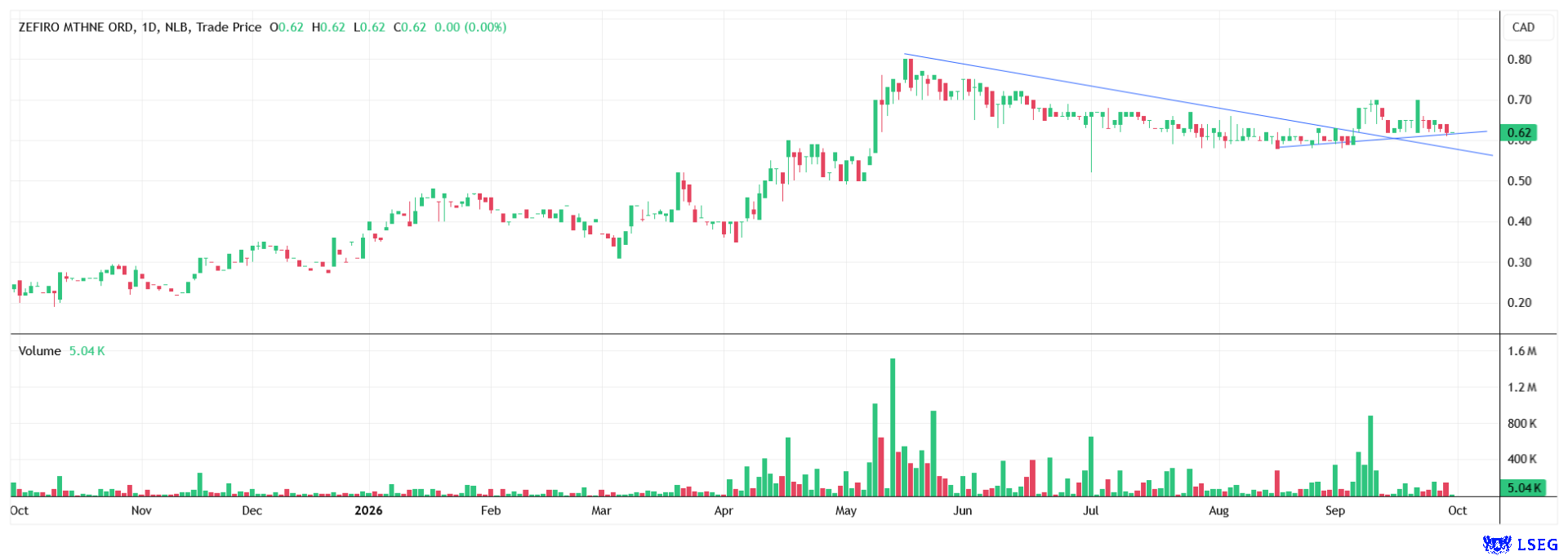
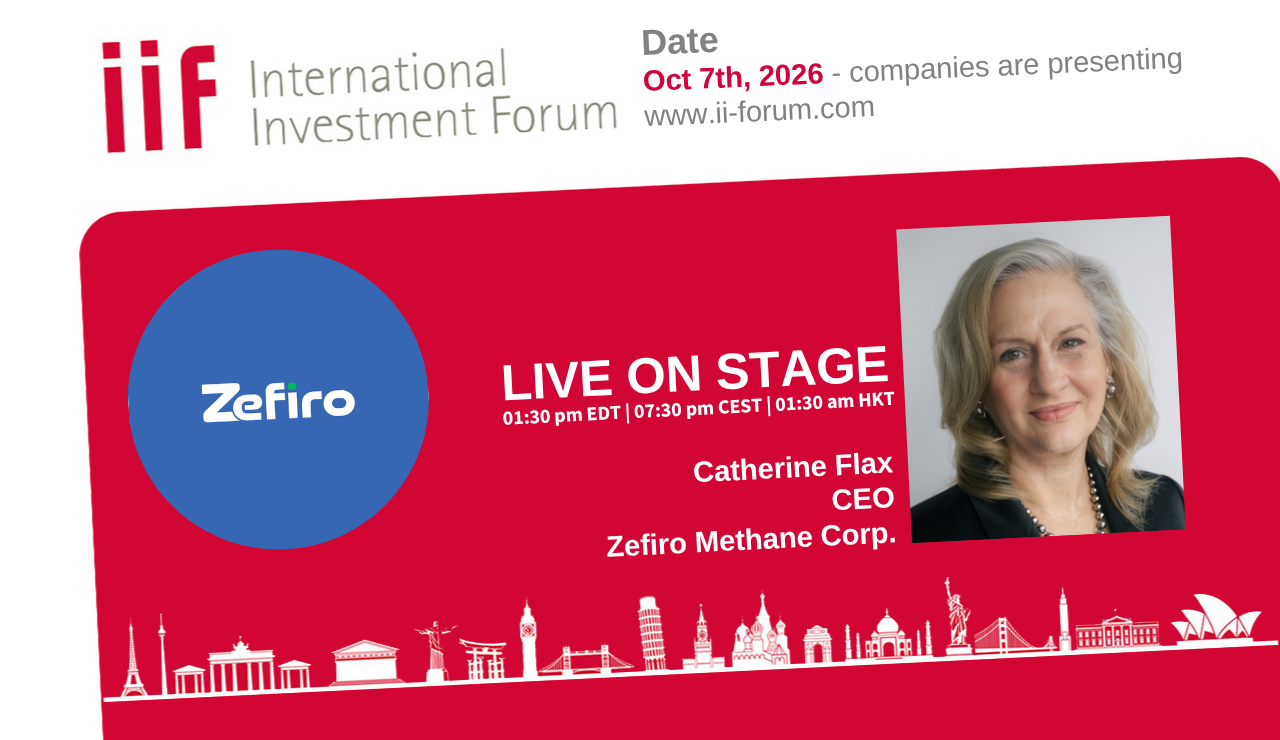
So when will the stock finally break out? Perhaps on October 7. That is when CEO Catherine Flax will present live at the virtual IIF investor conference. Registration is free!

The Bottom Line: The Company Is Just Getting Started
Record revenue, the start of scaling, expansion into new regions, and additional business areas such as carbon sequestration and the monetization of CO₂ credits suggest that Zefiro Methane is just at the beginning of its development. Particularly attractive is the combination of long-term government contracts, growing private demand, and a highly fragmented market worth billions, in which Zefiro aims to take a leading position. Analysts expect profits to rise significantly starting in the current fiscal year and view the stock as clearly undervalued at its current price level.
Conflict of interest
Pursuant to §85 of the German Securities Trading Act (WpHG), we point out that Apaton Finance GmbH as well as partners, authors or employees of Apaton Finance GmbH (hereinafter referred to as “Relevant Persons”) currently hold or hold shares or other financial instruments of the aforementioned companies and speculate on their price developments. In this respect, they intend to sell or acquire shares or other financial instruments of the companies (hereinafter each referred to as a “Transaction”). Transactions may thereby influence the respective price of the shares or other financial instruments of the Company.
In this respect, there is a concrete conflict of interest in the reporting on the companies.
In addition, Apaton Finance GmbH is active in the context of the preparation and publication of the reporting in paid contractual relationships.
For this reason, there is also a concrete conflict of interest.
The above information on existing conflicts of interest applies to all types and forms of publication used by Apaton Finance GmbH for publications on companies.
Risk notice
Apaton Finance GmbH offers editors, agencies and companies the opportunity to publish commentaries, interviews, summaries, news and the like on news.financial. These contents are exclusively for the information of the readers and do not represent any call to action or recommendations, neither explicitly nor implicitly they are to be understood as an assurance of possible price developments. The contents do not replace individual expert investment advice and do not constitute an offer to sell the discussed share(s) or other financial instruments, nor an invitation to buy or sell such.
The content is expressly not a financial analysis, but a journalistic or advertising text. Readers or users who make investment decisions or carry out transactions on the basis of the information provided here do so entirely at their own risk. No contractual relationship is established between Apaton Finance GmbH and its readers or the users of its offers, as our information only refers to the company and not to the investment decision of the reader or user.
The acquisition of financial instruments involves high risks, which can lead to the total loss of the invested capital. The information published by Apaton Finance GmbH and its authors is based on careful research. Nevertheless, no liability is assumed for financial losses or a content-related guarantee for the topicality, correctness, appropriateness and completeness of the content provided here. Please also note our Terms of use.
Stockhouse does not provide investment advice or recommendations. All investment decisions should be made based on your own research and consultation with a registered investment professional. The issuer is solely responsible for the accuracy of the information contained herein. For full disclaimer information, please click here.