


BASF: The Chemical Industry Veteran in Transition – Takeover Bid for Evonik Fails for Now
The chemical company BASF is struggling with high energy prices at its domestic sites. In addition, weakening global demand is noticeably slowing the recovery in the traditional chemicals market. Nevertheless, the Executive Board is consistently focusing on a cost-cutting program and a radical restructuring of the group to secure the future viability of the Ludwigshafen-based company.
The company is considering a takeover of its specialty chemicals competitor Evonik, but its initial non-binding offer of approximately EUR 10.3 billion has been rejected for now. Evonik and its major shareholder, the RAG Foundation, rejected the offer as too low. Although analysts expect annual synergy effects of up to EUR 700 million from potential consolidations in areas such as procurement, production, and sales—and see room for a higher offer based on the numbers—the plan is met with significant skepticism from the IGBCE union due to potential risks for locations and employees.
With annual revenue of approximately EUR 68.9 billion, the functioning integrated structure remains the operational backbone of the group. The launched cost-cutting program is intended to secure annual savings of over EUR 1.1 billion by the end of 2026 to gradually restore shrinking margins. Despite the currently subdued operating EBIT, the company continues to pay an attractive dividend.
With an estimated dividend yield of over 6.5%, the stock offers a solid safety buffer against market fluctuations. The valuation is historically low, but it requires patience and perseverance. Investors who believe in the long-term comeback of European industry will find a value stock here with the potential to catch up toward the EUR 60–70 range.
While BASF is navigating challenging markets with considerable discipline, we turn to Bayer, which continues to grapple with legacy issues of a very different nature.
Bayer: Out of the Crisis and Back into It?
The effects of the multi-billion-euro acquisition of Monsanto continue to weigh heavily on the share price and erode investor confidence. Yet under new leadership, the agricultural and pharmaceutical giant is realigning its operations.
With annual revenue of just under EUR 47.6 billion, the core segments Pharmaceuticals and Crop Science demonstrate a robust underlying business. To rapidly reduce the high level of net debt, the dividend was cut to EUR 0.11 per share for three years. This drastic measure frees up urgently needed cash to mitigate legal risks and selectively strengthen the research pipeline.
If management succeeds in gradually and then finally resolving the US litigation, the stock still has enormous upside potential. Bayer remains a classic turnaround play with high volatility but further recovery potential.
Current market developments underscore this ongoing volatility, as Bayer’s stock recently lost over 10% of its value on a weekly basis and tested key technical support levels in the range of EUR 45. The main drivers of the recent uncertainty are an ongoing lawsuit in the US state of Missouri, which focuses on alleged design flaws in the Roundup herbicide and could have far-reaching implications for a planned USD 7.25 billion settlement, as well as subdued analyst expectations for the upcoming quarterly earnings report on November 3.
Despite these headwinds, major banks such as JPMorgan (price target: EUR 61) and Deutsche Bank (price target: EUR 60) are maintaining positive assessments, as they clearly separate the company’s operations from its legal risks. In addition, a recent US court ruling has opened the door for Bayer to pursue its own mRNA patent lawsuits against competitors such as BioNTech and Pfizer, which could hold unexpected financial potential through future licensing revenues.
From BASF and Bayer, we now turn to Zefiro, which is transforming the remediation of environmental liabilities into a highly profitable growth model.
Zefiro Methane: The North American Oil Industry’s Eco-Friendly “Garbage Collector”
Hundreds of thousands of orphaned oil and gas wells in North America pose massive environmental and health risks because of unchecked methane leaks. As CEO Catherine Flax explains in an interesting interview (https://youtu.be/Ae_ErqnDCRA), Zefiro Methane is turning this underestimated crisis into a thriving environmental business. The remediation of these abandoned wells is being driven forward with government support from the US infrastructure package, thereby also opening up commercial opportunities.
In fiscal year 2026, the company increased its revenue by 31.1% to USD 42.5 million. Gross profit climbed by 66.0% to USD 12.4 million, while adjusted EBITDA turned a sustainable profit at USD 3.8 million. The group expanded rapidly with the acquisition of equipment from Viking Well Service. Key milestones followed at the end of September: an initial carbon sequestration project in Indiana worth USD 750,000, an emergency operation in Michigan worth USD 500,000, and the successful completion of the second remediation project in Cuyahoga Valley National Park. With an estimated 1,800 wells across 47 national parks, the potential for new contracts remains enormous.
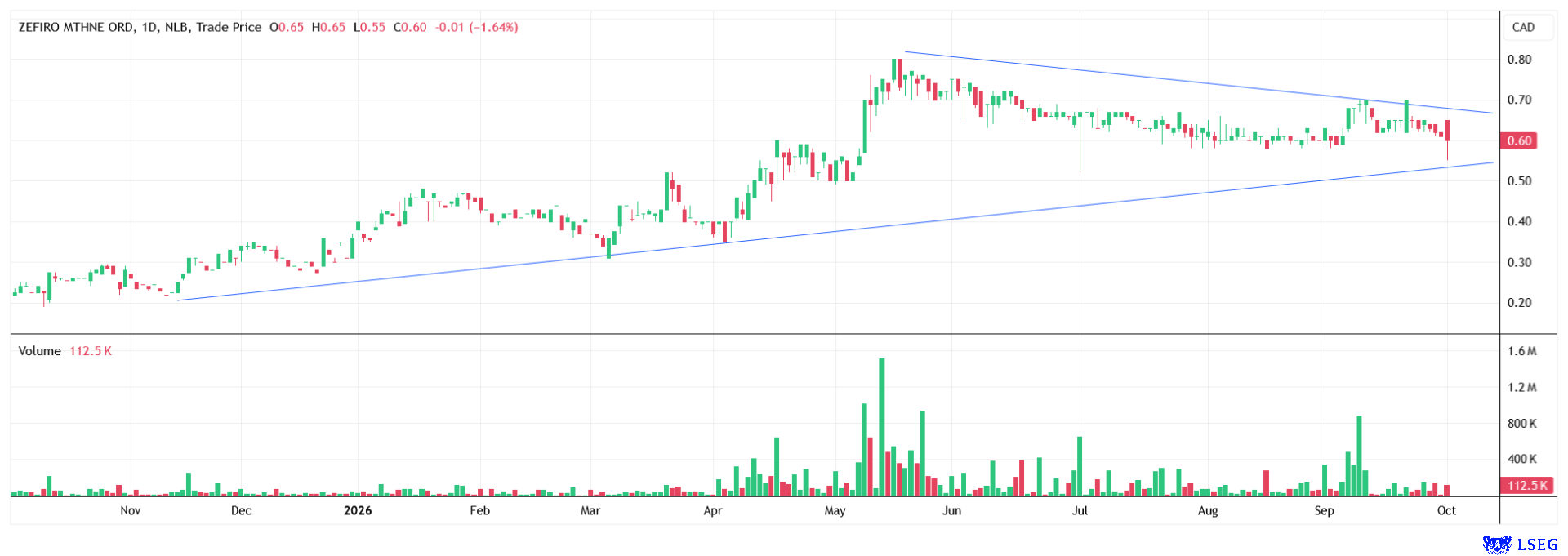
From a technical analysis perspective, Zefiro Methane’s stock is trading around CAD 0.60 within an intact wedge formation. Most recently, the price tested the multi-month uptrend line at its lower boundary and found support there. A swift breakout above CAD 0.70 could pave the way toward CAD 0.80, and if it clears this hurdle, it could generate a new annual high with a price target of CAD 1.00.
BASF stands out as a high-dividend value stock that offers price potential to patient investors during a cyclical recovery. Bayer remains a speculative turnaround opportunity, whose success depends largely on the gradual resolution of US legal risks. Zefiro Methane presents itself as a specialist in the environmental sector with strong operational growth. With full order books and an interesting chart pattern, it has good prospects for the next price surge.
Conflict of interest
Pursuant to §85 of the German Securities Trading Act (WpHG), we point out that Apaton Finance GmbH as well as partners, authors or employees of Apaton Finance GmbH (hereinafter referred to as “Relevant Persons”) may hold shares or other financial instruments of the aforementioned companies in the future or may bet on rising or falling prices and thus a conflict of interest may arise in the future. The Relevant Persons reserve the right to buy or sell shares or other financial instruments of the Company at any time (hereinafter each a “Transaction”). Transactions may, under certain circumstances, influence the respective price of the shares or other financial instruments of the Company.
In addition, Apaton Finance GmbH is active in the context of the preparation and publication of the reporting in paid contractual relationships.
For this reason, there is a concrete conflict of interest.
The above information on existing conflicts of interest applies to all types and forms of publication used by Apaton Finance GmbH for publications on companies.
Risk notice
Apaton Finance GmbH offers editors, agencies and companies the opportunity to publish commentaries, interviews, summaries, news and the like on news.financial. These contents are exclusively for the information of the readers and do not represent any call to action or recommendations, neither explicitly nor implicitly they are to be understood as an assurance of possible price developments. The contents do not replace individual expert investment advice and do not constitute an offer to sell the discussed share(s) or other financial instruments, nor an invitation to buy or sell such.
The content is expressly not a financial analysis, but a journalistic or advertising text. Readers or users who make investment decisions or carry out transactions on the basis of the information provided here do so entirely at their own risk. No contractual relationship is established between Apaton Finance GmbH and its readers or the users of its offers, as our information only refers to the company and not to the investment decision of the reader or user.
The acquisition of financial instruments involves high risks, which can lead to the total loss of the invested capital. The information published by Apaton Finance GmbH and its authors is based on careful research. Nevertheless, no liability is assumed for financial losses or a content-related guarantee for the topicality, correctness, appropriateness and completeness of the content provided here. Please also note our Terms of use.
Stockhouse does not provide investment advice or recommendations. All investment decisions should be made based on your own research and consultation with a registered investment professional. The issuer is solely responsible for the accuracy of the information contained herein. For full disclaimer information, please click here.