


Rock Tech Lithium: New Momentum in Ontario Broadens the Base for Future Growth
After years of preparation, Rock Tech Lithium is now igniting the next stage. The raw materials company focused on lithium deposits in Canada pursues an integrated business model along the entire value chain, positioning itself as a potential beneficiary of Western resource sovereignty. With Georgia Lake in Ontario, the Canada-based company with German roots is developing its own lithium source and combining it with planned converter sites in Guben and Red Rock to supply battery manufacturers directly with battery-grade lithium hydroxide in the future. Particularly in Europe and North America, political pressure is growing to secure critical raw materials independently of Chinese processing structures. Against this backdrop, the most recent acquisition option for the Victory Project gains significant importance. The 9,875-hectare site expands the resource base in Ontario and shows surface samples of up to 5.11 per cent Li₂O. The proximity to the Trans-Canada Highway, rail connections and energy infrastructure could significantly reduce future development and transport costs, lending the project additional strategic appeal. This article is disseminated in partnership with Apaton Finance GmbH. It is intended to inform investors and should not be taken as a recommendation or financial advice. The most recent optimisation advances at the Georgia Lake project are also noteworthy. New ore sorting processes enabled the removal of approximately 25 to 45 per cent of waste rock ahead of the actual processing stage in pilot trials. At the same time, ore grade was improved by a factor of 1.4 to 1.8. Even more significant from an investor perspective is the prospect of reducing capital costs for crushing and processing facilities by up to 50 per cent. The pre-feasibility study published in 2022 had already identified an after-tax NPV of USD 146 million and an attractive after-tax IRR of 35.6 per cent for Georgia Lake. The plan at that time was based on annual production of approximately 100,000 tonnes of spodumene concentrate with a nine-year mine life. Should the current efficiency improvements be confirmed in future studies, the project economics could improve significantly once again. Progress on the converter strategy is clearly evident. The Guben facility has been officially designated as a strategic project by the European Union and is set to deliver lithium hydroxide for batteries in approximately 500,000 electric vehicles annually. Complementing this, the Red Rock site is being developed as a second converter location in North America with a planned capacity of up to 32,000 tonnes of lithium chemicals per year. The cooperation with Siemens brings not only industrial expertise and automation technology, but also enhances the credibility of the overall project with potential capital providers. In addition, an infrastructure model is being discussed for Red Rock under which external investors could take on a large portion of the project financing. This would limit dilution for existing shareholders while simultaneously opening up new revenue streams via management and licensing fees. IIF moderator Lyndsay Malchuk interviewed Dirk Harbecke, Chairman of the Board of Directors, about his projects. https://youtu.be/4bWMsEsxK9s An Xetra listing now also improves the tradeability of the share in German-speaking markets, while the preparation of a Nasdaq listing could open access to North American investors. Against the backdrop of recovering demand for battery raw materials and the continued electrification of the transport sector, Rock Tech is increasingly emerging as a strategic infrastructure play within the lithium sector. Following the most recent advances at the Red Rock project, First Berlin has raised its price target from CAD 2.40 to CAD 3.90 and confirmed its Buy recommendation. The key drivers were in particular the strategic partnership with Siemens and the planned participation of infrastructure investor BMI, which could provide up to CAD 200 million for the development of the Canadian converter. Analysts now expect both the fully permitted converter in Guben and Red Rock to commence production in late 2028. That would be a move to shake the RCK share out of its long slumber.BYD: Success in the EU Stutters Noticeably
At BYD, the question of scarce raw materials and vulnerable supply chains has so far played little role, as its China base gives the company clear advantages in this regard. Nevertheless, hopes for a sustained turnaround in the widely watched BYD share have largely evaporated once again. Following a sharp correction last year, the share had initially stabilised around the EUR 10 level and had even received tailwinds from geopolitical tensions at times, as higher petrol and diesel prices could further support demand for electric vehicles. This recovery to just below EUR 12 has since been fully reversed and the share has come under significant pressure again. Prices of around EUR 8.60 on the previous day mark a new two-year low. The main culprits are the familiar headwinds: oversupply in the Chinese market, intensifying price competition and concerns about further margin erosion. In Europe, the market ramp-up is proceeding according to plan for now. Competing with heavy discounts and a new production facility in Hungary, the company is trying to gain a foothold in Europe; the 2 per cent registration threshold was crossed in Q1 2026. Quite something! With a 2026 P/E of 11.1, BYD is as cheap as it has not been for years. 25 analysts on the LSEG platform recommend the share as a “Buy”, with the consensus price target currently standing at over EUR 12 — representing a full 40 per cent upside potential. Given technical support levels from 2023, accumulating in the corridor between EUR 8.40 and EUR 9.20 could prove rewarding over the long term.Volkswagen and BMW Under Pressure: Between Margin and Transformation
The German automotive industry is facing one of its greatest tests in decades. Rising trade barriers, geopolitical tensions, intense price competition in China and billion-euro investments in electric mobility and software are forcing manufacturers to fundamentally restructure their cost bases. This is currently evident at Volkswagen and BMW, which — despite different starting positions — are seeking similar answers to the changed market conditions. Both groups are pursuing a radical cure, meaning efficiency programmes, lay-offs, capacity adjustments and productivity improvements to safeguard their competitiveness in the long term. At Volkswagen, CEO Oliver Blume recently defended the restructuring course at the AGM with unusually clear words. The Wolfsburg-based group plans to cut around 50,000 jobs across the group by the end of the decade, with 35,000 at the Volkswagen core brand alone. Around 28,000 voluntary departures have already been agreed. In parallel, production capacities in Europe are set to fall by several hundred thousand vehicles, while the China business is also being put to the test. The measures are part of a comprehensive programme aimed at raising the operating margin to between 8 and 10 per cent in the long term. At German sites, factory operating costs were already cut by more than 20 per cent in the previous year (2025). BMW also finds itself confronted with a more challenging market environment. After development in the important Chinese market fell short of expectations, the Munich-based premium manufacturer had to adjust its profit forecast and simultaneously announced an acceleration of ongoing efficiency measures. The new CEO Milan Nedeljkovic is pressing for faster decision-making and stricter cost control. Specific personnel reduction figures have not yet been announced, although BMW had already indicated a workforce reduction of up to 5 per cent. Based on the approximately 150,000 employees, this would arithmetically equate to a potential of up to 7,500 positions. A tough ride, because on the one hand both manufacturers possess strong brand portfolios, global distribution networks and considerable financial strength. Volkswagen additionally attracts with a dividend yield of around 6 per cent, while BMW has traditionally been one of the most profitable premium manufacturers in the industry. On the other hand, competitive pressure is intensifying in particular from Chinese manufacturers, which are gaining market share with modern plants, high vertical integration and aggressive pricing. Analysts on the LSEG platform are sceptical in their commentary but optimistic about the 12-month price targets. These stand at EUR 111.50 for Volkswagen preference shares at current prices of around EUR 79, and EUR 79.50 for BMW at a current price of EUR 59.20. That’s only for the brave!
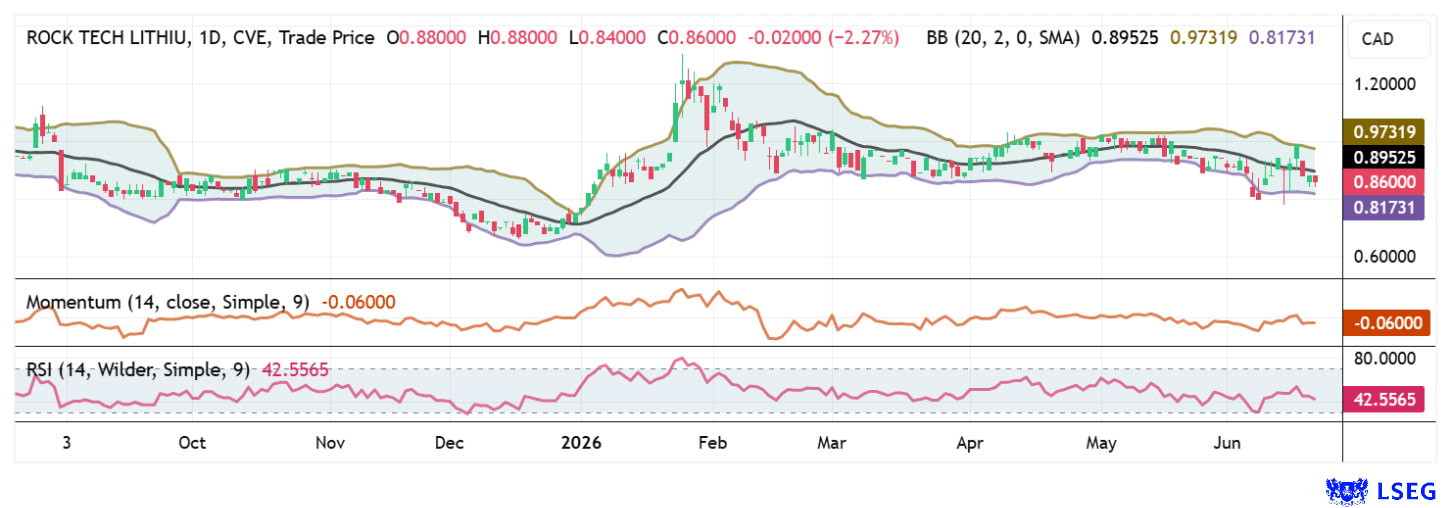
Whoever thinks about future mobility inevitably faces the question of electricity and infrastructure. Automotive manufacturers are now delivering what political majorities decided upon some years ago — meaning the phase-out of combustion engines and the push towards electric mobility. For investors, the automotive giants are back in focus, accompanied by raw materials stocks that draw their appeal from electrification and digitalisation. Rock Tech Lithium has made significant progress in project development in recent years and will soon emerge as a lithium supplier into the North Atlantic production chain for battery products.
Conflict of interest
Pursuant to §85 of the German Securities Trading Act (WpHG), we point out that Apaton Finance GmbH as well as partners, authors or employees of Apaton Finance GmbH (hereinafter referred to as “Relevant Persons”) currently hold or hold shares or other financial instruments of the aforementioned companies and speculate on their price developments. In this respect, they intend to sell or acquire shares or other financial instruments of the companies (hereinafter each referred to as a “Transaction”). Transactions may thereby influence the respective price of the shares or other financial instruments of the Company. In this respect, there is a concrete conflict of interest in the reporting on the companies. In addition, Apaton Finance GmbH is active in the context of the preparation and publication of the reporting in paid contractual relationships. For this reason, there is also a concrete conflict of interest. The above information on existing conflicts of interest applies to all types and forms of publication used by Apaton Finance GmbH for publications on companies.Risk notice
Apaton Finance GmbH offers editors, agencies and companies the opportunity to publish commentaries, interviews, summaries, news and the like on news.financial. These contents are exclusively for the information of the readers and do not represent any call to action or recommendations, neither explicitly nor implicitly they are to be understood as an assurance of possible price developments. The contents do not replace individual expert investment advice and do not constitute an offer to sell the discussed share(s) or other financial instruments, nor an invitation to buy or sell such. The content is expressly not a financial analysis, but a journalistic or advertising text. Readers or users who make investment decisions or carry out transactions on the basis of the information provided here do so entirely at their own risk. No contractual relationship is established between Apaton Finance GmbH and its readers or the users of its offers, as our information only refers to the company and not to the investment decision of the reader or user. The acquisition of financial instruments involves high risks, which can lead to the total loss of the invested capital. The information published by Apaton Finance GmbH and its authors is based on careful research. Nevertheless, no liability is assumed for financial losses or a content-related guarantee for the topicality, correctness, appropriateness and completeness of the content provided here. Please also note our Terms of use.Stockhouse does not provide investment advice or recommendations. All investment decisions should be made based on your own research and consultation with a registered investment professional. The issuer is solely responsible for the accuracy of the information contained herein. For full disclaimer information, please click here.