

While mining is an essential industry, supplying us with the basic materials that make up the products and services at the heart of our everyday lives, from lithium in electric vehicle batteries, to gold in our jewelry, to copper cables enabling the Internet, to nickel for the steel support structures in our homes, investing in it is a tricky endeavor.
This is because merely identifying economical minerals in the ground requires strong market demand, millions of dollars in exploration capital and a leadership team experienced enough to raise the capital and recognize the presence of a deposit, a combination that is awfully hard to come by, with the Ontario Mining Association noting that only about 1 in 1,000 mining projects ends up hosting a deposit worth developing, while less than 1 in 10,000 goes on to become a mine.
This article is disseminated in partnership with Globex Mining Enterprises Inc. It is intended to inform investors and should not be taken as a recommendation or financial advice.
Unsurprisingly, as laid out in an explainer from Investopedia, the potential returns when these elements align are often exponential, reflecting the elevated risks an individual investor must face by allocating into the mining space. These include:
- Overconcentration, allocating into too few projects, without adequate exposure across the mining lifecycle, such that the mining sleeve of your portfolio suffers from excessive volatility.
- Stunted development because leadership proved unable to raise sufficient capital.
- Stunted development because a company took on a project with limited upside.
- Commodity demand fading as the macroeconomic winds change direction and nudge a different metal or mineral into the spotlight.
To overcome these barriers to entry, retail investors must then increase the expertise in their corner, either by brushing up on geology in their spare time – which is an acquired taste to say the least – or by recruiting proven mining and finance professionals to invest on their behalf, whose process ideally minimizes sector risk, maximizes long-term returns and sidesteps the steep fees associated with actively managed funds.
Globex Mining: A veritable mineral property bank
Investors interested in a project acquirer, explorer, optionor and developer with a multi-decade track record of value creation in the mining space should take a closer look at Globex Mining (TSX:GMX), market cap C$111.74 million, whose stock has gained more than 380 per cent since 2016, more than double the TSX Index’s effort over the period, reflecting the diligent development of its mineral asset portfolio into one of the largest and most diversified in North America.
From the broadest perspective, Globex’s portfolio spans mining-friendly jurisdictions with low political risk, including Canada, the US states of Nevada, Arizona and Washington, as well as Saxony, Germany.
Zooming in a little closer, we find that the company’s interests reside along some of North America’s most prolific mineralized structures, including a strong presence in the Abitibi Greenstone Belt, lending themselves to high-conviction expansion and upgrading through exploration and data re-interpretation.

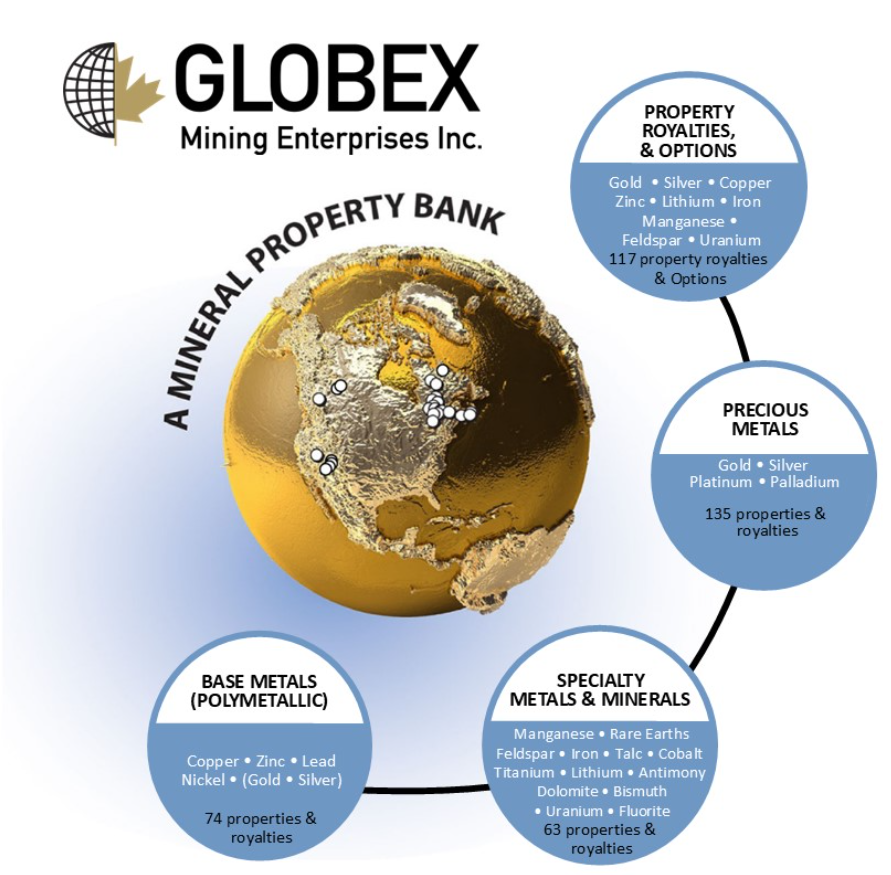
Stepping in closer still, Globex’s consistently robust growth trajectory comes into view, building its properties, royalties and options from 49 in 2005, to 146 in 2016, to 272 in 2026, all while fostering prudent diversification across commodities, ownership structures and the mining lifecycle. Here’s a breakdown:
- As far as commodities go, about 135 mineral assets are prospective for precious metals, with 137 falling under the base metals, specialty metals and industrial minerals categories, extending across the global industrial complex from construction materials to clean energy to minerals such as copper, platinum and rare earth elements powering the AI revolution.
- In terms of ownership, more than 155 projects are wholly owned, more than 105 are under royalty agreements and more than 11 are optioned to strategic partners, including high-profile operators such as Agnico Eagle Mines (TSX:AEM), IAMGOLD (TSX:IMG) and Elevra Lithium (NASDAQ:ELVR).
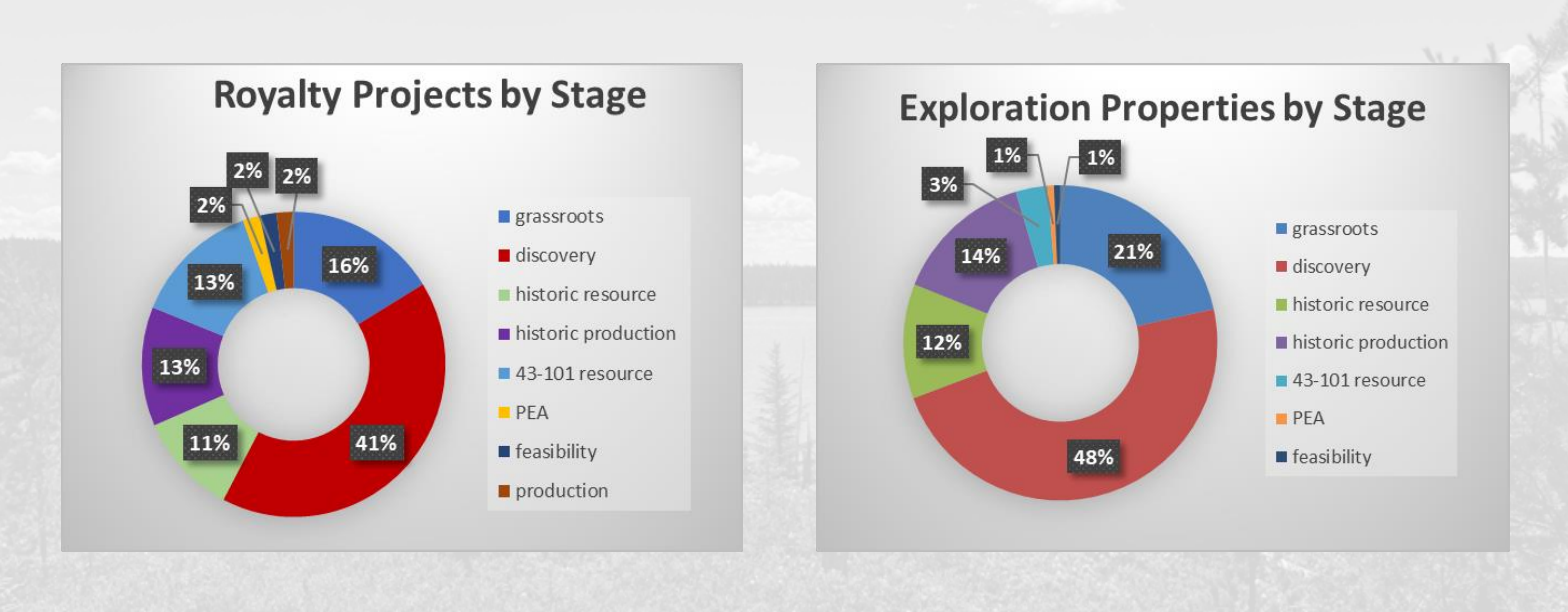
- In terms of development stage, the portfolio is no stranger to established mining camps, counting 43 past-producing projects, more than 86 hosting either historic or NI 43-101 resources, plus a single-digit percentage at the preliminary economic assessment stage or higher, as demonstrated in the chart below:

When we get even more granular, leadership’s eye for quality becomes readily apparent, as highlighted by how virtually all projects in Globex’s portfolio host either reserves or resources, mineralized drill intersections, mineral showings, and/or geophysical targets worth a follow-up exploration program.
It’s this high quality that has allowed the company, under the control of Chief Executive Officer, Jack Stoch, since 1983, to grow with minimal shareholder dilution, favoring options and royalties, fostering a healthy cash balance to take advantage of market opportunities from a position of strength.
As of March 31, the company held nearly C$40 million in cash and marketable securities in its coffers, sporting a tight 57.01 million shares outstanding with no warrants or debt, granting it the ability to continue decreasing investor risk, while front-running commodity prices, through strategic development and diversification.
Among the approximately 300,000 metres of drilling planned across Globex’s portfolio, spanning the gamut from mapping and prospecting, to maiden resource estimates, to economic studies, let’s shed some light on the most recent developments to better understand why the company should be considered a trusted name for investors seeking high-conviction mining exposure.
The Berrigan mine property
Globex Mining holds a 2 per cent gross metals royalty on the Berrigan mine in Quebec, a 483-hectare property hosting a historical resource of 1.39 million tons at 1.77 grams per ton (g/t) gold and 3.17 per cent zinc, supported by more than 41,000 metres of historical drilling dating back to 1950 yielding thick zinc, gold and silver mineralization suggesting the presence of a larger deposit.
The property, under option to TomaGold (TSXV:LOT) from Chibougamau Independent Mines, was the site of a recently finalized drilling program that confirmed and expanded historical mineralization. Here’s a breakdown:
- Phase 1 drilling delivered highlights of 5.08 per cent zinc equivalent (ZnEq) (1.19 g/t gold equivalent (AuEq) over 98.5 m, including 23.20 per cent ZnEq over 4.90 m) from the new lower zone; 13.68 ZnEq (3.17 g/t AuEq) over 1.4 m in the new lower zone; and 24.85 per cent ZnEq (5.83 AuEq) over 2.1 m in the Berrigan zone.
- Phase 2 drilling targeted the extension of 5 drillholes (TOM-25-009 to TOM 25-013) previously examined only for shallow mineralization, with assays pending and visual observations in the drill core described as “extremely encouraging” in TomaGold’s May 28th news release.
TomaGold intends to build upon these strong intercepts with a large-scale prospecting and exploration campaign across all of its options acquired from Globex, SOQUEM and Chibougamau Independent Mines, keen to evaluate numerous high-priority historical mineralized showings yet to be systematically followed up on. Upcoming catalysts for positive news flow under the campaign include:
- A borehole electromagnetic (BHEM) survey to detect off-hole conductors and map the continuity of mineralized zones at depth.
- A surface geophysical (UTEM) survey over a robustly mineralized 4 km by 2 km corridor in search of regional conductors and to home in on high-priority drill targets.
- An audio-frequency magnetotelluric (AMT) geophysical program to map deep resistivity contrasts, better define structural architecture and potentially uncover regional mineralized systems.
The UTEM and AMT surveys are of particular importance, given their ability to illuminate depths of up to 2 km, granting TomaGold the first glimpse into the land package’s clear potential to host massive sulphide lenses and major structural corridors and reinforce its burgeoning mining camp in the heart of the Chibougamau District.
The Carp property
In 2024, Globex staked the 117.06-hectare Carp fluorspar project in Lincoln County, Nevada, all of it located on road-accessible Bureau of Land Management land, soon engaging in surface mapping and prospecting that outlined several fluorspar occurrences and sampling that returned numerous high-grade assays. Here are the highlights:
- 14 of 25 samples captured very high fluorite grades from 49.83-88.15 per cent calcium fluoride (CaF2), with three grading between 22.81-32.67 per cent CaF2, which is comfortably above metallurgical-grade (metspar) thresholds for steelmaking and nearly reaches acidspar feedstock quality deployable in lithium-ion battery production.
- Anomalous gold evident in several samples.
- A sample of float, likely stemming from a sub-vertical mineralized carbonate replacement body, assaying 151.5 parts per million silver, 0.28 per cent copper, 2.79 per cent lead and 8.64 per cent zinc.
Globex’s results confirmed fluorite discoveries on the property dating back to 1957, spanning 62 drillholes totaling 2,182 m, including substantial manto-style mineralization ranging from 10-54.8 per cent CaF2. These discoveries were later monetized through production at four small open pits from 1958-1971 generating 44,900 tons grading 69 per cent CaF2.
In May 2026, the company proceeded to option Carp to Evion Group (ASX:EVG), who has the right to pay US$1.645 million in cash, US$2 million in Evion shares and complete US$3.75 million in work expenditures over four years to earn a 100-per-cent interest in the property, with Globex set to retain a 3 per cent gross metals royalty with no buy down.

As part of its due diligence, Evion recently confirmed Globex’s sampling work across multiple pit areas and mineralization styles, underlining the project’s district-scale prospectivity, going so far as to acquire 45 adjoining claims to maximize the potential of the exceptional assays on the books thus far. Under the option agreement, any mineral rights acquired within 10 miles of the original claim group are subject to the agreement.
Carp’s abundance of avenues to harvest exploration upside make it a high-conviction candidate to capitalize on fluorspar’s broad use-cases, such as the production of aluminum, steel, glass, ceramics and uranium fuel, the manufacturing of refrigerants and insulating foams, as well as the production of cathode, electrolyte and anode materials for lithium-ion batteries.
Demand for the mineral is especially pronounced in the United States, where it’s classified as critical due to lack of meaningful production, forcing the country to rely on imports from Mexico and China, with the latter’s status as the world’s leading producer and its propensity for export restrictions putting any nations that source from it at increased risk.
Evion is putting together a new exploration program at Carp incorporating surface sampling, geological mapping and drill targeting to better delineate project value for the market.
The Ramp/Maude Lake property
Last month, Globex Mining also signed an option agreement with 1001565486 Ontario Inc. on its 100-per-cent-owned Ramp/Maude Lake property in Ontario, who has the right to pay C$4.7 million in cash, C$1.05 million in Ontario Inc. shares and execute C$6 million in exploration work over four years to earn a 100 per cent interest in the property. Once the option agreement ends, Globex will retain a 3 per cent gross metals royalty with a 2 per cent buy-down priced at C$1.5 million.
The optionor’s interest in the land package becomes clear when we highlight the 1,792-hectare Ramp property’s known gold deposit enhanced by road and highway access, a lack of modern exploration work, and a strategic location in the Larder Lake Mining District, which has produced more than 13 million ounces of gold to date.
Ramp is complemented by multiple historical resources drawing on about C$11 million in exploration expenditures, including more than 49,000 m of drilling, dating back to the 1980s. These include:
- 175,000 tons grading 0.184 ounces per ton (oz/t) gold to the 140-m level at the Number 5 zone by Equinox Resources in 1987.
- 793,474 tons grading 0.235 oz/t gold (191,284 ounces of gold) to the 220-m level by Maude Lake Gold Mines in 1994.
- 270,000 tons at 3.5 g/t gold (41,000 ounces of gold) based on 4 new drillholes and newly compiled historical drilling by RJK Explorations in 2016-17, with no work completed on the property after this time.
Carp, Berrigan and Ramp/Maude Lake, each under active exploration, offer only a glimpse into a growing portfolio whose diversification, low risk and upside potential makes it one of the most important drivers shaping the future of North American mining today.
That being said, achieving and building upon such a differentiated industry position would not be possible without executives at the helm, whose eye for mineral value has been honed across the full market cycle.
A comprehensive leadership team
Highly aligned with shareholders at 14.04 per cent insider ownership, Globex’s leadership team, composed of seasoned geologists, mining executives and institutional investors, combines into an affective antidote for investor fears about the complex nature of transforming exploration upside into shareholder value. Let’s meet key members now:
- Jack Stoch, Director, Executive Chairman and CEO, is a geologist who has been acquiring and developing mineral properties for more than 50 years. He was once the largest private mineral rights holder in Quebec.
- David Christie, President and Chief Operating Officer, is a geologist who brings almost 40 years of exploration and mining experience, including as a former Equity Analyst at TD and Scotiabank, and as the former CEO of Orford Mining and Eagle Hill Exploration.
- Ian Atkinson, Director, served as a Director of Kinross Gold (TSX:K) until 2024 and as President of Centerra Gold (TSX:CG) until 2015, following senior executive tenures at Hecla Mining, Battle Mountain Gold, Hemlo Gold Mines and Noranda Group.
- Dianne Stoch, Director, is a former Senior Analyst and Revenue Planner at Noranda Mines, having served a more than 18-year tenure with the company.
- Johannes H.C. Van Hoof, Outside Director, is a former Chairman & Senior Executive Officer at Soros Funds and has held numerous senior positions at European financial institutions, including PVF Pension Funds, Paribas Capital Markets and Bankers Trust, spanning portfolio management, risk management, derivatives and M&A.
- Chris Bryan, Outside Director, is a retired geologist who previously served as President of CBIM, a private OSC-registered investment counsel, President of Ophir Capital, an investment management company, and as a Mining Analyst at Lévesque Beaubien, Nesbitt Thompson and the Caisse de Dépôt et Placement du Québec.
With experience covering everything from acquisition project due diligence, to capital raising, to exploration, development and production, it’s no wonder the Globex Mining team has been able to usher the company across a prolific growth trajectory for more than 40 years, while positioning it to keep momentum going well into the future.
Any reasonable investor should then be asking themselves about what the future may have in store for the company as it continues expanding and enhancing value creation across its portfolio.
A de-risked investment in industrial evolution
Globex’s broad exposure to precious metals and critical minerals, each chosen for its potential to contribute to the global supply chain, makes the company an ideal vehicle for exposure to the industrial trends of today – AI, clean energy, digitization – as well as those of tomorrow, whatever they happen to be, as leadership actively manages the portfolio – without charging a management expense ratio – towards commodities with the most prospective value propositions.
This rotation towards the highest-conviction opportunities, having delivered alpha over the past decade, cuts right through the risks we discussed at the beginning of this article, offering investors with dry powder long-term proof that the company knows how to pick projects worth exploring, raise the capital to study them and shift its focus to align with commodity tailwinds as they arise.
Given Globex’s generational success, it is both a testament to its process and a free lunch for those with room in their mining allocations that the company has only 57 million shares outstanding. This leaves plenty of leverage for an investment today to compound into a future that will doubtlessly rely on metals and minerals to keep life in motion.
Join the discussion: Find out what investors are saying about this micro-cap mining stock on the Globex Mining Enterprises Inc. Bullboard and make sure to explore the rest of Stockhouse’s stock forums and message boards.