


Gold Above USD 5,000: Why Capital Flows Are Returning to the Exploration Sector
The gold market is clearly in a revaluation phase in 2026. Since the start of the year, the precious metal has gained around 30% at times, while many investment firms expect price targets of only between USD 4,400 and USD 6,300 per ounce by the end of 2026. At the same time, pressure is mounting on major producers to replace their reserves: the average lifespan of many mines has declined significantly in recent years. Accordingly, consolidation momentum is increasing, as evidenced by multi-billion-dollar transactions in the West African sector, where the Chinese major Zijin Mining recently acquired the Canadian company Allied Gold Corp for CAD 5.5 billion. For smaller developers with approved projects, existing resources, and near-term production prospects, this creates an environment in which deposits developed over many years can quickly attain strategic value.
440 km² in the Tier-1 SMSZ Corridor: Resource Base with Scaling Potential
The SMSZ (Senegal-Mali Shear Zone) project covers approximately 440 km² in one of West Africa’s most productive gold regions. Currently, the project hosts a resource of approximately 1.1 to 1.3 million ounces of gold with average grades of 1.1 to 1.2 g/t. The structure of the deposit is particularly relevant: it consists predominantly of near-surface oxide mineralization, which typically enables lower mining costs via heap leaching. Of more than 30 identified gold zones, only 5 zones have been incorporated into the resource estimate to date. In purely mathematical terms, this means that currently less than 20% of the geological potential has been economically modeled. At the same time, only about 10% of the total area has been systematically explored to date, a key lever for future growth. CEO Jared Scharf speaks of “hidden values in the ground.”
Production Start in 2026: From Development Project to Cash Flow Generator
The operational goal for 2026 is clearly defined: commencement of gold production. In the first phase, the plant is expected to process around 200 tons of material per day. Scaling up to approximately 1,200 tons per day is planned by the fourth quarter—a sixfold increase within a few months. In parallel, a modular processing plant is being built with an initial capacity of around 10 tons of ore per hour, which can be expanded fivefold in the future. This phased expansion reduces capital requirements and enables rapid generation of operating revenue. From a financial strategy perspective, this is a crucial difference from traditional large-scale projects, which often require several hundred million USD in upfront investment before the first ounce is produced. Desert Gold expects to generate its first revenue from gold sales as early as 2026.
Robust profitability: 57% IRR and cash flow potential exceeding USD 150 million
The current economic analysis shows exceptionally high profitability. At a gold price of around USD 3,000 per ounce, this results in an internal rate of return (IRR) of approximately 57% and a net present value (NPV, 10%) of over USD 61 million after taxes. If the gold price rises to the USD 5,000 per ounce range, the project value increases to well over USD 100 million, according to the sensitivity analysis. At the same time, operating costs are estimated at around USD 1,110 per ounce. This results in a potential operating margin of more than 60% based on conservative price assumptions. Over its modeled life, the project could generate a cumulative free cash flow of approximately USD 155.9 million—a multiple of the current market valuation.
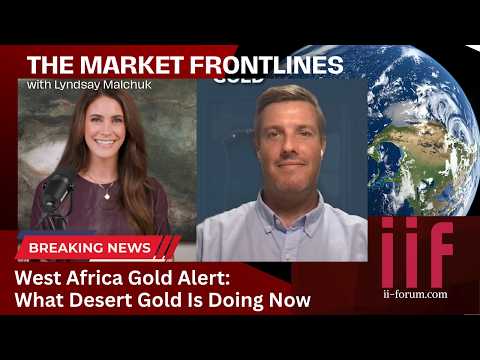
IIF host Lyndsay Malchuk in conversation with CEO Jared Scharf about the outlook for the current projects in West Africa.
Second Growth Option: 297 km² Exploration Area in Côte d’Ivoire
But that is not all! With the Tiegba Gold project, the company expanded its regional presence in 2025 with an additional exploration platform. The concession area covers approximately 297 km², of which less than 20% has been explored in detail to date. Historical soil samples identified a gold anomaly approximately 4.2 km long and 2.1 km wide with grades ranging from 50 to over 200 ppb gold. This scale suggests a large-scale mineralized system that could deliver standalone resources in the long term. From a strategic perspective, Tiegba thus serves as an optional growth engine, while the main project already forms the economic foundation.

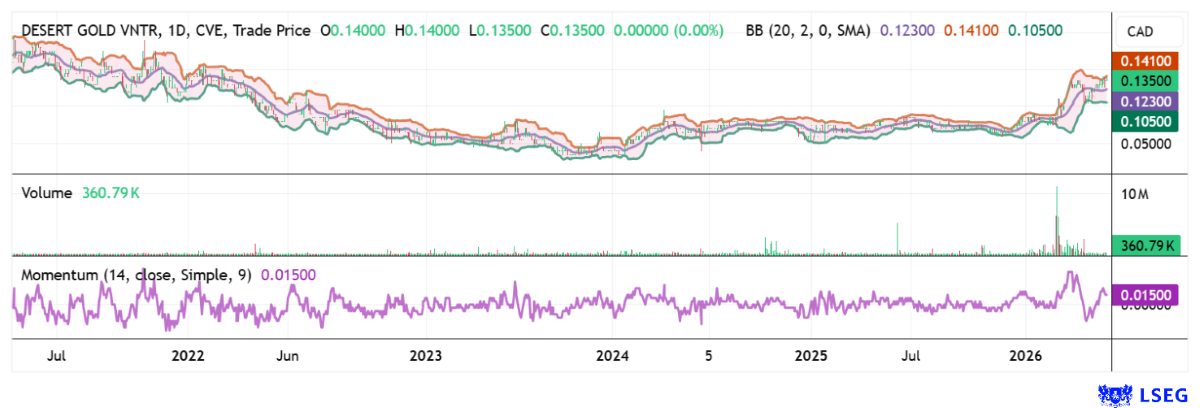
Conclusion: For a Market Capitalization of USD 33 Million, Investors Gain Exposure to a Project Valued at Over USD 100 Million
Despite clear operational progress, the company’s market valuation, based on approximately 360 million outstanding shares, currently stands at only around USD 33 million. At the same time, the economic feasibility analysis points to a project value of more than USD 60 million. Based on current gold price assumptions, this figure could exceed USD 100 million. Research firm GBC has set a price target of approximately CAD 0.93, implying significant upside from current levels. Such discrepancies between market capitalization and project value are not uncommon for companies in the transition phase from explorer to producer. Historically, the strongest price movements often occur precisely during this phase, especially as key milestones, such as the commencement of production, are reached. Upcoming operational developments and news flow could therefore play a decisive role in how the market reassesses the company.
Conflict of interest
Pursuant to §85 of the German Securities Trading Act (WpHG), we point out that Apaton Finance GmbH as well as partners, authors or employees of Apaton Finance GmbH (hereinafter referred to as “Relevant Persons”) currently hold or hold shares or other financial instruments of the aforementioned companies and speculate on their price developments. In this respect, they intend to sell or acquire shares or other financial instruments of the companies (hereinafter each referred to as a “Transaction”). Transactions may thereby influence the respective price of the shares or other financial instruments of the Company.
In this respect, there is a concrete conflict of interest in the reporting on the companies.
In addition, Apaton Finance GmbH is active in the context of the preparation and publication of the reporting in paid contractual relationships.
For this reason, there is also a concrete conflict of interest.
The above information on existing conflicts of interest applies to all types and forms of publication used by Apaton Finance GmbH for publications on companies.
Risk notice
Apaton Finance GmbH offers editors, agencies and companies the opportunity to publish commentaries, interviews, summaries, news and the like on news.financial. These contents are exclusively for the information of the readers and do not represent any call to action or recommendations, neither explicitly nor implicitly they are to be understood as an assurance of possible price developments. The contents do not replace individual expert investment advice and do not constitute an offer to sell the discussed share(s) or other financial instruments, nor an invitation to buy or sell such.
The content is expressly not a financial analysis, but a journalistic or advertising text. Readers or users who make investment decisions or carry out transactions on the basis of the information provided here do so entirely at their own risk. No contractual relationship is established between Apaton Finance GmbH and its readers or the users of its offers, as our information only refers to the company and not to the investment decision of the reader or user.
The acquisition of financial instruments involves high risks, which can lead to the total loss of the invested capital. The information published by Apaton Finance GmbH and its authors is based on careful research. Nevertheless, no liability is assumed for financial losses or a content-related guarantee for the topicality, correctness, appropriateness and completeness of the content provided here. Please also note our Terms of use.
Stockhouse does not provide investment advice or recommendations. All investment decisions should be made based on your own research and consultation with a registered investment professional. The issuer is solely responsible for the accuracy of the information contained herein. For full disclaimer information, please click here.