


NEL Aims to Turn the Tide: Hedge Funds Bet on Its Decline
The Norwegian hydrogen specialist NEL is currently demonstrating just how difficult it is to transform promising technology into market-ready products that generate revenue growth. The company responded to changing market conditions by spinning off its refueling business under the name Cavendish Hydrogen as early as 2024—a move similar to the one Siemens Energy is currently planning for its industrial and hydrogen divisions. While NEL has since focused entirely on the manufacture of electrolysers, the business is suffering from weak order intake and a 5% decline in revenue to NOK 148 million in the first quarter of 2026. To reduce production costs, NEL entered into a licensing agreement with the Indian giant Reliance Industries, which enables the partner to mass-produce alkaline electrolysers and, in return, secures revenue for NEL from the Indian market and allows it to procure equipment for its own projects. Despite this sensible deal, NEL’s stock plummeted by more than 84% over a three-year period. Well-known hedge funds such as Parvus, Marshall Wace, Ennismore, and Qube had already established short positions in the wake of the Cavendish spin-off in 2024—a signal that institutional investors are pricing in the risk of delays in the market’s ramp-up.
Amazon: The Retail and Tech Giant Lives in a World of Its Own
Retail giant Amazon is taking a completely different approach; rather than reacting to change, it is driving it forward with its own solutions. Across more than 80 logistics centers, the company has replaced over 17,000 lead-acid batteries in its forklift fleet with fuel cells from its partner Plug Power. At the Aurora distribution center in the US state of Colorado, Amazon even installed its own on-site hydrogen production system featuring a 1 MW PEM electrolyser, which supplies fuel to up to 400 logistics vehicles daily. Since its facilities are decentralized, Amazon is able to utilize capacity peaks from its own PV systems and avoid expensive hydrogen transport by road. Starting in 2025, a supply contract for 10,950 metric tons of liquid hydrogen annually will ensure the supply for up to 30,000 forklifts or 800 long-haul trucks.
Range Without Charging Frustration: First Hydrogen Launches a Van Offensive
While industry and corporations are driving their own transformation, electric vehicles in logistics are reaching their limits when it comes to heavy payloads and tight schedules. This is exactly where First Hydrogen aims to make its mark with its hydrogen-powered fuel cell vans. The vans, which have been officially certified by the UK’s Vehicle Certification Authority, offer a range of 400 to 600 km and can be fully refueled in just a few minutes. In intensive real-world tests with fleet operator Rivus, one vehicle covered 700 miles in 47 hours of driving and, with a tank capacity of 10.3 kg of hydrogen, achieved a range of 500 km at 90% load. Analysis of real-world data from urban, suburban, and highway operations showed that even at near-maximum load, there was no significant loss of range. The trials were supplemented by tests conducted with utility companies such as Wales & West Utilities, as well as 14 other UK fleet operators in the parcel delivery, food logistics, and healthcare sectors. First Hydrogen aims to use its vans to fill the gap for operators whose daily operations do not allow for extended refueling stops or who produce hydrogen themselves.

Refueling Infrastructure as a Bottleneck and Opportunity
The biggest problem for hydrogen in commercial logistics remains the lack of a comprehensive refueling infrastructure. To solve this problem, First Hydrogen is focusing on “Hydrogen-as-a-Service”. Under this model, First Hydrogen provides the entire infrastructure for production, storage, and refueling. This all-inclusive package reduces risks and significantly simplifies the transition from diesel to hydrogen. When intelligently controlled, electrolysers can produce hydrogen precisely when solar or wind power is generating excess capacity. First Hydrogen is thus targeting the global commercial vehicle market, which, according to Allied Market Research, is expected to reach a total volume of USD 786.5 billion by 2030. By combining certified vehicle technology with a secure fuel supply, First Hydrogen is creating an ecosystem for fleet customers.
First Hydrogen in an Exciting Position
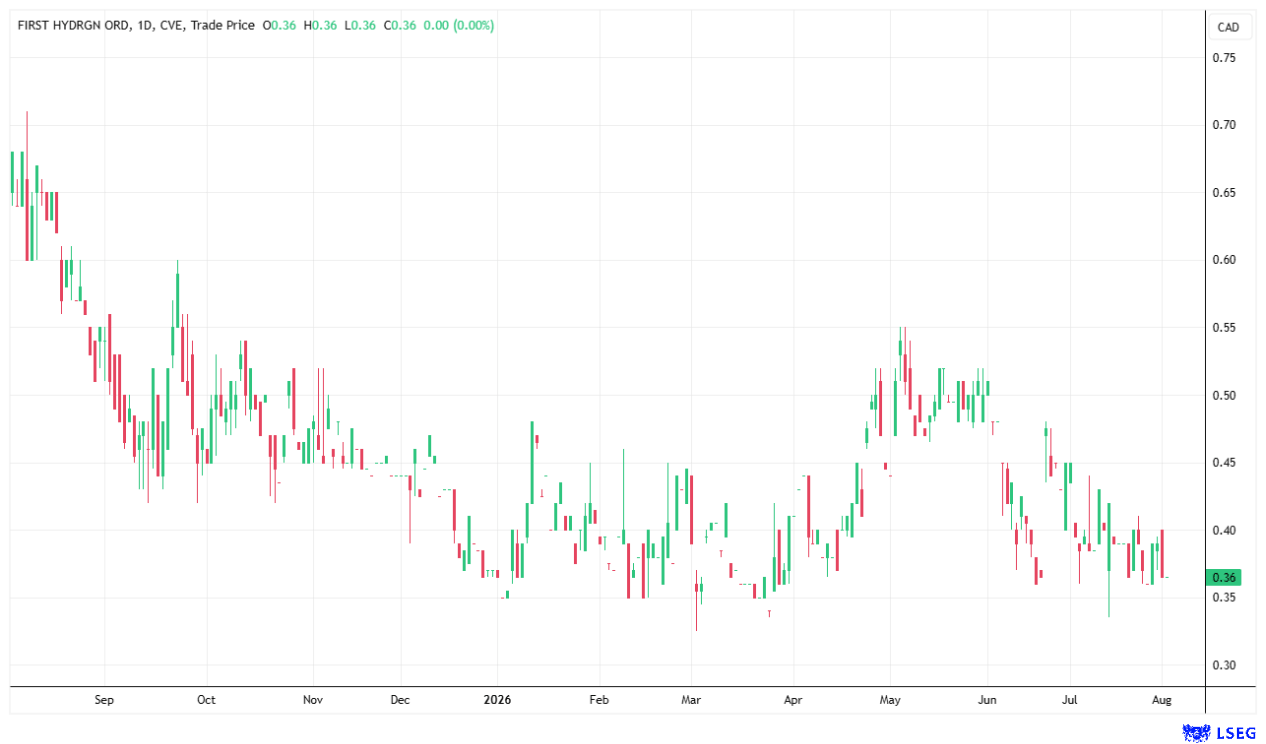
First Hydrogen’s stock has had a turbulent history and has at times traded at many times its current price. The current situation in the energy market and the growing regulatory pressure, even on small and medium-sized enterprises, could present a major opportunity for this ambitious company, which has already begun exploring future-oriented fields such as modular nuclear reactors and robotics. If First Hydrogen succeeds in establishing a sustainable market position, its stock could also become an exciting investment option.
https://www.youtube.com/embed/JIVd5kOYalI
Conflict of interest
Pursuant to §85 of the German Securities Trading Act (WpHG), we point out that Apaton Finance GmbH as well as partners, authors or employees of Apaton Finance GmbH (hereinafter referred to as “Relevant Persons”) may hold shares or other financial instruments of the aforementioned companies in the future or may bet on rising or falling prices and thus a conflict of interest may arise in the future. The Relevant Persons reserve the right to buy or sell shares or other financial instruments of the Company at any time (hereinafter each a “Transaction”). Transactions may, under certain circumstances, influence the respective price of the shares or other financial instruments of the Company.
In addition, Apaton Finance GmbH is active in the context of the preparation and publication of the reporting in paid contractual relationships.
For this reason, there is a concrete conflict of interest.
The above information on existing conflicts of interest applies to all types and forms of publication used by Apaton Finance GmbH for publications on companies.
Risk notice
Apaton Finance GmbH offers editors, agencies and companies the opportunity to publish commentaries, interviews, summaries, news and the like on news.financial. These contents are exclusively for the information of the readers and do not represent any call to action or recommendations, neither explicitly nor implicitly they are to be understood as an assurance of possible price developments. The contents do not replace individual expert investment advice and do not constitute an offer to sell the discussed share(s) or other financial instruments, nor an invitation to buy or sell such.
The content is expressly not a financial analysis, but a journalistic or advertising text. Readers or users who make investment decisions or carry out transactions on the basis of the information provided here do so entirely at their own risk. No contractual relationship is established between Apaton Finance GmbH and its readers or the users of its offers, as our information only refers to the company and not to the investment decision of the reader or user.
The acquisition of financial instruments involves high risks, which can lead to the total loss of the invested capital. The information published by Apaton Finance GmbH and its authors is based on careful research. Nevertheless, no liability is assumed for financial losses or a content-related guarantee for the topicality, correctness, appropriateness and completeness of the content provided here. Please also note our Terms of use.
Stockhouse does not provide investment advice or recommendations. All investment decisions should be made based on your own research and consultation with a registered investment professional. The issuer is solely responsible for the accuracy of the information contained herein. For full disclaimer information, please click here.