

A drop of 1,000 points in the DAX, now that is quite something. It is not surprising that some stocks are no longer stable, but it also shows the relative stability compared to larger volatility swings. Experts refer to this relative market risk as the beta factor. The lower this value, the more stable the stock. In a vulnerable environment of geopolitical upheaval, the impact of operational announcements is also noteworthy. Stellantis, for example, took a 25% hit on less-than-good news of a restructuring, while DroneShield is seeing strong gains due to a collaboration with the Australian Department of Defense. NEO Battery Materials is making steady progress in measurable and scalable ways, and capacities are now being adjusted to handle potential defense orders in the medium term. Extremely exciting!
This article is disseminated in partnership with Apaton Finance GmbH. It is intended to inform investors and should not be taken as a recommendation or financial advice.
Stellantis – A slump from another planet
Wow, a 35% crash since the beginning of the year. EU automotive giant Stellantis is facing significant financial and operational challenges in the wake of electrification. As part of its strategic realignment towards electric vehicles, write-downs of around EUR 22 billion were recorded, of which around EUR 15 billion were in North America.
The stock reacted with significant price losses, hitting a five-year low of EUR 5.74, while the dividend was suspended. In addition, the group has temporarily postponed planned investments in further battery factories in Germany and Italy. Management admitted that the pace of the transition to electric mobility had been set too high and demand had been overestimated. Pragmatic solutions are currently being sought feverishly.
The crisis is particularly evident at the Italian plant in Cassino, where production of the Alfa Romeo Giulia and Stelvio has been interrupted several times. In 2025, there were over 100 days of downtime, with output at only 19,000 vehicles. Other European locations also experienced temporary production stoppages and capacity adjustments as a result of weak demand. The postponement of planned electric successor models is placing additional strain on individual plants and making reliable capacity utilization planning more difficult. Stellantis is therefore strategically considering making greater use of the technology of its Chinese partner Leapmotor. Its electric platforms are considered cost-efficient and technologically competitive within the group. Although this step carries a high risk of creating a new dependency, integration into existing brands could significantly shorten development times and radically improve the cost base. Of course, regulatory and trade policy risks must be taken into account. Analysts seem desperate, as only 9 out of 28 dare to issue a “Buy” recommendation. The average 12-month price target is set at a low EUR 8. That is still 30% above the last traded price of around EUR 6.18. There is room for speculative hopes of a medium-term turnaround!
NEO Battery Materials – Poised for a big leap
NEO Battery Materials (TSXV:NBM). has diversified its activities and developed from a pure research company to a supplier of commercial prototypes in a remarkably short time. The company has thus completed its transition to operational value creation. Within a few months, silicon-reinforced lithium-ion cells were transferred from the material level to system integration in real-world applications.
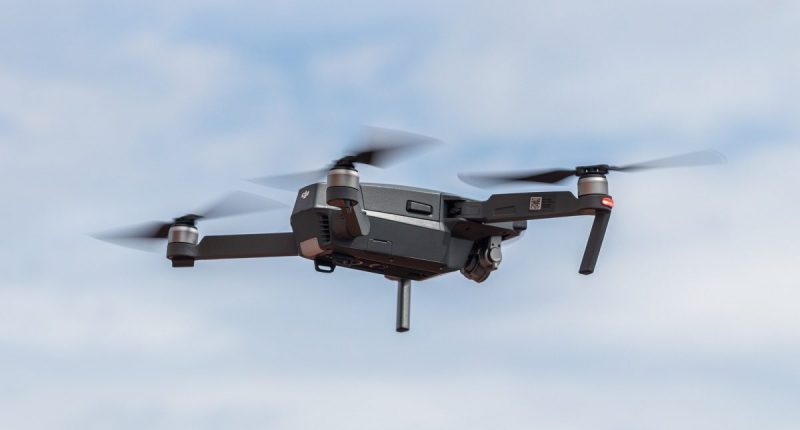
Particularly noteworthy is the first-ever external field validation, in which the performance data previously measured at the cell level was confirmed under operating conditions. Nearly doubling the flight time of a commercial drone system in winter temperatures and at operational altitude proves that the technology works not only in the lab but also in practical use. The company is thus closing a typical gap in many battery values, where scaling and system integration often lag behind laboratory results.
NEO is strategically positioning itself as a Western alternative to Chinese battery systems, thereby addressing a geopolitically sensitive market segment. The validation chain, from material development to cell and pack design to complete drone integration, creates a technological consistency that has rarely been demonstrated outside of China in this form. The combination of high energy density, fast charging capability, and adapted cell architecture enables significant performance gains that are decisive for military and industrial applications. In the defense environment in particular, a nearly 100% increase in runtime is not seen as incremental optimization, but as an expansion of operational capabilities. Against the backdrop of regulatory tightening, such as the US NDAA regime, a verifiably non-Chinese supply chain is gaining additional strategic importance.
Another milestone is the acquisition of a 3.2-acre expansion site in South Korea to scale cell production to a target capacity of 500 MWh per year. This will enable the company to create the infrastructure needed to supply tens of thousands of ISR drones or other devices per year with locally manufactured battery packs. The planned exclusive procurement of raw materials outside the People’s Republic of China explicitly addresses the requirements of Western defense procurement and significantly increases the likelihood of entry into government contract programs. At the same time, the company’s proprietary NBMSiDE® silicon anode technology is being ramped up to industrial volumes, strengthening vertical integration and securing margin potential.
Additional diversification is provided by the technology partnership with Zio Robot, which enables entry into the high-growth market of autonomous logistics robotics. The integration of high-performance cells into modular heavy-duty AMR systems expands the range of applications beyond drones to physical AI and industrial automation. For operators, this means higher payloads and longer operating times. NEO’s low valuation of around CAD 111 million by international standards currently reflects its early commercialization status rather than the potential future market volume in drone, robotics, and defense applications. However, with the current setup, the rocket should finally take off!
DroneShield – Ups and downs like a roller coaster
The shares of the Australian defense technology specialist DroneShield, which has fallen on hard times, are constantly up and down. After some turbulence caused by its own shareholders, the share price was able to turn around at the important EUR 1 mark and climbed back up to EUR 2.09 amid high volatility. As a result of new NATO decisions and growing security budgets, DroneShield was briefly one of the shooting stars in the European defense segment. Fundamentally, things are now moving in the right direction, but the previously overheated valuation is now adjusting to a more realistic level. On a positive note, DroneShield could become significantly more profitable in the future thanks to recurring software revenues and high-margin licensing models.
Some exciting news came recently: DroneShield and the Australian Department of Defense have entered into a research partnership to further develop drone defense technologies. The Defense Science and Technology Group (DSTG) will establish a formal framework for data exchange, joint testing, and mutual access to test sites. The goal is to combine scientific expertise and industrial development to combat new threats from unmanned systems more effectively. This may create the necessary confidence for a renewed upswing. With the new crisis in the Middle East, there has already been a 20% surge! Speculative & highly valued.

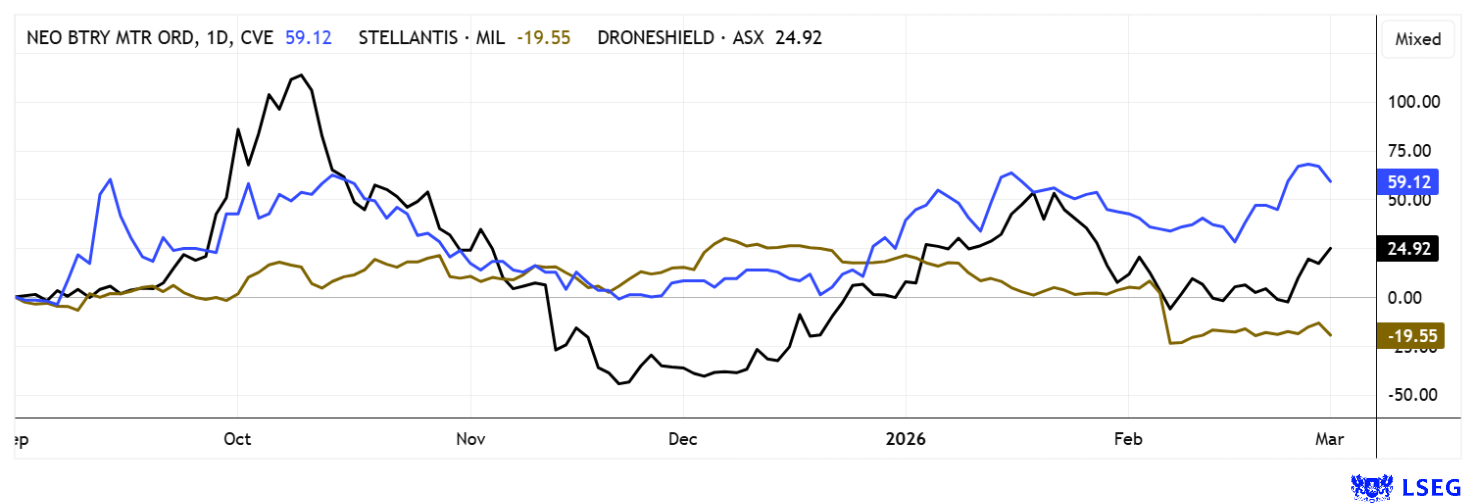
A new Middle East conflict is weighing on the markets. Yesterday, the DAX lost over 1,000 points in just six trading hours. Virtually all sectors were affected. Our selection group is currently being buoyed by NEO Battery Materials, while Stellantis and Droneshield are being sent on a roller coaster ride due to the challenging news environment. Caution at the platform edge!
Conflict of interest
Pursuant to §85 of the German Securities Trading Act (WpHG), we point out that Apaton Finance GmbH as well as partners, authors or employees of Apaton Finance GmbH (hereinafter referred to as “Relevant Persons”) currently hold or hold shares or other financial instruments of the aforementioned companies and speculate on their price developments. In this respect, they intend to sell or acquire shares or other financial instruments of the companies (hereinafter each referred to as a “Transaction”). Transactions may thereby influence the respective price of the shares or other financial instruments of the Company.
In this respect, there is a concrete conflict of interest in the reporting on the companies.
In addition, Apaton Finance GmbH is active in the context of the preparation and publication of the reporting in paid contractual relationships.
For this reason, there is also a concrete conflict of interest.
The above information on existing conflicts of interest applies to all types and forms of publication used by Apaton Finance GmbH for publications on companies.
Risk notice
Apaton Finance GmbH offers editors, agencies and companies the opportunity to publish commentaries, interviews, summaries, news and the like on news.financial. These contents are exclusively for the information of the readers and do not represent any call to action or recommendations, neither explicitly nor implicitly they are to be understood as an assurance of possible price developments. The contents do not replace individual expert investment advice and do not constitute an offer to sell the discussed share(s) or other financial instruments, nor an invitation to buy or sell such.
The content is expressly not a financial analysis, but a journalistic or advertising text. Readers or users who make investment decisions or carry out transactions on the basis of the information provided here do so entirely at their own risk. No contractual relationship is established between Apaton Finance GmbH and its readers or the users of its offers, as our information only refers to the company and not to the investment decision of the reader or user.
The acquisition of financial instruments involves high risks, which can lead to the total loss of the invested capital. The information published by Apaton Finance GmbH and its authors is based on careful research. Nevertheless, no liability is assumed for financial losses or a content-related guarantee for the topicality, correctness, appropriateness and completeness of the content provided here. Please also note our Terms of use.
Stockhouse does not provide investment advice or recommendations. All investment decisions should be made based on your own research and consultation with a registered investment professional. The issuer is solely responsible for the accuracy of the information contained herein.
For full disclaimer information, please click here.