

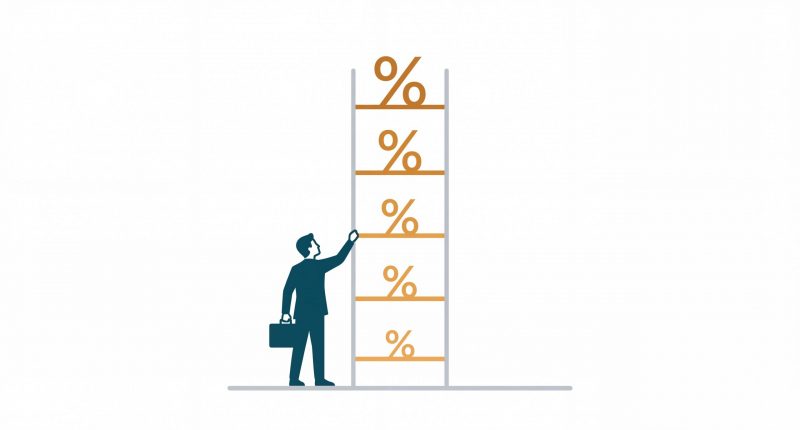
If you type ‘interest rates’ into the Google News search bar, you’ll notice how the current rising-rate environment is inspiring its fair share of dire and dreary headlines, likely leaving many investors with a sharp sense of worry, mixed with restlessness about whether or not they should be doing something to protect their stocks from big bad inflation.
This article is a journalistic opinion piece written based on independent research. It is intended to inform investors and should not be taken as a recommendation or financial advice.
The logical urge here is to shift focus from speculative growth stocks to those guided by capital preservation, free cash flow and balance sheet resilience. Whereas, if interest rates were falling, the predisposition would be to favour more volatile stocks with a higher potential for risk and reward.
Here’s the thing, though: Our psychological tendency to fluctuate between existential threat and an imminent rally, at least as far as stocks are concerned, is often confused for a tool to guide financial decision-making, when it’s actually the default setting when we act on partial or incorrect information.
In the interest of swapping out headline-driven hype for the sobriety of underlying company fundamentals, let’s attempt to make sense of what a central bank’s hawkish pivots and dovish turns mean for your stock portfolio.
How interest rates impact your stock portfolio
To make this article as didactic as possible, let’s follow an interest rate decision in order – from central bank boardroom, to public companies, down into your portfolio – taking care to demystify an aspect of monetary policy that ultimately shouldn’t trouble you, supposing you’re a diversified long-term investor who insists on rigorous due diligence before putting capital to work.
1. Corporate margins and borrowing costs
Once the Bank of Canada or US Federal Reserve publicizes an interest rate decision, institutions that issue debt may either raise or lower servicing and refinancing costs in line with their operational needs.
This dynamic could raise borrowing costs and compress margins for the companies you own, or vice versa, if they rely on debt to pursue growth. Indebted customers whose purchases keep the lights on will also feel the heat, as interest payments eat into their personal income.
Actionable insight: If a company’s debt load becomes a major obstacle to building a track record of profitable growth and fostering shareholder value, warping metrics rising up and to the right into roller coasters of volatility, a reallocation may be in order.
2. Stock valuations
When interest rates rise, investors discounting a company’s future cash flows back to the present day must use a higher discount rate, leading to a lower net present value for your investment.
Conversely, if the cost of capital is low, the opportunity cost of investing in a company today becomes more attractive.
An investor crunching numbers may run into wide disparities with high-growth companies, which are more focused on market share than profitability, as well as companies whose growth plans are, by nature, of the slow developing variety, such as miners or government contractors, which may have to wait years or decades to truly reflect their cash flow potential.
Actionable insight: When performing discounted cash flow analyses, establish a margin of safety between the present and future value of your investment to make room for the future’s unavoidable uncertainty. Warren Buffett famously looked for an up to 50% cushion before investing.
3. Sector rotation
As investors vie to fill their portfolios with the highest-conviction stocks – whose underlying companies offer the strongest value-creation potential at the lowest price – they must navigate how different sectors react to changes in interest rates.
Financial stocks, for example, will benefit the most from rising interest rates because they allow banks to charge more for issuing debt, while rewarding insurance companies with higher yields on the significant amount of low-risk investments, such as cash and bonds, they must carry to meet claim payout requirements.
Investors with lower risk profiles, including retirees, will also be drawn to higher yields from cash and bonds to better meet their day-to-day spending needs and near to medium-term goals.
On the flip side, real estate stocks, saddled with mortgages that move in line with interest rates, will have nowhere to hide come refinancing time. Consumer discretionary stocks, tied to industries such as travel and entertainment, also tend to suffer under tight monetary conditions, as consumers reallocate fun money to essential industries, such as energy, healthcare and consumer staples (i.e. groceries).
Actionable insight: Instead of committing the cardinal sin of market timing, pick an index designed to replicate the global public market, such as the MSCI ACWI Index, and take cues from its sector allocations, each of which are representative of that sector’s real-world size. As always, rely on your due diligence process to trim winners in sectors that outgrow the index’s thresholds and add attractive names in sectors that fall below them.
4. Inflation and real returns
Years down the line, following dozens of central bank rate decisions trickling through the economy, inflation will have risen and fallen, determining if your overall portfolio return resulted in purchasing power compared to stuffing cash under your mattress.
If we look at Canadian inflation over the past 15 years, we’re talking about an annual average of 2.33%. By subtracting that number from your average return over the period from 2011-2026, we can determine how much money you actually earned.
Obviously, the higher your portfolio’s inflation-adjusted return, the more flexibility you will have to live the life you want, but it’s important to set realistic expectations about what the stock market can offer you.
Buffett, arguably the world’s greatest investor, managed to compound his investments at 19.9% annually from 1964-2024, setting the genius level for potential returns.
Index funds, which, in their broadest instantiations, are designed to track the global stock market, set the base level, with the MSCI ACWE posting an 8.83% annual return from inception in 1987 through October 30, 2026.
Where in between these levels, inflation adjusted to 17.57% and 6.5% for Canadians, does your required return for a good life lie?
Actionable insight: Take some time to find out by sketching out your spending needs in retirement, generating a rough number of total dollars to aim for with your investments to reach financial independence. Then, simply work backwards from this number with a compound interest calculator to learn your required return.
Takeaway
Central banks will keep adjusting the economic thermostat and financial headlines will carry on shouting, but the disciplined investor should never trade conviction for reaction.
Rate cycles, at best, are an opportunity to stress test your portfolio’s foundation for durable balance sheets, a margin of safety, sectors diversification, and expectations anchored to inflation-adjusted returns.
Ultimately, your financial independence won’t be decided in a boardroom, but by your temperament, and the quiet, compounding power of owning great businesses through every season.
Join the discussion: Find out what investors are saying about interest rates on Stockhouse’s stock forums and message boards.