

In the mineral exploration space, it’s common knowledge that a mining project, in the absence of supporting data, garners no benefit from a more attractive asset in the vicinity, no matter how large the resource or how plentiful production might be.
This article is disseminated in partnership with Sego Resources Inc. It is intended to inform investors and should not be taken as a recommendation or financial advice.
However, once that data starts to materialize, speculation begins to morph into a story about the scale of upside potential, opening the door for eagle-eyed investors to conduct due diligence, ascertain conviction and potentially put capital to work.
Sego Resources
Sego Resources (TSXV:SGZ), market cap C$7.06 million as of November 10, 2026, a junior miner active in British Columbia, fits our prospective neighbors scenario like a glove, thanks to its 100%-owned Miner Mountain copper and gold porphyry project strategically located just 17 km north of the large open pit of Hudbay Minerals’ Copper Mountain copper mine.
An ongoing, fully-financed drilling program on the project, guided by deep induced-polarization (IP) chargeability anomalies, holds the potential to significantly elevate the company’s standing in one of Canada’s most prospective mineral belts.
The Miner Mountain Project
The 2,056-hectare Miner Mountain Project, optioned by Sego in 2007, is located only 4 kilometres from the thriving mining community of Princeton, at the southern end of the more than 1,000-km Quesnel Arc – known as BC’s Porphyry Superhighway – whose proven geological setting is substantiated by ready access to roads, infrastructure, a skilled workforce, terrain amenable for year-round exploration, not to forget numerous globally relevant mines. Three notable assets include:
- Teck Resources’ Highland Valley Copper Project, which produced 127,000 tons of copper in 2025 and hosts estimated reserves of 1.07 billion tons averaging 0.28% copper.
- Coeur Mining’s New Afton Mine, which is expected to produce an average of 105,000 ounces of gold and 44,000 tons of copper over the next five years and hosts reserves estimated at 778,000 ounces of gold, 295,500 tons of copper and 2.1 million ounces of silver.
- Hudbay Minerals’ Copper Mountain Mine, located only 15 km to the south, which is expected to produce an average of 45,000 tons of copper over the next decade, drawing on estimated reserves of 367 million tons at 0.25% copper and 0.12 grams per ton (g/t) of gold.
The superhighway’s mostly alkalic porphyries, noted for copper and gold grades suitable for bulk mining, are geologically similar to Miner Mountain’s extensive high-grade mineralization, which shares a regional fault system with the Copper Mountain Mine. This commonality planted the seed of Sego’s thesis that its flagship project holds the potential to host a significant discovery.

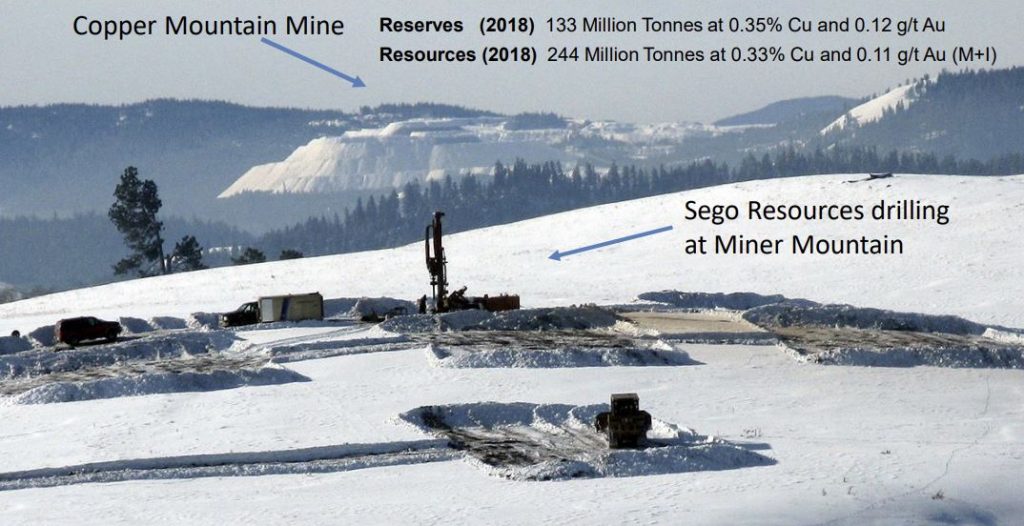
Now, as we mentioned in the introduction, belief in the absence of data is merely speculation. To overcome this obstacle, Sego has made considerable progress towards proving Miner Mountain’s worthiness to reside alongside its well-mineralized peers. The project, permitted until August 2028, stands out for two main mineralized zones:
- The Cuba Zone, whose porphyry copper and gold mineralization, based on current deposit modelling, is interpreted to be an upper extension of a deeper alkaline porphyry copper system similar to the Copper Mountain Mine.
- The Southern Gold Zone, whose bulk-recovered gold and significant nearby copper mineralization are interpreted to be related to a distal or buried alkalic porphyry copper-gold system. The zone offers the potential for near-term cash flow thanks to near-surface mineralization and economic gold recovery grades, positioning the company to capitalize on a gold price that has been over US$4,000 per ounce for more than 12 months.
Sego’s most recent step towards proving Miner Mountain’s value to the market is a 5-line 3D IP Volterra diamond array program, executed by SJ Geophysics, which defined robust IP chargeability anomalies beneath known mineralization at both zones. The company has since compiled a drill hole and chargeability 3D model based on the recent results to design the ongoing 2,000-m exploration drilling program that kicked off in the middle of October.
The Cuba Zone
Mineralization at the Cuba Zone forms an up to 100 m by 750 m trend thoroughly tested by past drilling, including 105 m of 0.31% copper and 0.08 g/t gold in DDH 17-30 and 64 m of 0.46% copper and 0.14 g/t gold in DDH 08-04.
The SJ Geophysics 3D IP Volterra diamond array survey identified a more than 12 millisecond chargeability anomaly that measures about 200 m (north-south) by 500 m (east-west) below the known mineralization from 400 m depth, likely surpassing the survey’s maximum depth of 500 m.
The anomaly is further characterized by zones of potentially spatially related albitic-sericite-pyrite and potassic alteration encountered in drillhole DDH 71 at more than 180 m deep, as described in a February 2026 news release.

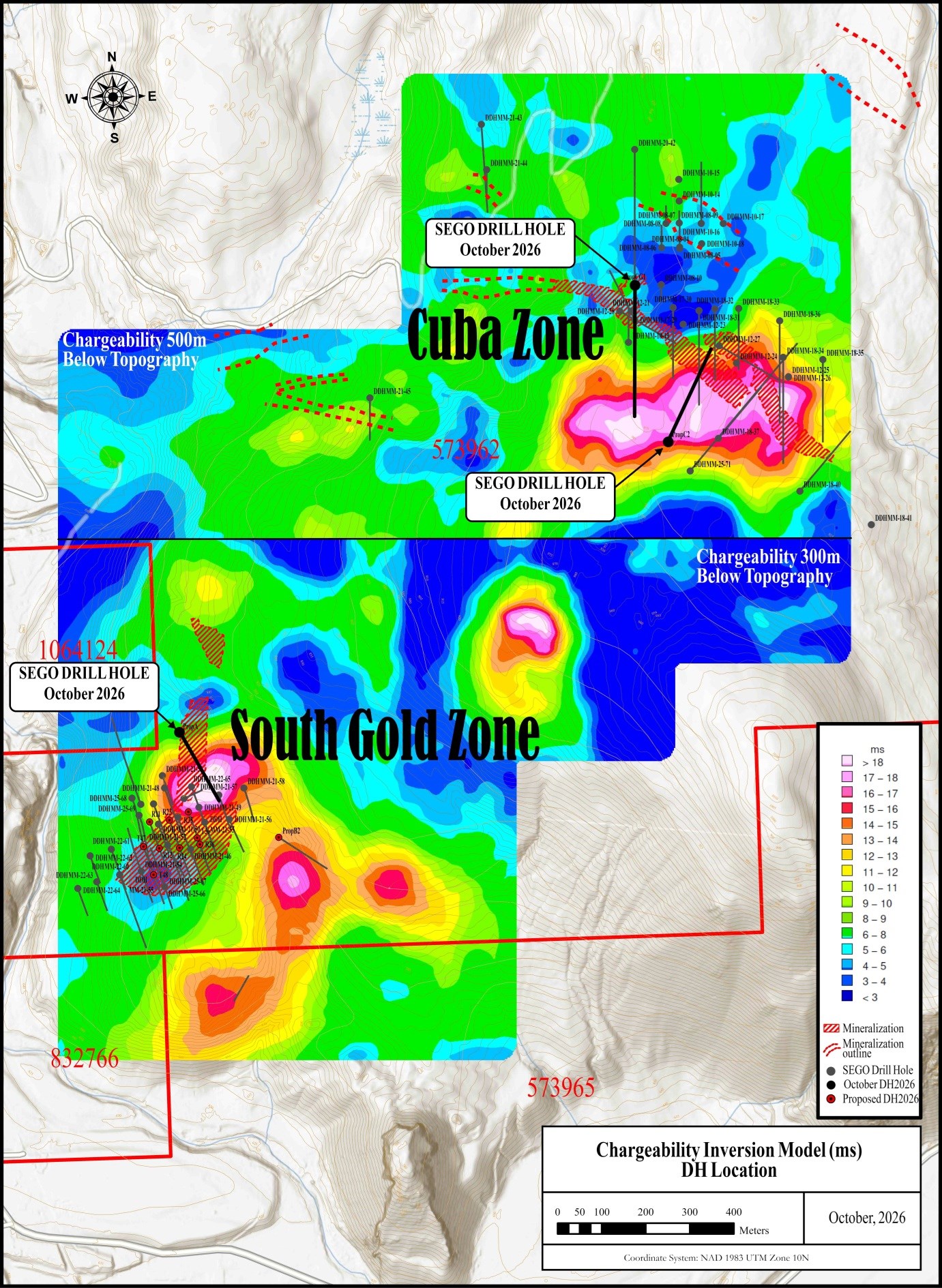
Drilling aims to intersect the IP chargeability anomaly at about 450 m depth to confirm its relation to Miner Mountain’s emerging porphyry copper and gold potential. To this end, Sego plans to drill two holes.
CG1 will be collared in the northwest part of the Cuba Zone trend and drilled south towards the chargeability high, aiming to intersect it after about 400 m and continue the hole to about 690 m, well beyond the depth of the defined 12-millisecond chargeability. The initial part of the hole will be in an area of high-grade drill intersections reported in 2010, 2012 and 2018, including:
- 0.23% copper and 0.13 g/t gold over 24.4 m (66.14-90.53 m deep) in DDH 10-19.
- 0.96% copper and 0.55 g/t gold over 100.4 m (10.06-110.45 m deep) in DDH 12-21.
- 0.93% copper and 0.26 g/t gold over 27 m (8-35 m deep), plus 0.16% copper and 0.51 g/t gold over 21 m (77-98 m deep) in DDH 17-29.
C2 will be collared in the southeast portion of the Cuba Zone trend, targeting the chargeability anomaly to the northeast and intersecting it at about 500 m vertical depth, guided by strong drilling intercepts reported in 2012 and 2018, including:
- 0.23% copper and 0.21 g/t gold over 76.2 m (20.4-96.6 m deep) in DDH 12-27.
- 0.06% copper and 0.11 g/t gold over 62 m (21-83 m deep) and 0.011% copper and 0.07 g/t gold over 99 m (122-221 m deep) in DDH 18-31.
- 0.14% copper and 0.15 g/t gold over 129 m from 14 m deep in DDH 18-32.
- 0.36% copper and 0.07 g/t gold over 45 m from 14 m deep in DDH 18-33.
- Additional attention will be paid to the aforementioned alteration in DDH 71 for clues about the anomaly’s distribution.
Sego is complementing its efforts in the Cuba Zone by exploring an area with resource potential and a pathway to future production, subject to financing, differentiating the company from many of its junior exploration peers.
The Southern Gold Zone
Mineralization at Miner Mountain’s Southern Gold Zone extends for 280 m from east to west and 130 m from north to south, with 5.7% gold grades over 1 g/t gold and an un-cut average grade at 0.3 g/t of 1.06 g/t.
In August 2024, SRK Consulting Canada estimated the zone’s resource potential at 3.5-6 million tons at 0.3 g/t with gold grades of 0.5 to 0.7 g/t gold, representing a potential 100,000-150,000 ounces on a non-compliant basis. Subsequent preliminary leach and gravity tests within the zone yielded recovery grades of up to 95.8%, suggesting a potential 95,800-143,700 ounces of recoverable gold representing a gross value of between US$378 million and US$567 million based on the spot price of US$3,946 on November 2, 2026, which supports the evaluation of commercial production of gold doré bars from the Southern Gold Zone.
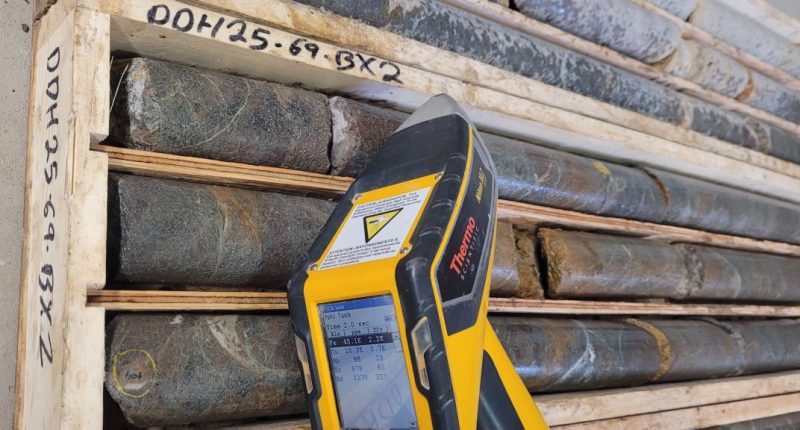
During the 2025 Fall diamond drilling program Sego identified chalcopyrite mineralization in drillholes DDH 66, 68 and 69 associated with patchy to moderate potassic alteration, which has been over printed by later chlorite, sericite and pyrite alteration. The drill program also identified several more than 1-m intervals within the alteration yielding anomalous copper values between 1,000-2,340 parts per million (0.1 to 0.234%), with half of the anomalous copper values associated with gold grades over 1 g/t. The combination of anomalous copper and high-grade gold further supports the Southern Gold Zone mineralization to potentially be related to buried alkaline porphyry copper mineralization.
SJ Geophysics’ 3D model over the Southern Gold Zone identified a chargeability anomaly extending from about 120 m in the north to about 450 m in the southeast – appearing as a semi-circle to the north, east and south of the zone some 300 m below surface – establishing a plausible vector for alkaline porphyry copper and gold mineralization at depth.
The estimated in-situ value justifies follow-up drilling to enhance the company’s understanding of a potential buried alkalic copper and gold porphyry system as indicated by the chargeability anomalies.

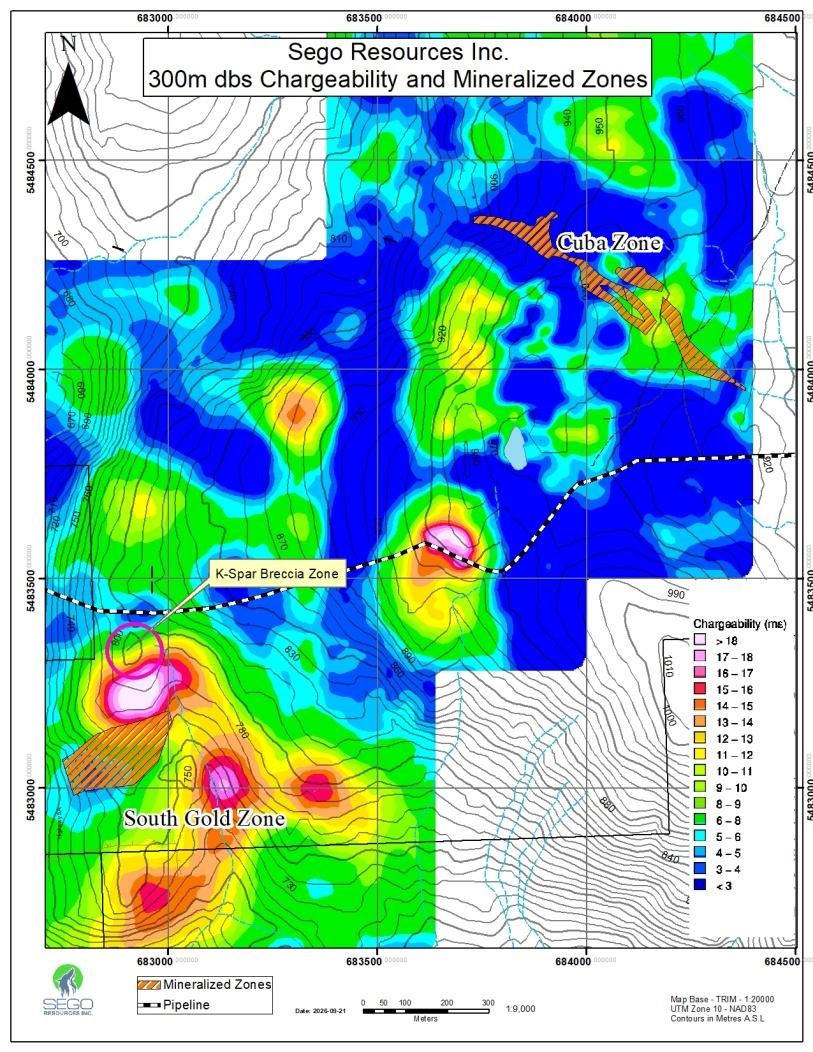
The chargeability high runs deeper than known Southern Gold Zone mineralization, while boasting a similar size and geometry, prompting the company to strengthen their association by drilling to the north of the Southern Gold Zone near trenches and drillholes dating back to 1963 grading in excess of 0.1% copper, in addition to more recent drillholes from 2021 and 2022, including:
- 0.61 g/t gold, 0.41 g/t silver and 0.02% copper over 56.9 m (23-79.9 m deep) in DDH 21-49.
- 0.16 g/t gold, 0.27 g/t silver and 0.01% copper over 82.2 m (3.1-85.3 m deep) in DDH 21-53.
- 0.13 g/t gold, 0.27 g/t silver and 0.01% copper over 53.7 m (5.5-59.2 m deep) in DDH 21-56.
- 0.34 g/t gold, 0.35 g/t silver and 0.01% copper over 59.65 m (42.65-102.30 m deep) in DDH 21-57.
Equipped with a multitude of leads to expand the Southern Gold Zone’s resource and potentially upgrade it to NI 43-101 status, Sego is in a favorable position to ramp up news flow and foster share price momentum over the coming months.
A leadership team ripe for discovery and development
Sego Resources entrusts its polymetallic value proposition to a leadership team highly aligned with shareholders, to the tune of 40% insider ownership, captained by Director and Chief Executive Officer (CEO), J. Paul Stevenson, who brings more than 50 years of mineral exploration and development experience with an emphasis on porphyry copper. He became CEO of BC-based Pacific Booker Minerals in 1995, ushering the Morrison Copper and Gold Project into the preliminary economic assessment stage.
Stevenson’s more than half century in the industry is complemented by a team of veteran mining professionals, whose collective track record includes hundreds of millions of dollars in capital raised, the discovery of the Samatosum Silver Mine in BC, as well as past tenures with mining heavyweights Barrick, Kinross and Placer Dome, equipping Sego with a well-rounded skillset to bolster Miner Mountain’s prominence among the Quesnel Arc’s robustly mineralized mines.
A textbook contrarian play
With copper headed for a 20-million-ton deficit by 2050, according to data from Bloomberg, and gold projected to build upon its millennia of history as a store of value by reclaiming the US$5,000 per ounce mark by 2030, as per projections from Bernstein, Sego benefits from a long demand runway on which to harvest exploration upside from Miner Mountain, leverage spot prices and create shareholder value.
That being said, the permitted project, grounded in a memorandum of understanding with the Upper Similkameen Indian Band, on whose traditional territory the land package is situated, hasn’t found favor with the broader investing public, as highlighted by a stock that has given back 62.5% of its value since 2021.
The potential reasons behind this price-value dislocation are hardly surprising, given Sego’s pre-revenue operations, daily trading volume of often less than 10,000 shares, and the highly-technical nature of ascertaining conviction in a junior mining company, all of which make the company more likely to end up in the average investor’s too hard/risky pile than in their portfolio.
These barriers to entry, however, clear the way for investors who can recognize the company’s high-quality assets and leadership team, as we’ve laid them out in this article, to build positions at a moment of heightened and unwarranted pessimism, knowing full well that catalysts for shareholder value abound as drill core makes it way from the field, to the assay lab, to the news wire, fostering Miner Mountain’s reputation as a signature destination on BC’s Porphyry Superhighway.
Join the discussion: Find out what investors are saying about this copper and gold mining stock on the Sego Resources Inc. Bullboard and explore the rest of Stockhouse’s stock forums and message boards.