

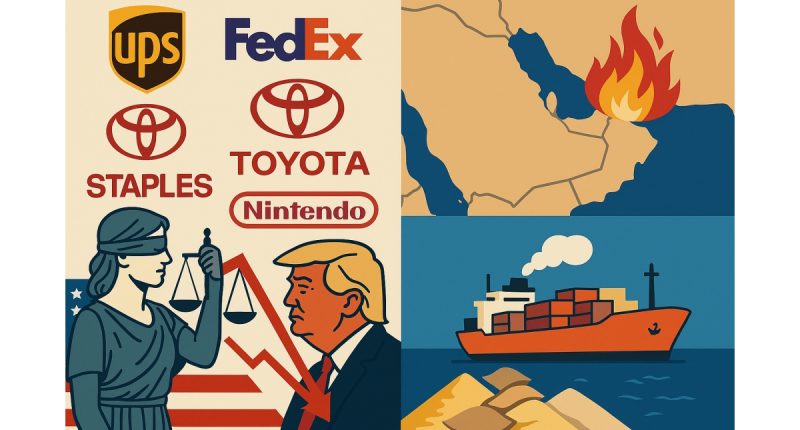
- Several major companies — including FedEx, UPS, Costco, Toyota, Staples, and Nintendo — are suing the U.S. government to recover tariffs the Supreme Court ruled were unlawfully imposed under emergency powers
- Consumers are unlikely to see refunds, since repayments go to importers of record and tariff costs were unevenly passed through supply chains
- Middle East Gulf states, though largely spared from U.S. tariff measures, are now distancing themselves from U.S. actions after being drawn into the widening conflict with Iran
- The Strait of Hormuz remains a critical chokepoint not only for oil but also for sulphur and fertilizer shipments, making the conflict a major risk factor for global supply chains
When “emergency” tariffs collide with the courts
In February, the U.S. Supreme Court ruled that the White House lacked authority under the International Emergency Economic Powers Act (IEEPA) to impose sweeping, economy‑wide tariffs—voiding a large tranche of duties assessed since early 2025 and opening the door to a wave of refund litigation. The Court also underscored that the U.S. Court of International Trade (CIT) has exclusive jurisdiction over refund disputes but stopped short of laying out a refund mechanism—leaving importers, brokers, and consumers in limbo.
This article is a journalistic opinion piece that has been written based on independent research. It is intended to inform investors and should not be taken as a recommendation or financial advice.
Within days, FedEx became one of the first major companies to sue the U.S. government for a “full refund” of IEEPA‑based duties it paid as importer of record, with similar actions cropping up across industries while Customs and Border Protection (CBP) signaled operational uncertainty about how to process repayments.
At the same time, tariffs imposed under other statutes (e.g., Section 301 China duties; Section 232 steel/aluminum) remain in force. A 2025 Federal Circuit ruling upheld the legality of Section 301 Lists 3 & 4A tariffs, an important reminder that not all tariff litigation will end with refunds.
Who’s suing—and why: A company‑by‑company snapshot
FedEx (NYSE:FDX)
Grievance: IEEPA duties were unlawful; refund all duties paid.
Why it matters: FedEx paid tariffs as importer of record and passed charges through to shippers in many cases; it now seeks reliquidation and refunds plus interest. A separate consumer class action also alleges FedEx wrongfully collected tariff fees that are now invalid.
Investor angle: A successful refund could be meaningful to working capital and to customer relations if pass‑through rebates are offered, though timing is uncertain because CBP has not finalized a refund workflow.
UPS (NYSE:UPS)
Grievance: Class action claims UPS collected unlawful tariff‑related charges from shippers/consumers tied to IEEPA duties; UPS itself has published guidance for importers on how to prepare for potential CBP refunds.
Investor angle: Litigation risk is on the collections side (customer refunds), not on a government‑refund claim—yet the same uncertainty around CBP processes applies to UPS customers that used the company as broker.
Costco (NASDAQ:COST)
Grievance: Protective lawsuits at the CIT challenging emergency tariffs (IEEPA) and separate actions connected to Section 301 collections—meant to preserve refund rights before entries liquidate.
Investor angle: Analysts note refunds (if/when realized) could bolster cash and potentially flow through to members via pricing—though the litigation timeline is inherently long and outcomes mixed.
Nintendo (OTC Pink:NTDOF)
Grievance: Filed CIT complaint seeking a prompt refund, with interest, for duties paid under the IEEPA tariff regime, citing the Supreme Court’s February decision and CBP’s inability (so far) to execute broad refunds.
Investor angle: The company publicly tied tariffs to pricing and launch timing (e.g., Switch 2 peripherals), so refunds could partially reverse 2025–26 cost headwinds in North American hardware.
Toyota (NYSE:TM)
Grievance: Toyota‑related entities are among manufacturers pursuing refunds tied to post‑2025 tariff actions (IEEPA) and/or continuing to contest tariff applications via broader industry litigation strategies. While automakers absorbed billions under multiple tariff programs, the refund path is clearest for IEEPA‑based duties invalidated by SCOTUS.
Investor angle: Given global sourcing footprints, even partial refunds (or clarity on future exposure under Section 122 or 301) can affect FY26–27 gross margin planning.
Staples (private, Sycamore Partners)
Grievance: Office‑supply retailers were among the broad group of importers paying emergency duties and filing protective CIT suits to suspend liquidation and preserve refund eligibility. While a Staples‑specific complaint has not been widely reported, trade counsel highlight that many retailers filed to avoid losing rights as entries liquidate—an administrative nuance every importer should note.
Investor angle: For private‑equity‑owned retailers, refunds can directly support liquidity and vendor terms; absence of timely filings can permanently foreclose recovery once entries liquidate.
Will consumers get money back? The pass‑through problem
A central practical question is whether consumers who paid higher prices will ever see refunds. Economically, tariff incidence is shared among importers, retailers, and consumers—and that share shifts over time. New York Fed survey work found many firms passed through a meaningful portion of tariff costs to customers, especially in services; other research shows pass‑through rose as 2025 progressed, with some estimates putting two‑thirds of costs on consumers by late 2025.
Macro trackers similarly tie durables and core goods price increases in 2025 to tariff shocks, with pass‑through into consumer prices ranging roughly from 40–100 per cent depending on category and methodology.
Legal reality: Refunds flow to the importer of record via CBP reliquidation—not to downstream consumers. Absent explicit class settlements or retailer programs, consumers typically won’t receive direct rebates. Economists at The Brattle Group underscore that even tracing the “true bearer” of tariff costs is analytically complex and unlikely to be operationalized in CBP processes. Bottom line: expect company‑level refunds; consumer‑level refunds are unlikely outside litigation or voluntary programs.
A brief detour: Why the Gulf States mostly escaped the tariff blitz—but not the war
Tariffs
The 2025–26 “emergency” tariffs hit most U.S. trading partners; however, Gulf economies’ direct exposure to U.S. consumer‑goods flows is relatively small, and the legal fights (IEEPA/Section 122/301) are centred on U.S.–China and global “reciprocal tariffs,” not on GCC states specifically. (By contrast, China‑focused Section 301 actions—the ones still standing—remain the key legal anchor for much of today’s tariff regime.)
Geopolitics
Fast‑forward to late February–March 2026: as the U.S. and Israel launched major strikes in Iran, the Gulf monarchies—Saudi Arabia, the UAE, Qatar, Kuwait, Bahrain, Oman—were not cheerleaders. They had warned Washington against an Iran strike and are now distancing themselves from the war, even while intercepting Iranian missiles and protecting their own infrastructure. The UAE has urged de‑escalation and stated its bases won’t be used to attack Iran; Saudi officials privately pressed Gulf partners not to take steps that would inflame Tehran; public commentary across the region reflects anger at the lack of notice from Washington.
Analysts and diplomats describe GCC capitals as rattled and focused on self-defence and economic continuity, not on aligning with Trump’s war aims. That’s a pullback from even tacit support: their priority is de‑risking—air defence, infrastructure hardening, and political signalling to avoid further escalation.
Why fertilizer—and sulphur—suddenly matter as much as oil
The Strait of Hormuz is not only the world’s most important oil chokepoint—it is also a major artery for fertilizer commodities and sulphur, a key input in phosphate fertilizer and other industrial value chains. Industry groups and market trackers estimate roughly one‑third of global fertilizer trade and ~50 per cent of seaborne sulphur exports rely on Gulf routes through Hormuz.
- Urea and ammonia: Countries west of Hormuz account for roughly half of global urea exports and ~30 per cent of ammonia exports; disruptions are already pushing prices higher just as North American spring planting begins.
- Sulphur: The UAE (ADNOC) and Saudi Arabia are among the world’s largest sulphur exporters; Abu Dhabi’s Shah Gas complex alone produces ~4.2 million t/yr of sulphur (about 5 per cent of global output), shipped as granules via Ruwais—cargoes that typically must transit Hormuz.
With the war sending missiles at energy and industrial targets across the Gulf and insurers cancelling coverage, fertilizer and sulphur loadings have been disrupted and freight risk premia are rising—amplifying price volatility in crop nutrients from urea to phosphates.
Investor angle: Beyond oil and LNG, watch fertilizer equities, sulphur logistics, and agribusiness input costs. Tightness in fertilizer markets can ricochet into crop margins, food processors, and consumer staples inflation.
What to watch next (and how to position)
- Refund mechanics and timing.
Track CIT orders and CBP guidance on reliquidation. Early rulings suggest importers are entitled to refunds, but CBP has admitted near‑term execution challenges. Companies should ensure ACH refund readiness and documentation hygiene. - More lawsuits—different statutes.
After the IEEPA loss, the administration pivoted to Section 122 (threatening a 10–15 per cent “global tariff”), drawing multistate lawsuits. Parallel Section 301 actions continue to frame the medium‑term tariff map. Policy volatility remains a headline risk. - Gulf risk premiums beyond oil.
Expect episodic shutdowns of Hormuz shipping lanes and insurance cancellations to spill into fertilizer and sulphur chains—reinforcing the case for diversified sourcing and inventory buffers in agriculture and chemicals. - Consumer payback? Unlikely at scale.
Given legal plumbing, most repayments will stop at the importer level unless firms voluntarily share refunds or courts craft consumer remedies in class actions.
From courtrooms to chokepoints
For investors, 2026’s tariff saga is evolving from a political headline into a cash‑flow event—but one unfolding at two speeds. In the courtrooms, importers from FedEx to Nintendo are racing to lock in refunds the Supreme Court’s IEEPA ruling made possible—yet administration, statute‑switching, and CBP execution will determine how quickly dollars flow.
On the water, the Strait of Hormuz is reminding markets that the Gulf ships not only oil but also the sulphur and fertilizers that underpin global food and industrial supply chains. With Gulf states distancing themselves from Washington’s Iran campaign and prioritizing de‑escalation and self-defence, investors should price a higher, more persistent Gulf risk premium across energy and ag‑inputs—and a refund cycle that benefits importers first, consumers last.
Stockhouse does not provide investment advice or recommendations. All investment decisions should be made based on your own research and consultation with a registered investment professional. The issuer is solely responsible for the accuracy of the information contained herein. For full disclaimer information, please click here.