

BP and OMV: Is the Rally Over Now?
Few asset classes are as volatile as the oil and gas market. Although some banks predicted triple-digit oil prices, up to USD 200, during the blockade in the spring, the gradual normalization of tanker traffic in the Gulf has caused the geopolitical risk premium to shrink dramatically for the time being. As a result of recent talks and a de facto ceasefire, leading investment banks have now drastically revised their oil price forecasts for the second half of the year downward once again. Analysts at Barclays lowered their forecast for North Sea Brent crude to USD 96 per barrel, while JPMorgan reacted even more sharply, setting a fair value of USD 86 for Q3. The US bank Citi also anticipates a continuing downward trend and even forecasts a drop to USD 70 in Q4. As the main reasons for these revised outlooks, economists cite not only geopolitics but, above all, weaker global demand and looming market supply surpluses. What a boom-and-bust cycle!
Energy companies BP and OMV are popular with investors because they offer high, stable dividend yields of 5 to 9%. In the wake of the Iran crisis, their share prices rose sharply. At their peaks, BP and OMV saw gains of 30% and 45%, respectively, but two-thirds of those gains have now melted away. Those who did not sell at the peak can take comfort in one of the lowest valuations in recent years. The 2026 P/E ratio for both stocks is now a modest 6.6, what a coincidence, and the high selling prices from the Gulf crisis should start to show up in the next quarterly earnings report. Analysts on the LSEG Refinitiv platform see an average 12-month upside potential of 32% for BP, while for OMV it is only 10%. But there is an added bonus on the horizon for 2027. The chemical subsidiary Borouge Group, jointly held with ADNOC, is estimated to be worth approximately USD 60 billion and is set to go public in 2027. OMV owns a 46.84% stake in Borouge, which is worth just under USD 28 billion. However, OMV’s entire market capitalization is valued at only EUR 17.6 billion. This looks like a real bargain!
Zefiro Methane: Previously Overlooked, Now Operating in a Billion-Dollar Niche
And here is another highlight from the oil sector with an extremely low valuation. It is the oil and methane remediation specialist Zefiro Methane. Until recently, the company had been quietly expanding its business one contract at a time. Now, however, public attention is increasing significantly, and the pace of new deals is accelerating. Zefiro specializes in the permanent plugging and remediation of abandoned oil and gas wells, so-called orphan wells, which is one of the industry’s most pressing environmental challenges. Its services include measuring and reducing methane emissions as well as preparing sites for future energy projects. The Canadians are thus occupying a market niche that has received little attention to date but is worth billions.
Zefiro is receiving a particular boost from the explosive growth in electricity demand driven by the AI industry, as US energy providers are expected to invest approximately USD 1.4 billion in expanding and modernizing the American power grid over the next five years. This is driven by the forecast that AI data centers could account for about 9% of total US electricity consumption by 2030, necessitating the construction of new power plants, transmission lines, and energy facilities at record speed. However, before new infrastructure can be built, old oil and gas wells often must be identified, secured, and permanently plugged. This is a highly specialized field in which Zefiro has become a sought-after problem-solver.
As early as the end of 2025, the company eliminated a total of nine discovered, unplugged gas wells in Indiana County (Pennsylvania) as part of a three-month project, enabling the conversion of a former coal-fired power plant into a modern natural gas power plant to continue; the first electricity production is scheduled for 2028. This was followed in early 2026 by another infrastructure project in Lake Charles, Louisiana, with a contract value of approximately USD 5 million, which was completed three weeks ahead of schedule and simultaneously marked the company’s successful market entry in that state. There, previously plugged wells had to be further remediated to enable the construction of a private power plant, which is scheduled to begin operations in 2029. Notably, this project was deliberately carried out during the winter months, underscoring the strategy of utilizing personnel and equipment to full capacity year-round and thereby further increasing operational efficiency. Thanks to investments in additional specialized equipment and the expansion of its teams, Zefiro now has significantly greater capacity to handle multiple infrastructure projects simultaneously and to benefit from the dynamic growth surrounding AI data centers.
At the same time, US regulatory authorities are intensifying their focus on grid connections for large electricity consumers after the Federal Energy Regulatory Commission (FERC) called on regional grid operators to fundamentally review their rate and connection models for large consumers such as data centers. This not only increases the pressure to expand the grid but also the need for companies capable of quickly and professionally remediating contaminated sites at future energy and industrial locations. In addition to this new infrastructure business, the traditional plug-and-abandonment business remains a structural market worth billions, whose development is shaped by long-term investment programs and regulatory requirements and is thus significantly less dependent on commodity price cycles than many sectors of the oil and gas industry. The next phase of the energy transition will not be determined solely by the construction of new power plants or data centers, but rather by the remediation of existing energy infrastructure. Zefiro Methane appears well-positioned and currently has a market capitalization of only about CAD 50 million. For perspective, a single infrastructure project can generate contract volume of around USD 5 million, or nearly CAD 7 million. On that basis, the valuation appears highly attractive.
CEO Catherine Flax comments on current developments at the 19th International Investment Forum.
Repsol: Doubled since 2025, and now?
Yet another “Buy” recommendation for Spain’s Repsol. Over the past 12 months, the stock has already surged from EUR 13 to 25. But that is not enough, say the analysts at Alphavalue. They have upgraded their rating from “Add” to “Buy” and set a price target of EUR 30.80. The experts justified the move by citing stronger earnings in the upstream and liquefied natural gas (LNG) businesses, which more than offset the weaker margins in the downstream segment. Investors also appreciate the company’s strategic realignment toward higher-margin oil and gas projects in politically stable regions such as the US and Brazil. According to Alphavalue, the temporarily higher commodity prices will be reflected in the realized prices of the upstream business. Due to exceptionally high volume growth in Brazil, the United States, and other key projects, EBIT is expected to more than double to over EUR 6 billion in 2026. The P/E ratio is falling to 5.6 this year, and on top of that, there is an 8% dividend payout. The LSEG platform has set a price target of EUR 24.50; however, this could also become Alphavalue’s target, in which case there would be nearly 50% upside potential!
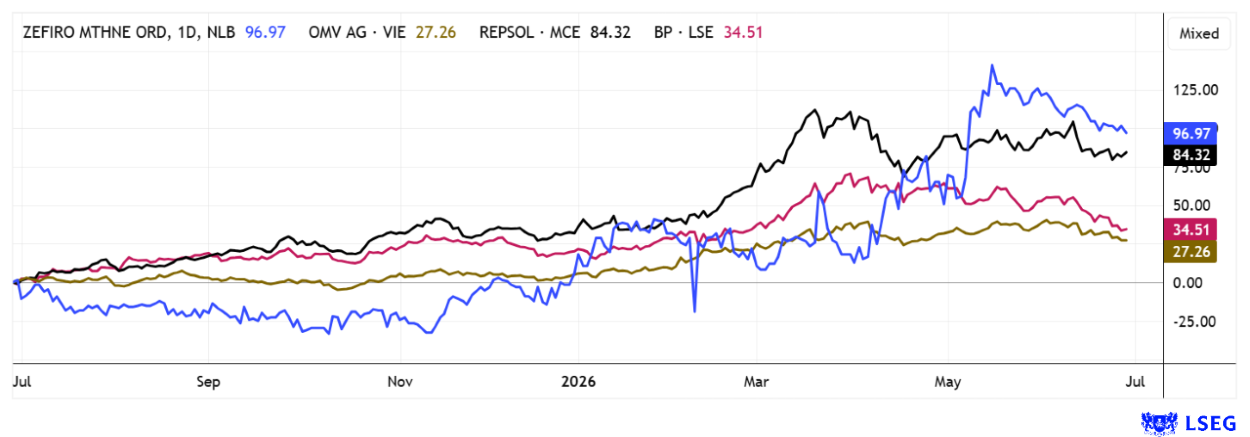
Capital markets are being pulled in opposite directions at the moment. Tech stocks surged to new highs yesterday, while oil and energy shares are moving in the opposite direction. Due to the 30% drop in oil prices in just three weeks, investors are locking in substantial profits across the energy sector. Companies such as BP, OMV, and Repsol are feeling the pressure. Meanwhile, the already attractively valued Zefiro Methane appears to offer a compelling buying opportunity.
Conflict of interest
Pursuant to §85 of the German Securities Trading Act (WpHG), we point out that Apaton Finance GmbH as well as partners, authors or employees of Apaton Finance GmbH (hereinafter referred to as “Relevant Persons”) currently hold or hold shares or other financial instruments of the aforementioned companies and speculate on their price developments. In this respect, they intend to sell or acquire shares or other financial instruments of the companies (hereinafter each referred to as a “Transaction”). Transactions may thereby influence the respective price of the shares or other financial instruments of the Company.
In this respect, there is a concrete conflict of interest in the reporting on the companies.
In addition, Apaton Finance GmbH is active in the context of the preparation and publication of the reporting in paid contractual relationships.
For this reason, there is also a concrete conflict of interest.
The above information on existing conflicts of interest applies to all types and forms of publication used by Apaton Finance GmbH for publications on companies.
Risk notice
Apaton Finance GmbH offers editors, agencies and companies the opportunity to publish commentaries, interviews, summaries, news and the like on news.financial. These contents are exclusively for the information of the readers and do not represent any call to action or recommendations, neither explicitly nor implicitly they are to be understood as an assurance of possible price developments. The contents do not replace individual expert investment advice and do not constitute an offer to sell the discussed share(s) or other financial instruments, nor an invitation to buy or sell such.
The content is expressly not a financial analysis, but a journalistic or advertising text. Readers or users who make investment decisions or carry out transactions on the basis of the information provided here do so entirely at their own risk. No contractual relationship is established between Apaton Finance GmbH and its readers or the users of its offers, as our information only refers to the company and not to the investment decision of the reader or user.
The acquisition of financial instruments involves high risks, which can lead to the total loss of the invested capital. The information published by Apaton Finance GmbH and its authors is based on careful research. Nevertheless, no liability is assumed for financial losses or a content-related guarantee for the topicality, correctness, appropriateness and completeness of the content provided here. Please also note our Terms of use.
Stockhouse does not provide investment advice or recommendations. All investment decisions should be made based on your own research and consultation with a registered investment professional. The issuer is solely responsible for the accuracy of the information contained herein. For full disclaimer information, please click here.