


The central bank and monetary policy dynamics
Anyone seeking to understand mining finance in Côte d’Ivoire must look at the currency: the country belongs to the West African Economic and Monetary Union (UEMOA). The CFA franc used here is pegged to the euro at a fixed exchange rate, offering international investors price stability and reducing the devaluation risk often typical of African projects. The Central Bank of West African States, or BCEAO for short, manages the monetary policy of this union. UEMOA Regulation 06/2024 on external financial relations, whose implementation is overseen by the BCEAO, has significantly tightened foreign exchange controls. Mining companies are legally required to transfer gold export proceeds back into the currency area through resident commercial banks. These capital controls create a strong incentive for international mine operators to keep liquidity in local currency and to take out project loans at least partly in CFA francs. By taking on local debt, companies match their revenues and liabilities within the same currency area and avoid regulatory hurdles when making repayments through foreign accounts.
Resolute Mining and the Doropo project
The financing of Resolute Mining’s Doropo project, located in the north-eastern Bounkani region near the border with Burkina Faso, illustrates the new market power of local banks. The Australian mining company estimates initial capital expenditure of around USD 516 million, equivalent to approximately CFA 311 billion, to construct the facility, which will have a capacity of 4.9 million tonnes per year. In early November, the company signed loan agreements for CFA 148 billion with a consortium of seven Ivorian and regional banks, including Banque Nationale d’Investissement and Bank of Africa. This amount covers almost half of the mine’s construction costs and reduces exchange rate risk for domestic expenditure such as cement, steel and wages. The strong involvement of local banks should also reduce the risk of arbitrary government intervention, as such measures would directly burden the balance sheets of domestic institutions. Based on the updated feasibility study from December 2025, the company plans its first gold pour for the second half of 2028.
Strict tax regimes and environmental protection requirements
Alongside monetary policy, the Code Minier regulates the Ivorian mining industry and ensures greater value capture by the state. Since January 2025, gold producers have paid an 8.0% royalty on gross sales. In addition, there is a 25% corporate tax, as well as contributions to local development funds. Compliance with environmental legislation is also strictly monitored. Under the requirements of the Centre Ivoirien Antipollution, every mining project must submit detailed rehabilitation plans and provide financial guarantees so that the state does not bear the environmental costs after mining ends. For project financiers, this means that feasibility depends not only on geological data but also on comprehensive environmental and social plans.
Montage Gold and Wheaton Precious Metals
For true megaprojects that exceed the capacity of regional banks, mining groups turn to alternative financing vehicles such as precious metals streaming. Montage Gold’s Koné project is currently the fastest-progressing major project in West Africa and is characterised by a massive volume at a low gold grade of around 0.6 g/t Au. The infrastructure needed to process 11.0 million tonnes of rock annually requires capital expenditure of over USD 712 million. To meet this requirement, Montage Gold structured a USD 825 million package led by Canada’s Wheaton Precious Metals. Wheaton is providing a total of USD 700 million for the Koné project and in return receives the right to 19.5% of total gold production until 400,000 ounces have been delivered, with only 20% of the spot price paid upon delivery. The facility is ramping up at a record pace. The first gold was poured as early as the end of September, and Montage Gold reported production of around 23,460 ounces in October alone.
Kobo Resources on the path to bankability
The next generation of Ivorian gold projects is emerging at exploration companies such as Kobo Resources, which are investigating undeveloped areas and making them investable. The Kossou project covers 110 km² in a greenstone belt and is located around 20 km northwest of the political capital Yamoussoukro. Its key advantage is its immediate proximity to Perseus Mining’s producing Yaouré mine, which, according to CEO Edward Gosselin, is around 9 km away by road. This suggests a geologically comparable setting and reduces exploration risk. Kobo Resources is advancing an extensive drilling programme and reported strong results from the so-called Road Cut Zone at the end of September. Diamond drill hole KDD0191 intersected prominent shear zones and returned 1.94 g/t Au over 19.0 m from a depth of 67.0 m, including a higher-grade interval of 2.44 g/t Au over 14.2 m.
Alongside the drilling data, rock processing is a bottleneck for any financing decision. Metallurgical tests by SGS Canada yielded average gold recovery of around 97%, within a range of 94 to 99%, and show that the mineralisation is well suited to conventional processing using gravity separation and cyanide leaching. This high recovery rate reduces metallurgical risk – an important prerequisite for subsequent economic studies. The next critical milestone for bankability is the publication of the first official resource estimate, which Gosselin says in his interview with the International Investment Forum (IIF) is scheduled for the first quarter of 2027, likely in early to mid-March. Before then, a further 9,000 to 10,000 m of drilling are to be completed by around mid-January. The engineering firm WSP is preparing the estimate.

ESG challenges and takeover potential
To demonstrate their creditworthiness to international development banks and financiers, companies must also manage complex social risks. Illegal artisanal gold mining poses a significant reputational and security risk. With its National Water Security Pact (2026–2030), the Ivorian government aims, among other things, to curb environmental damage and requires clear plans from companies. Kobo Resources is doing important integration work in the surrounding communities through programmes such as the regional Kobo Football Cup. International financiers such as the International Finance Corporation require this kind of stakeholder management. At the same time, the Kossou project may never have to finance its own plant. Perseus Mining, the operator of the neighbouring Yaouré mine, produced around 405,000 ounces across the group in the past financial year and held around USD 1 billion in cash and gold at the end of June. According to Gosselin, the processing plant at Yaouré, with an annual capacity of around 4 million tonnes, is currently underutilised. If Kobo Resources demonstrates a sufficient quantity of near-surface ounces, the project could appeal to Perseus Mining as a satellite pit and potential takeover target. Such a prospect would significantly reduce the financing risk for the exploration project.
Conclusion: Côte d’Ivoire offers investors exciting prospects
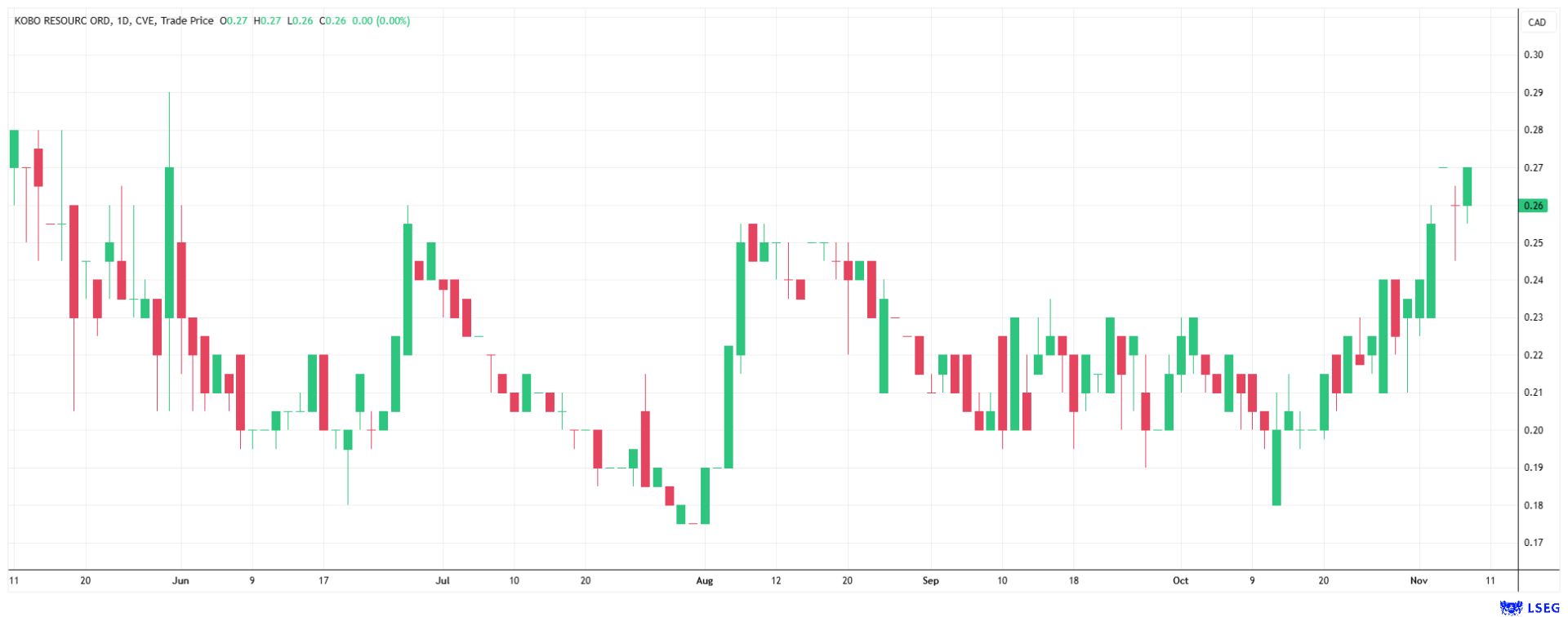
Gold mining in Côte d’Ivoire is currently undergoing a surge in professionalisation for several reasons. Projects such as Doropo and Koné are committing large amounts of capital within a tightly regulated but stable monetary union and setting new standards in production capacity. This market offers favourable conditions for emerging players such as Kobo Resources, provided the company can convert the geological data into certified resources. The high recovery rate in metallurgical tests and proximity to a well-capitalised producer provide a good starting point. Kobo Resources’ shares are currently speculative, as the company has yet to present its maiden resource estimate and is in the early exploration phase.
In his interview with the IIF, Kobo CEO Edward Gosselin explains the status of the Kossou project, the metallurgy and the timetable leading up to the maiden resource estimate.

Conflict of interest
Pursuant to §85 of the German Securities Trading Act (WpHG), we point out that Apaton Finance GmbH as well as partners, authors or employees of Apaton Finance GmbH (hereinafter referred to as “Relevant Persons”) may hold shares or other financial instruments of the aforementioned companies in the future or may bet on rising or falling prices and thus a conflict of interest may arise in the future. The Relevant Persons reserve the right to buy or sell shares or other financial instruments of the Company at any time (hereinafter each a “Transaction”). Transactions may, under certain circumstances, influence the respective price of the shares or other financial instruments of the Company.
In addition, Apaton Finance GmbH is active in the context of the preparation and publication of the reporting in paid contractual relationships.
For this reason, there is a concrete conflict of interest.
The above information on existing conflicts of interest applies to all types and forms of publication used by Apaton Finance GmbH for publications on companies.
Risk notice
Apaton Finance GmbH offers editors, agencies and companies the opportunity to publish commentaries, interviews, summaries, news and the like on news.financial. These contents are exclusively for the information of the readers and do not represent any call to action or recommendations, neither explicitly nor implicitly they are to be understood as an assurance of possible price developments. The contents do not replace individual expert investment advice and do not constitute an offer to sell the discussed share(s) or other financial instruments, nor an invitation to buy or sell such.
The content is expressly not a financial analysis, but a journalistic or advertising text. Readers or users who make investment decisions or carry out transactions on the basis of the information provided here do so entirely at their own risk. No contractual relationship is established between Apaton Finance GmbH and its readers or the users of its offers, as our information only refers to the company and not to the investment decision of the reader or user.
The acquisition of financial instruments involves high risks, which can lead to the total loss of the invested capital. The information published by Apaton Finance GmbH and its authors is based on careful research. Nevertheless, no liability is assumed for financial losses or a content-related guarantee for the topicality, correctness, appropriateness and completeness of the content provided here. Please also note our Terms of use.
Stockhouse does not provide investment advice or recommendations. All investment decisions should be made based on your own research and consultation with a registered investment professional. The issuer is solely responsible for the accuracy of the information contained herein. For full disclaimer information, please click here.