

Lockheed Martin: New Contracts and Technological Milestones
Lockheed Martin continues to fill its already massive order book. Most recently, the defence contractor secured a new major project to supply the US Armed Forces. The US Army has awarded the company a framework contract to manufacture the “Precision Strike Missile” in its second development phase. The contract value amounts to up to USD 1.2 billion. The systems are specifically designed for the precise engagement of mobile targets on land and at sea. In addition to production, the agreement also covers further system development. To ensure the planned deliveries, the company intends to significantly expand its manufacturing capacity in this segment and quadruple output.
In addition to operational progress in its home market, Lockheed Martin is also reporting international business successes. The Mexican Air Force has confirmed the purchase of another C-130J-30 Super Hercules transport aircraft. With this, the country is further expanding its logistical capabilities, becoming the first Latin American nation to order this model in early 2026. The longer variant of the aircraft offers increased cargo capacity and is primarily used for transport missions and humanitarian operations. Most recently, the first aircraft in this series was deployed to deliver aid following the recent earthquakes in Venezuela.
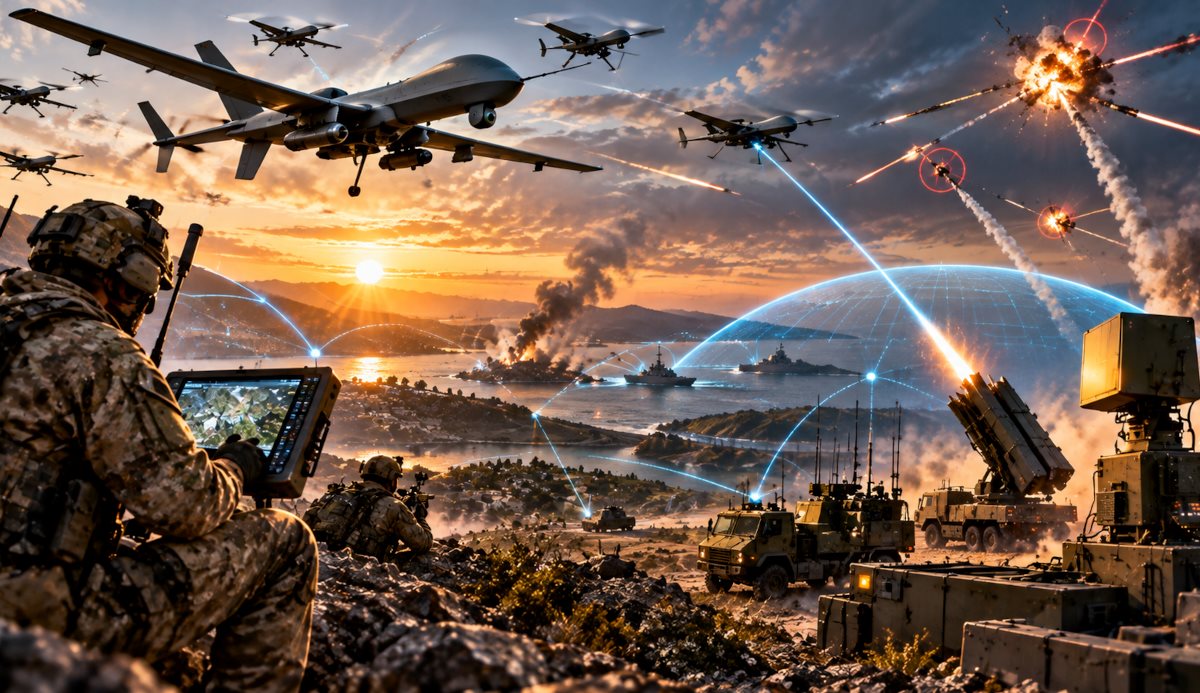
In addition, the company is advancing technical research in the field of unmanned systems. As part of a US Army technology exercise about two weeks ago, Lockheed Martin demonstrated a new defence system called CARI. This vehicle-based technology uses an autonomous swarm of drones to intercept enemy drones. The defence drones position themselves autonomously and form a three-dimensional barrier in the air in real time. A key feature of the control software used is its flexibility. It works across platforms with various drone models and remains operational even if the communication link to individual units is interrupted.
Volatus Aerospace: The Next Technological Leap
Volatus Aerospace has reached a technological milestone. During initial flight tests, the company’s proprietary V-Cortex system navigated without GPS and without external sensors. Instead, the AI-based autonomy platform kept the aircraft airborne using only the available onboard sensors. This capability is crucial for military operations where GPS is deliberately jammed, as well as for the Canadian Arctic or densely built-up areas. For the first time, a development platform has become verifiably functional technology.
However, the potential extends far beyond a single flight controller. V-Cortex is platform-independent and modular in design. Volatus can adapt the software to various unmanned systems without developing a completely new autonomy solution for each aircraft. This shared technological foundation across drones, reconnaissance, critical infrastructure, and defence creates significant economies of scale.
Recent developments in the defence sector show how strong this potential is. As recently as September, Volatus qualified for all five areas of the Canadian Defence Drone Initiative. Shortly after, Volatus signed a 5-year contract with the Canadian government. Initially, 100 tactical ISR drone systems will be procured. However, the framework provides Canada with options for an additional 4,900 systems, for a total of up to 5,000 units. The initial procurement framework is valued at up to CAD 25 million.
As a result, the strategy is becoming increasingly integrated. With Mirabel, Volatus has operated a 53,000-square-foot production and integration facility since June. At the same time, Q2 revenue rose 49.5% from the previous quarter to CAD 8.42 million. With CAD 59.2 million in cash, the company also has the highest liquidity in its history.
Volatus has thus long since become more than just a drone service provider. In-house manufacturing, autonomy software, operational experience, and access to government defence programs are increasingly forming an integrated platform. The company still needs to prove it can scale these investments profitably. However, if the transition from individual contracts to larger production programs is successful, Volatus’s revenue scale could change significantly.
DroneShield: Operational Success, Technical Setback
The Australian defence specialist DroneShield has also completed a major procurement project for the US government. As part of the government’s JIATF-401 initiative, the company equipped US military light infantry vehicles with the DroneSentry-X Mk2 defence system. The company completed technical integration, real-world testing, and operator training in just under 80 days. The system combines radio frequency detection with electronic countermeasures. This enables troops to locate and neutralize enemy unmanned aerial vehicles both during stops and while on the move. A planned contract extension already provides for the equipping of additional vehicles.
In addition, DroneShield is expanding its technological capabilities through a new partnership with the Australian developer AIM Defence. At the heart of the agreement is the integration of the Fractl laser weapon into DroneShield’s existing software and defence platform. While the company has primarily relied on disrupting control signals to date, this collaboration now also gives customers the option of physically destroying enemy drones. The open architecture lets military users control various sensors and defence methods through a common user interface.
Despite these operational advances, the situation on the stock market remains tense for investors. DroneShield’s share price has recently recorded significant losses and fallen below EUR 1. Since the beginning of the year, the stock has lost about half its value. Although the company reports committed revenue of AUD 251 million for 2026 as well as new orders from Europe, other factors are weighing on sentiment. In particular, high short-selling, regulatory investigations, and a change in the chief financial officer are creating market uncertainty.
With its billion-dollar contract, Lockheed Martin demonstrates the massive technological upgrade taking place in traditional defence systems. Volatus Aerospace’s V-Cortex brings autonomous drones one step closer to operation without GPS. DroneShield, in turn, provides technologies to detect and counter precisely these kinds of new threats. Attack, autonomy, and defence are thus converging into a new billion-dollar market.
Conflict of interest
Pursuant to §85 of the German Securities Trading Act (WpHG), we point out that Apaton Finance GmbH as well as partners, authors or employees of Apaton Finance GmbH (hereinafter referred to as “Relevant Persons”) may hold shares or other financial instruments of the aforementioned companies in the future or may bet on rising or falling prices and thus a conflict of interest may arise in the future. The Relevant Persons reserve the right to buy or sell shares or other financial instruments of the Company at any time (hereinafter each a “Transaction”). Transactions may, under certain circumstances, influence the respective price of the shares or other financial instruments of the Company.
In addition, Apaton Finance GmbH is active in the context of the preparation and publication of the reporting in paid contractual relationships.
For this reason, there is a concrete conflict of interest.
The above information on existing conflicts of interest applies to all types and forms of publication used by Apaton Finance GmbH for publications on companies.
Risk notice
Apaton Finance GmbH offers editors, agencies and companies the opportunity to publish commentaries, interviews, summaries, news and the like on news.financial. These contents are exclusively for the information of the readers and do not represent any call to action or recommendations, neither explicitly nor implicitly they are to be understood as an assurance of possible price developments. The contents do not replace individual expert investment advice and do not constitute an offer to sell the discussed share(s) or other financial instruments, nor an invitation to buy or sell such.
The content is expressly not a financial analysis, but a journalistic or advertising text. Readers or users who make investment decisions or carry out transactions on the basis of the information provided here do so entirely at their own risk. No contractual relationship is established between Apaton Finance GmbH and its readers or the users of its offers, as our information only refers to the company and not to the investment decision of the reader or user.
The acquisition of financial instruments involves high risks, which can lead to the total loss of the invested capital. The information published by Apaton Finance GmbH and its authors is based on careful research. Nevertheless, no liability is assumed for financial losses or a content-related guarantee for the topicality, correctness, appropriateness and completeness of the content provided here. Please also note our Terms of use.
Stockhouse does not provide investment advice or recommendations. All investment decisions should be made based on your own research and consultation with a registered investment professional. The issuer is solely responsible for the accuracy of the information contained herein. For full disclaimer information, please click here.