

McDonald’s: It Is Not Just the McRib That Is Disappearing
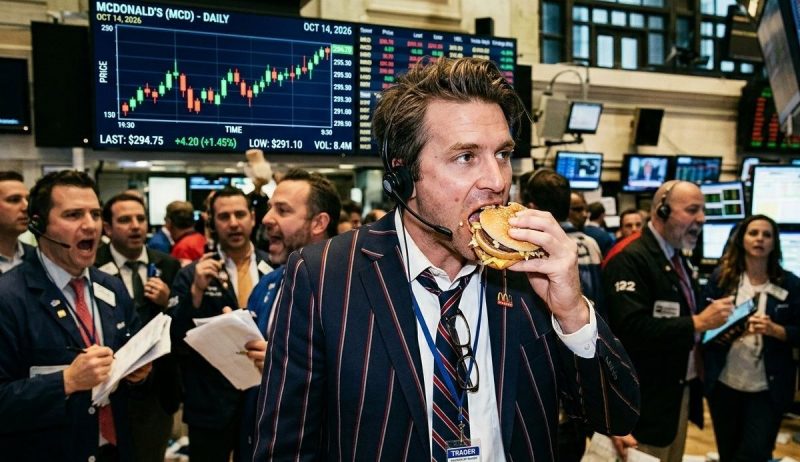
With the McRib, McDonald’s will soon lose an established menu item. Many fans mourned the pork burger online. With this burger, the “Falling Down vibes” were gone for good. But it is not just McRib fans that the company is currently missing. Above all, McDonald’s is also missing investors willing to buy back in.
The shares of the company, popular as a “compounder”, hit a four-year low just a few days ago. The fast-food giant is clearly struggling with the weak economy. In its home market, the US, consumer sentiment is near pandemic lows, as the University of Michigan index recently showed. Like many competitors, McDonald’s has also raised prices sharply in recent years, leading customers to hold back. Prices are a far cry from the cheap burgers of earlier times. But the group still has to recoup its rising costs.
Management wants to counter this with the “NEXT” strategy unveiled in the summer. CEO Chris Kempczinski and his team are planning innovations to entice customers back into restaurants more often, such as new chicken products or a drinks offensive. Alongside this, however, the company is making significant investments in digitalisation and automation. In future, AI could play the most important role at the drive-through. Potential is also seen in automating the kitchens. Last but not least, work is also to be done on restaurant design.
All this sounds like a lot and, of course, costs money initially, and not a small amount. A total of around USD 8.5 billion is to be made available as part of “NEXT”. Adding the planned investments in ongoing operations brings the sum to USD 20 billion and more over the coming years. This eats into margins, and that is likely to have prompted stock market investors to hold back on the shares.
Analysts currently seem to be the only optimists when it comes to the stock. Banks such as UBS and DZ Bank continue to recommend buying shares, with many price targets around USD 300, implying considerable upside. However, consumer stocks are currently out of favour on US markets, and consumer sentiment is unlikely to improve quickly. For now, we would give McDonald’s shares a miss.
dynaCERT: New Orders Provide Fresh Momentum
High oil prices and the resulting high fuel prices are currently making life difficult not just for German consumers. The rush for alternative powertrains has already begun, as running costs make the difference. Volkswagen reported on the sidelines of the motor show in Paris that it already had 150,000 orders for its four latest electric vehicle models. For several models, buyers already have to wait until the beginning of next year for delivery.
For consumers, high diesel prices may be an unpleasant problem, but for truck fleet operators, they could threaten their very existence. Competitors from countries with lower fuel prices gain cost advantages, while others see their costs spiral.
But there are also ways for freight forwarders, logistics providers and others to reduce fuel costs relatively quickly. dynaCERT has developed an approach that allows diesel trucks to be retrofitted with its HydraGEN™ technology at short notice. The process not only saves diesel, but also makes the engine run more cleanly and efficiently. The system produces hydrogen and oxygen onboard during operation and feeds them directly into the engine’s air intake system. The patented technology can be installed quickly and does not require a separate hydrogen tank. The unit is only the size of a standard suitcase.
The German management team led by CEO Kevin Unrath can now report further successes in series production. The company announced that it had received its first series-production order from a logistics provider in Vietnam following successful field tests. This means the technology can also prove itself in large-scale deployment in Southeast Asia. Meanwhile, in France, a follow-up order from an existing customer shows the technology is gaining market acceptance.
The German-Canadian company’s shares have given back the strong gains made in the spring and are now trading at March levels. More recently, the stock has moved higher again on increased trading volumes. With a market capitalisation of around EUR 35 million, the machinery manufacturer still has considerable upside potential. The shares are currently trading about 30% below their year-high.
BioNTech: A Closer Look Is Worthwhile
On Tuesday, shares in the German cancer-treatment hopeful BioNTech initially fell sharply before stabilising during the day. The reason was the new trial data for the immunotherapeutic BNT113. The promising candidate is already in a Phase III trial, the final stage before potential approval, and is being tested in combination with Merck & Co.’s Keytruda in head and neck tumours. However, progression-free survival showed no statistically significant advantage over Keytruda alone. The trial thus missed one of two so-called primary endpoints.
The independent data monitoring committee did recommend continuing the trial. But initially, the shares saw massive selling. Once again, the stock market reacted too early. This is because the data show that the treatment fulfils its intended mechanism of action, according to BioNTech. However, the anti-tumour effects could emerge with a delay. In an initial reaction, BMO analysts consider this interpretation plausible. The immune response could need more time.
Like the results of medical trials, biotech investments are always something of a black box. Investors with a low risk appetite tend to steer clear of the stock. Those willing to take on more risk, however, should take a closer look at the trial data. This helps explain why both the company and BMO’s analyst believe the immune response is likely to take more time to develop.
Conclusion
With BioNTech, investors are backing one of the best-funded companies in oncology. dynaCERT’s latest orders show that its fuel-saving technology is winning over customers. McDonald’s, meanwhile, is primarily competing for consumers’ increasingly limited budgets.
Conflict of interest
Pursuant to §85 of the German Securities Trading Act (WpHG), we point out that Apaton Finance GmbH as well as partners, authors or employees of Apaton Finance GmbH (hereinafter referred to as “Relevant Persons”) may hold shares or other financial instruments of the aforementioned companies in the future or may bet on rising or falling prices and thus a conflict of interest may arise in the future. The Relevant Persons reserve the right to buy or sell shares or other financial instruments of the Company at any time (hereinafter each a “Transaction”). Transactions may, under certain circumstances, influence the respective price of the shares or other financial instruments of the Company.
In addition, Apaton Finance GmbH is active in the context of the preparation and publication of the reporting in paid contractual relationships.
For this reason, there is a concrete conflict of interest.
The above information on existing conflicts of interest applies to all types and forms of publication used by Apaton Finance GmbH for publications on companies.
Risk notice
Apaton Finance GmbH offers editors, agencies and companies the opportunity to publish commentaries, interviews, summaries, news and the like on news.financial. These contents are exclusively for the information of the readers and do not represent any call to action or recommendations, neither explicitly nor implicitly they are to be understood as an assurance of possible price developments. The contents do not replace individual expert investment advice and do not constitute an offer to sell the discussed share(s) or other financial instruments, nor an invitation to buy or sell such.
The content is expressly not a financial analysis, but a journalistic or advertising text. Readers or users who make investment decisions or carry out transactions on the basis of the information provided here do so entirely at their own risk. No contractual relationship is established between Apaton Finance GmbH and its readers or the users of its offers, as our information only refers to the company and not to the investment decision of the reader or user.
The acquisition of financial instruments involves high risks, which can lead to the total loss of the invested capital. The information published by Apaton Finance GmbH and its authors is based on careful research. Nevertheless, no liability is assumed for financial losses or a content-related guarantee for the topicality, correctness, appropriateness and completeness of the content provided here. Please also note our Terms of use.
Stockhouse does not provide investment advice or recommendations. All investment decisions should be made based on your own research and consultation with a registered investment professional. The issuer is solely responsible for the accuracy of the information contained herein. For full disclaimer information, please click here.