


Merck loses its US business and sets the benchmark in Europe
Last week’s figures highlight the pressure on the US business. In its quarterly report, Merck reported a 24% decline in revenue from its MS drug Mavenclad to EUR 232 million and expects US sales to fall to zero from November due to generic competition. In the third quarter, US revenue plunged 42% compared with the previous quarter after competitors such as Apotex and Sandoz launched generic cladribine tablets. At group level, Merck is cushioning the setback with strong growth in its Electronics and Life Science divisions and has raised its full-year revenue guidance to EUR 21.5 to 21.9 billion.
In Europe, meanwhile, Mavenclad continues to grow at a double-digit rate. But the clock is ticking here too: the European basic patent expired at the end of 2025, and the European Commission’s 10-year regulatory market exclusivity expires in August 2027. A bioequivalence study for conventional generic cladribine tablets is already listed in the public EU clinical trials register CTIS. At the same time, Merck sets the bar high for any challenger with the European Medicines Agency (EMA) summary of product characteristics: Mavenclad works as a short-course therapy with a maximum of 20 dosing days over 2 years, and the body absorbs only around 40% of the active ingredient from the tablet. BioNxt attributes this to degradation in the stomach and transporters in the intestine.
Sanofi demonstrates Europe’s distinct regulatory approach
The Sanofi case shows that European authorities make independent decisions where there is a high medical need. The European Commission approved the BTK inhibitor Cenrifki in June for a progressive form of multiple sclerosis without relapses, after the US regulator FDA rejected the application at the end of 2025, primarily because of severe liver damage and doubts about its benefit in subgroups. A limited market launch has been under way in Germany since October, accompanied by liver function monitoring, weekly during the first twelve weeks, and an ongoing benefit assessment by the Federal Joint Committee through April 2027.
Financially, however, Europe does not replace the United States. In the third quarter, Sanofi increased group revenue by 14.3% at constant exchange rates to EUR 14.44 billion, but generated EUR 8.60 billion of this in the US and just EUR 2.58 billion in Europe. Competition is also growing: in October, Roche presented strong Phase 3 data for its competing BTK inhibitor fenebrutinib. Europe is establishing itself not as the biggest sales driver, but as an attractive region for initial approval and development.
BioNxt Solutions ventures into a direct comparison in humans
BioNxt Solutions is bringing its sublingual cladribine dissolving film BNT23001 into this European environment. In mid-October, the company submitted its first application for a clinical trial in humans via the central EU portal CTIS, directly comparing the oral dissolvable film (ODF) with Merck’s Mavenclad. The regulatory review takes around three months. Following the necessary ethics approvals and formal batch release of around 1,500 investigational films manufactured at Gen-Plus in Munich, the study is likely to start in the first quarter of 2027 at the earliest. BioNxt has already postponed the timetable several times.
The medical rationale focuses on patients with swallowing difficulties: according to a meta-analysis published in 2023 involving more than 11,000 MS patients, around 45% experience swallowing difficulties during the course of the disease. However, since cladribine is taken on only a few days each year, this everyday convenience offers less of an advantage than it would with daily long-term treatments.
The pharmacokinetic data in humans will be decisive. In a large-animal study in Bama miniature pigs, the ODF reduced variability in active ingredient absorption by more than two-thirds, according to the company presentation. At the same time, the film’s total exposure was 40.4% higher than that of the tablet. For the intended accelerated EU hybrid procedure, this higher bioavailability also poses a risk. If the film exceeds the EMA’s narrow bioequivalence range of 80% to 125% in humans, a lower revised dose and a time-consuming second study may be required. BioNxt must also demonstrate that the cytotoxic active ingredient is well tolerated locally under the tongue.
Patent strength meets an acute need for funding
On the patent front, BioNxt Solutions has established a solid foundation. In March, the European Patent Office granted unitary patent EP4539857 for 18 EU countries, with a term running until at least June 2043. Management expects an accelerated US patent decision between late December and March 2027.
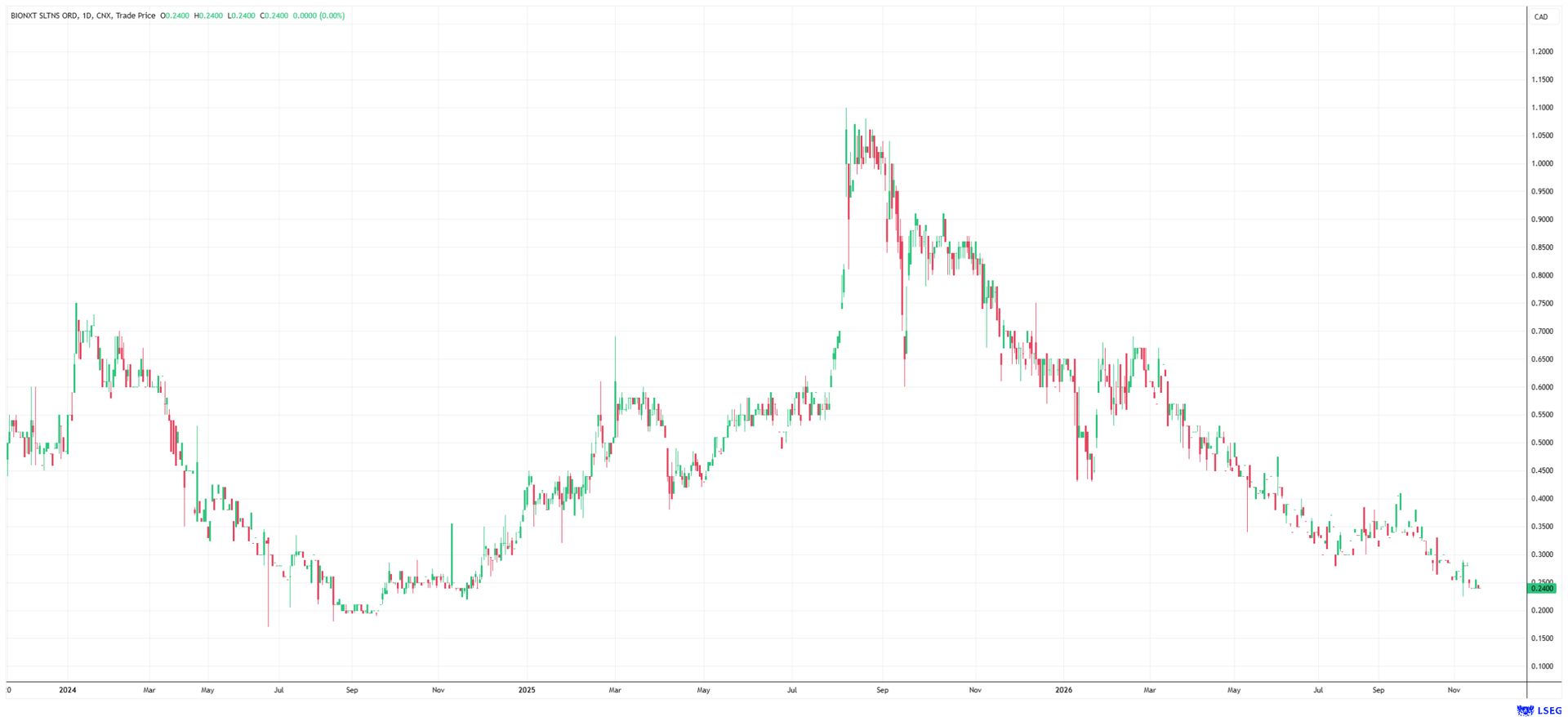
This patent protection is offset by a strained balance sheet. The private placement announced on November 16 of up to CAD 2.5 million at CAD 0.25 per unit, including warrants at CAD 0.50, is therefore necessary to finance the European human trial – while it increases dilution pressure, if successful it also demonstrates that capital providers have confidence in BioNxt’s plans.
Conclusion: Realistic partners and risks for investors
Europe will not replace the US as a global sales driver because of lower net prices and steep generic discounts following patent expiry, but it offers opportunities for improved dosage forms. If BioNxt Solutions succeeds in convincingly demonstrating bioequivalence, interested buyers may be less likely to be global pharmaceutical giants such as Merck or Sanofi than European neurology specialists such as Neuraxpharm and Pharmanovia, or specialised generics suppliers. Aquestive Therapeutics’ diazepam film Libervant illustrates what scale is realistic. Pharmanovia paid just USD 3.5 million upfront for Europe in 2022, while Eton Pharmaceuticals paid USD 10 million for the US in 2026. Given the ongoing capital increase and the risk of excessive absorption of the active ingredient, BioNxt Solutions shares are currently a speculative investment. However, the completion of the capital measure alone could bring the stock back into calmer waters.
Conflict of interest
Pursuant to §85 of the German Securities Trading Act (WpHG), we point out that Apaton Finance GmbH as well as partners, authors or employees of Apaton Finance GmbH (hereinafter referred to as “Relevant Persons”) may hold shares or other financial instruments of the aforementioned companies in the future or may bet on rising or falling prices and thus a conflict of interest may arise in the future. The Relevant Persons reserve the right to buy or sell shares or other financial instruments of the Company at any time (hereinafter each a “Transaction”). Transactions may, under certain circumstances, influence the respective price of the shares or other financial instruments of the Company.
In addition, Apaton Finance GmbH is active in the context of the preparation and publication of the reporting in paid contractual relationships.
For this reason, there is a concrete conflict of interest.
The above information on existing conflicts of interest applies to all types and forms of publication used by Apaton Finance GmbH for publications on companies.
Risk notice
Apaton Finance GmbH offers editors, agencies and companies the opportunity to publish commentaries, interviews, summaries, news and the like on news.financial. These contents are exclusively for the information of the readers and do not represent any call to action or recommendations, neither explicitly nor implicitly they are to be understood as an assurance of possible price developments. The contents do not replace individual expert investment advice and do not constitute an offer to sell the discussed share(s) or other financial instruments, nor an invitation to buy or sell such.
The content is expressly not a financial analysis, but a journalistic or advertising text. Readers or users who make investment decisions or carry out transactions on the basis of the information provided here do so entirely at their own risk. No contractual relationship is established between Apaton Finance GmbH and its readers or the users of its offers, as our information only refers to the company and not to the investment decision of the reader or user.
The acquisition of financial instruments involves high risks, which can lead to the total loss of the invested capital. The information published by Apaton Finance GmbH and its authors is based on careful research. Nevertheless, no liability is assumed for financial losses or a content-related guarantee for the topicality, correctness, appropriateness and completeness of the content provided here. Please also note our Terms of use.
Stockhouse does not provide investment advice or recommendations. All investment decisions should be made based on your own research and consultation with a registered investment professional. The issuer is solely responsible for the accuracy of the information contained herein. For full disclaimer information, please click here.