


The Tungsten Shock: Why Almonty Industries Suddenly Has Systemic Importance
The tungsten market has developed momentum over the past four weeks that has surprised even experienced commodity strategists. What was once considered a niche metal is now openly treated as a security-critical commodity. Prices above USD 3,000 per metric ton unit (MTU) are no longer a short-term blip but rather a reflection of a structural supply deficit, further exacerbated by export restrictions and military demand. In this new reality, the valuation of producers is shifting fundamentally: it is no longer production volume or cash flow alone that determines the price, but rather geopolitical positioning and supply security. This is precisely where Almonty has strategically positioned itself in recent weeks.
IIF moderator Lyndsay Malchuk in conversation with Christopher Ecclestone of Hallgarten & Company about the strategic importance of the Strait of Hormuz and the Middle East conflict, along with the effects on supply chains and global commodity supplies.

Analysts are catching up: The market suddenly discovers the valuation gap
The analyst landscape has noticeably consolidated, not in the sense of short-term price speculation, but as a reaction to a new valuation logic. Several firms have adjusted their models after production officially began in South Korea and, at the same time, price assumptions for tungsten were revised significantly upward. What stands out is the new line of reasoning. Analysts are increasingly speaking of a “valuation gap” because, according to discounted cash flow models, the stock is still trading below its calculated fair value, even though the price has already risen massively. This is a paradoxical but typical pattern seen in early commodity supercycles. Due to the dramatic pace of events, analysts consistently fall behind with their calculations and sometimes have to catch up erratically. This is not euphoria, but pure mathematics. So the market is not beginning to overreact; it is only beginning to understand.
The Relocation to the US: A Political Move with Financial Consequences
The relocation of the company’s headquarters to Dillon (Montana, US) is one of the most strategically significant events of recent weeks, even if it appears at first glance to be an administrative decision. In reality, it is a classic industrial policy move that brings the company closer to government procurement programs and defense contracts. Especially in the context of new US regulations that will restrict the procurement of tungsten from China for military contractors starting in 2027, this creates a structural competitive advantage. Capital markets do not react to such changes immediately, but they do so sustainably. Companies integrated into strategic supply chains often receive more stable valuations and lower financing costs in the long term.
Moving to the Next Phase: Sangdong Becomes a Cash Cow
The true crown jewel in Almonty’s growth story is undoubtedly the Sangdong mine in South Korea. This is not just any mining project, but one of the world’s most outstanding tungsten deposits with strategic significance. The most recently reported data almost reads like a textbook example of a raw material shortage: the grade is around 0.51% tungsten trioxide, and mining is expected to continue for a full 45 years. Such mine lifespans are extremely rare. With the first expansion phase already completed, the market is likely to be supplied with a noticeable amount of tungsten concentrate in the foreseeable future. And this comes at a time when inventory levels among customers in the semiconductor and high-tech industries are looking increasingly critical. Anyone who sees this as just a normal mine is underestimating the leverage. For Almonty, this could become a massive value driver that elevates the company to an entirely new level.
IIF host Lyndsay Malchuk in conversation with CEO Lewis Black about Almonty Industries’ strategic direction for the current year.

Tungsten prices are skyrocketing: But the real story is the supply crisis
The price movement in tungsten is spectacular, but the real problem runs deeper: the supply side can barely react in the short term. Even with immediate financing, it usually takes years for new mines to become operational. In recent months, the price of ammonium paratungstate (APT) has risen by more than 500% compared to the previous year—a level that is exceptional even in commodity markets. The result is a market that reacts extremely price-elastically to demand in the short term but remains structurally undersupplied in the long term. It is precisely this combination that generates sustainable margins. Those who believe the price could fall again quickly are mistaken!
Deutsche Rohstoff Sells: Not an Alarm, but Classic Risk Management
Deutsche Rohstoff AG made a substantial move with Almonty in early April. By selling approximately 9 million shares, or 38% of its holdings, and securing a hefty profit of around EUR 100 million, its stake shrank from 9% to 4.9%. The Mannheim-based company is pouring the proceeds into expanding its oil and gas production, which currently appears very lucrative. The background is certainly also classic profit-taking: Instead of staring endlessly at high prices, one secures profits before the next dip arrives. A timeless stock market adage that sometimes works out well, but can also go terribly wrong.
One day up, one day down: Valuation runs ahead of or behind reality
As convincing as the narrative is, one risk remains clear: The market today values expectations, not results. If production figures fall short of forecasts or the commodity price temporarily corrects, the valuation can quickly come under pressure. Especially in commodity cycles, every phase of euphoria is followed by a phase of consolidation. This is not a sign of weakness, but a necessary part of the market mechanism.

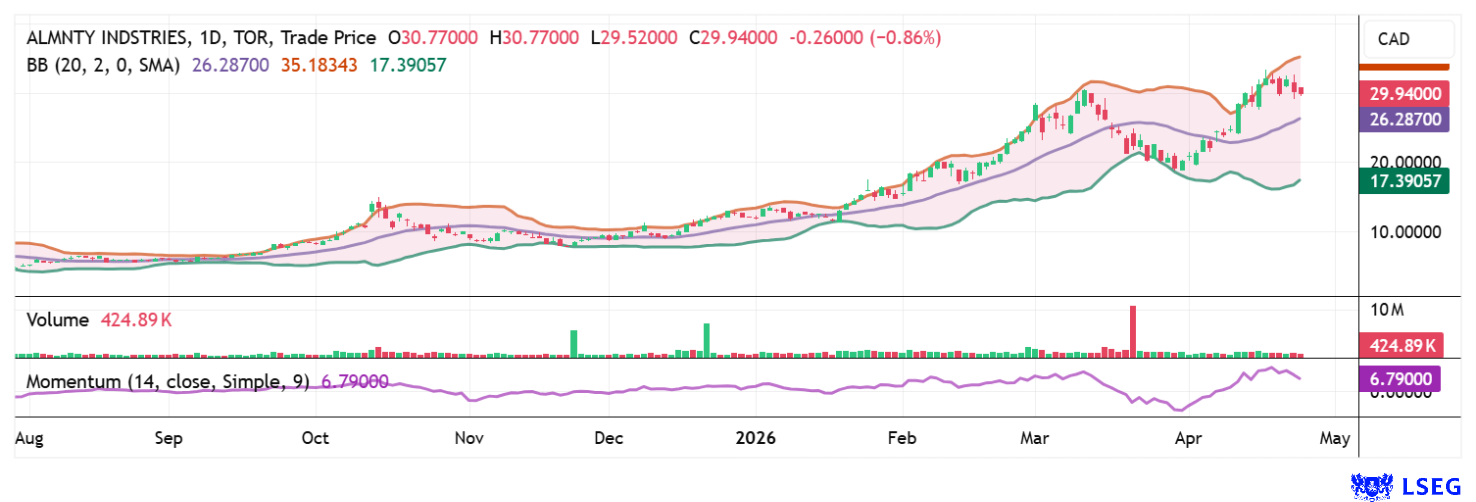
However, the current argument points in a different direction. Every day, the valuation must face new realities of scarcity. This constantly pushes the decision point regarding “short-term overbought or long-term undervalued” further ahead. Consequently, slight technical pullbacks have dominated over the past 5 days, but the fundamental underlying trend remains: Upward!
Conflict of interest
Pursuant to §85 of the German Securities Trading Act (WpHG), we point out that Apaton Finance GmbH as well as partners, authors or employees of Apaton Finance GmbH (hereinafter referred to as “Relevant Persons”) currently hold or hold shares or other financial instruments of the aforementioned companies and speculate on their price developments. In this respect, they intend to sell or acquire shares or other financial instruments of the companies (hereinafter each referred to as a “Transaction”). Transactions may thereby influence the respective price of the shares or other financial instruments of the Company.
In this respect, there is a concrete conflict of interest in the reporting on the companies.
In addition, Apaton Finance GmbH is active in the context of the preparation and publication of the reporting in paid contractual relationships.
For this reason, there is also a concrete conflict of interest.
The above information on existing conflicts of interest applies to all types and forms of publication used by Apaton Finance GmbH for publications on companies.
Risk notice
Apaton Finance GmbH offers editors, agencies and companies the opportunity to publish commentaries, interviews, summaries, news and the like on news.financial. These contents are exclusively for the information of the readers and do not represent any call to action or recommendations, neither explicitly nor implicitly they are to be understood as an assurance of possible price developments. The contents do not replace individual expert investment advice and do not constitute an offer to sell the discussed share(s) or other financial instruments, nor an invitation to buy or sell such.
The content is expressly not a financial analysis, but a journalistic or advertising text. Readers or users who make investment decisions or carry out transactions on the basis of the information provided here do so entirely at their own risk. No contractual relationship is established between Apaton Finance GmbH and its readers or the users of its offers, as our information only refers to the company and not to the investment decision of the reader or user.
The acquisition of financial instruments involves high risks, which can lead to the total loss of the invested capital. The information published by Apaton Finance GmbH and its authors is based on careful research. Nevertheless, no liability is assumed for financial losses or a content-related guarantee for the topicality, correctness, appropriateness and completeness of the content provided here. Please also note our Terms of use.
Stockhouse does not provide investment advice or recommendations. All investment decisions should be made based on your own research and consultation with a registered investment professional. The issuer is solely responsible for the accuracy of the information contained herein. For full disclaimer information, please click here.