

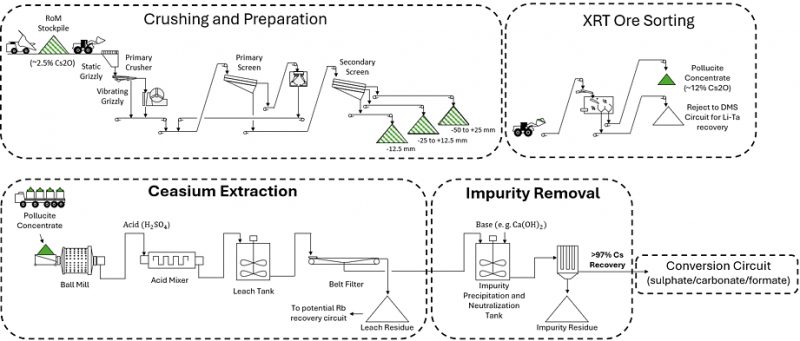
- PMET Resources Inc.’s (TSX:PMET) SGS Canada test program successfully extracted 97–98 per cent of cesium from pollucite concentrate while effectively removing impurities such as aluminum
- Testing identified a possible rubidium by-product recovery opportunity, and the next phase will focus on producing high-purity caesium chemical products, including sulphate, carbonate, and formate
- Parallel work with Koch Technology Solutions also delivered strong selective caesium recovery, supporting PMET’s goal of unlocking value from what it describes as the world’s largest known pollucite-hosted caesium resource
- PMET Resources stock (TSX:PMET) last traded at C$5.15
PMET Resources Inc. (TSX:PMET) reported encouraging results from two parallel bench-scale test programs focused on extracting caesium from pollucite concentrate sourced from its Shaakichiuwaanaan Project in Québec, highlighting progress toward the potential production of value-added caesium chemical products.
The company announced that conventional testing conducted by SGS Canada achieved more than 97 per cent recovery of caesium from pollucite concentrate using sulphuric acid leaching, while a separate program with Koch Technology Solutions (KTS) demonstrated strong selective recovery of the metal through a proprietary extraction process.
The results in a media release serve to support PMET’s broader strategy of evaluating downstream processing opportunities to maximize the value of what it says is the world’s largest known in-situ pollucite-hosted caesium resource.
This article is a journalistic opinion piece that has been written based on independent research. It is intended to inform investors and should not be taken as a recommendation or financial advice.
SGS program achieves high caesium recovery
At SGS Canada’s Lakefield, Ontario facility, PMET tested a conventional extraction process involving sulphuric acid digestion followed by impurity removal. The primary objective was to identify operating conditions capable of extracting caesium at high recovery rates while minimizing impurities in the resulting solution.
Using approximately 15 kilograms of pollucite concentrate produced through X-ray Transmission (XRT) ore sorting, the test program examined different grinding sizes and leaching conditions, including temperatures up to 120°C.
According to the company, the program consistently achieved caesium extraction rates of 97 per cent to 98 per cent. At the same time, key impurities such as aluminum were extracted at significantly lower levels. Follow-up purification tests successfully removed the remaining aluminum and most sulfur from solution while resulting in negligible caesium losses.
The company said the work fulfilled its primary objective of establishing preliminary conditions for high-recovery caesium extraction while characterizing and limiting impurity content.
In addition, researchers identified a potential opportunity to recover rubidium as a by-product from one of the process streams. Further assessment of rubidium recovery was not part of the initial program but may become a focus of future testing.
Focus shifts to caesium chemical products
With the extraction phase largely successful, PMET’s next step is to advance proof-of-concept work aimed at producing gram-scale quantities of high-purity caesium compounds.
The company plans to focus on the development of caesium sulfate, caesium carbonate, and caesium formate products, while also evaluating the potential production of rubidium carbonate.
This next phase of testing is already underway at the SGS facility, with results expected during the fourth quarter of 2026.
SGS is conducting the work with support from Primero Group Americas and a company-retained subject matter expert specializing in caesium extraction and recovery technologies. These groups have also contributed to PMET’s ore-sorting initiatives alongside TOMRA Mining.
Koch Technology Solutions advances proprietary process
In parallel, PMET is collaborating with Koch Technology Solutions, a subsidiary of Koch Inc., to evaluate alternative processing routes for producing value-added caesium products.
The KTS program uses approximately six kilograms of pollucite concentrate and is designed to assess the applicability of the company’s proprietary flowsheet technology.
Preliminary Phase 1 testing indicated strong and selective caesium recovery from both synthetic and live pregnant leach solutions, according to PMET. The company said the results demonstrated high loading factors and efficient caesium capture through the KTS process.
Following these initial results, the program is advancing to Phase 2. PMET also indicated it may expand the scope of the KTS work to include production of gram-scale caesium derivative products as part of a complete bench-scale proof-of-concept study.
The importance of the caesium resource
PMET is primarily known for its significant lithium and tantalum assets at the Shaakichiuwaanaan Project. However, the company also controls what it describes as the world’s largest in-situ pollucite-hosted caesium mineral resource.
The current resource estimate includes:
- 0.69 million tonnes grading 4.40 per cent Cs₂O in the Indicated category
- 1.70 million tonnes grading 2.40 per cent Cs₂O in the Inferred category
The caesium resource is hosted within the CV13 Pegmatite, including the Vega Caesium Zone, located less than three kilometres from the company’s flagship CV5 Pegmatite.
The concentrate used in both extraction programs was produced from drill core material obtained from the Vega Zone and graded approximately 12 per cent Cs₂O after ore sorting.
Economic studies underway
PMET said the ongoing metallurgical programs form part of a broader effort to evaluate the commercial potential of caesium production alongside lithium and tantalum.
A Preliminary Economic Assessment (PEA) covering lithium, caesium, and tantalum is expected to be completed in the fourth quarter of 2026. The study will provide what the company says will be the first comprehensive economic assessment of the project’s caesium potential.
The PEA is scheduled to be released alongside a Feasibility Study for the CV5 Pegmatite’s lithium and tantalum development, also targeted for completion in the fourth quarter of 2026.
The latest testwork results suggest PMET is making progress toward establishing viable processing routes for caesium recovery and downstream chemical production, potentially adding a third strategic commodity stream to a project already recognized for its lithium and tantalum resources.
About PMET Resources Inc.
PMET Resources Inc. engages in the identification, acquisition of exploration, development, and evaluation of mineral properties in the United States and Canada.
PMET Resources stock (TSX:PMET) opened trading 2 per cent lower at C$5.15 and is down 7.41 per cent since the year began, but has risen 59.24 per cent since this time last year.
Join the discussion: Find out what the Bullboards are saying about PMET Resources and check out Stockhouse’s stock forums and message boards.