

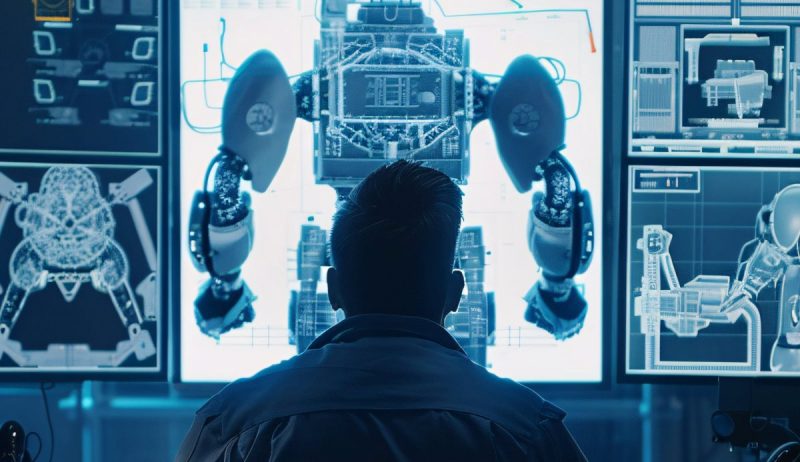
Rheinmetall – Between Missile Deals and a Space Offensive
Rheinmetall is systematically driving the unmanned future of the battlefield. The LUNA NG drone family provides reconnaissance from contested zones with a flight duration of over 12 hours, supplemented by the FV-014 “Raider” for precision strikes. On the ground, the PATH module transforms conventional vehicles into autonomous convoys, while Mission Master robots handle logistics and dangerous missions. Three new centers of excellence in Germany are consolidating the development of swarm intelligence and defense technologies. The group is positioning itself at the forefront of the next stage of military technology, not just in the air.
The past two weeks have seen decisive strategic moves. Together with Destinus, Rheinmetall is founding a joint venture for cruise missiles and ballistic missile artillery. The headquarters are in Unterlüß, with an existing production capacity of over 2,000 systems per year. At the same time, the US subsidiary received the coveted CMMC Level 2 cyber certification for all six plants—a sort of ticket to future Pentagon contracts. Added to this is the accelerated construction of the third Class 424 fleet service vessel at the Peene shipyard, a clear signal of accelerated naval rearmament.
In parallel, Rheinmetall is breaking new ground. A satellite test center is being built in Andøy, Norway, designed to strengthen the local space and defense industry. The cooperation with Boeing Australia on the MQ-28 Ghost Bat combat drone aims for a Bundeswehr contract by 2029, with a potential value in the hundreds of millions for Rheinmetall as system manager. Although Citi warns of normalizing ammunition demand with a neutral rating of EUR 1,480, the long-term trend toward higher defense spending in Europe remains intact. The stock is currently trading at EUR 1,520.60.
First Hydrogen – From Niche Provider to Technology Portfolio
Anyone looking at First Hydrogen in the spring of 2026 will be presented with a completely new picture. The company, which originally developed hydrogen vehicles, has expanded radically within just a few weeks. The exclusive global rights to a patented, AI-controlled robotic platform for ground operations mark the first step. The vehicle combines solar cells, a battery, and a fuel cell, and thanks to eight articulated legs, it moves just as smoothly over rough terrain as it does on asphalt. The platform is not a prototype destined for the drawer. It is expected to be ready for series production in two years, and First Hydrogen retains all rights to further developments. Customers rent the system via a subscription, similar to software.
This fits perfectly with the existing hydrogen service model. The market for Drone-as-a-Service (DaaS) is growing rapidly, and a huge field is opening up, particularly in the military sector as well as in security applications, agriculture, and construction. Management has made a clever combination here. At the same time, First Hydrogen is advancing its own energy supply. First Nuclear Corp, a subsidiary founded in January, is focusing on small modular reactors to produce green hydrogen around the clock, regardless of weather conditions. This is the decisive advantage over solar or wind power.
The company’s fuel cell commercial vehicles are already registered in the UK and have a range of over 630 km. In-house production eliminates dependence on external suppliers. Financially, the company remains disciplined. A placement of up to CAD 3 million strengthens working capital, ensuring the next steps in expansion. With a market capitalization equivalent to approximately CAD 31.4 million, the overall package of hydrogen mobility, AI robotics, and nuclear energy is by no means overpriced. Those looking to invest early in connected future technologies will find a bundled offering here. The stock is currently trading at CAD 0.40.

Volkswagen: On A Cost-Cutting Path
The shift toward self-driving vehicles presents the entire industry with enormous technical challenges. Every vehicle equipped with lidar sensors and high-performance chips requires a perfectly optimized software platform. However, Volkswagen has been lagging in this area. Its internal software has long been a weak point. But that could be about to change. New chip deals with Horizon Robotics and XPeng in China, as well as the successful winter testing of Rivian’s software, are injecting momentum into autonomous development. The company is closing technological gaps—an early sign of a potential turnaround. The path toward self-driving models is becoming clearer.
The latest reports read like a restructuring roadmap. 50,000 jobs are being cut in Germany, while US tariffs and the weakening Chinese market are squeezing margins. The operating target for 2026 is a return of just 4 to 5.5%. Yet VW is responding with unusual flexibility. The Elli subsidiary is building large-scale storage facilities for energy trading, a new source of cash. The Rivian partnership for electronic architectures is in full swing, providing breathing room in the fierce competition with BYD and Tesla. The job cuts are painful, but there is no alternative.
Despite the cost-cutting measures, the model strategy remains aggressive. Over 20 new electrified vehicles are coming this year, including locally developed Chinese EVs. Order backlogs in Europe are picking up, and the battery division PowerCo is expected to reach the break-even point by 2027. Analysts see upside potential of over 20%, but warn of trade conflicts and high energy costs. Whether this rally succeeds will become clear in the second half of the year. Anyone jumping in now needs patience—and strong nerves. The coming months will be decisive. The stock is currently trading at EUR 92.28.
Forget AI stocks—unmanned systems for air, ground, and civilian use are likely to play an increasingly important role in the coming years. Rheinmetall is driving LUNA drones, PATH ground modules, and a missile joint venture. First Hydrogen, in turn, combines a patented AI-controlled robot platform with hydrogen mobility and small nuclear reactors into a broad technology portfolio. Volkswagen, meanwhile, is pushing its way into the autonomous leadership group, despite cost-cutting measures and job cuts, with chip deals and Rivian software, featuring over 20 new electric models. The structural trend here is comparable to that of electric mobility. Early positioning could offer upside if the trend continues.
Conflict of interest
Pursuant to §85 of the German Securities Trading Act (WpHG), we point out that Apaton Finance GmbH as well as partners, authors or employees of Apaton Finance GmbH (hereinafter referred to as “Relevant Persons”) currently hold or hold shares or other financial instruments of the aforementioned companies and speculate on their price developments. In this respect, they intend to sell or acquire shares or other financial instruments of the companies (hereinafter each referred to as a “Transaction”). Transactions may thereby influence the respective price of the shares or other financial instruments of the Company.
In this respect, there is a concrete conflict of interest in the reporting on the companies.
In addition, Apaton Finance GmbH is active in the context of the preparation and publication of the reporting in paid contractual relationships.
For this reason, there is also a concrete conflict of interest.
The above information on existing conflicts of interest applies to all types and forms of publication used by Apaton Finance GmbH for publications on companies.
Risk notice
Apaton Finance GmbH offers editors, agencies and companies the opportunity to publish commentaries, interviews, summaries, news and the like on news.financial. These contents are exclusively for the information of the readers and do not represent any call to action or recommendations, neither explicitly nor implicitly they are to be understood as an assurance of possible price developments. The contents do not replace individual expert investment advice and do not constitute an offer to sell the discussed share(s) or other financial instruments, nor an invitation to buy or sell such.
The content is expressly not a financial analysis, but a journalistic or advertising text. Readers or users who make investment decisions or carry out transactions on the basis of the information provided here do so entirely at their own risk. No contractual relationship is established between Apaton Finance GmbH and its readers or the users of its offers, as our information only refers to the company and not to the investment decision of the reader or user.
The acquisition of financial instruments involves high risks, which can lead to the total loss of the invested capital. The information published by Apaton Finance GmbH and its authors is based on careful research. Nevertheless, no liability is assumed for financial losses or a content-related guarantee for the topicality, correctness, appropriateness and completeness of the content provided here. Please also note our Terms of use.
Stockhouse does not provide investment advice or recommendations. All investment decisions should be made based on your own research and consultation with a registered investment professional. The issuer is solely responsible for the accuracy of the information contained herein. For full disclaimer information, please click here.