

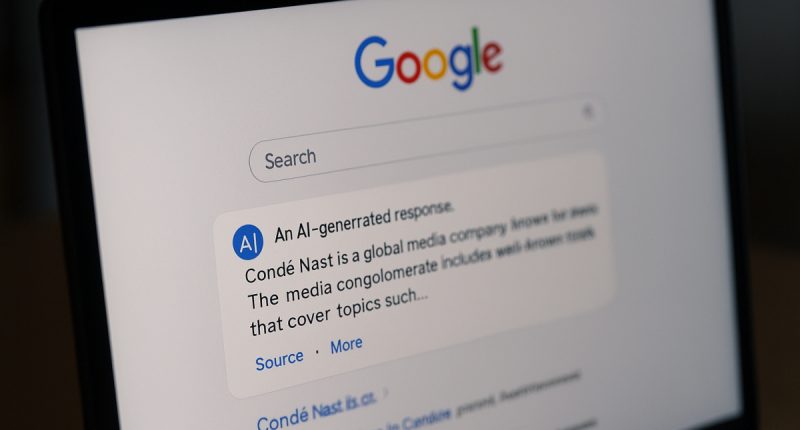
- Google (NASDAQ:GOOG) is transforming its search into an AI answer engine that gives users direct responses instead of sending them to websites
- Major publishers are already preparing for a future where search traffic disappears as AI summaries replace clicks
- Website traffic is collapsing across the internet with most searches now ending without users leaving Google
- The shift is redistributing value away from content creators toward AI platforms that aggregate and deliver information
In May 2026, a subtle but profound signal emerged from the executive suite of one of the world’s most influential media companies.
Roger Lynch, CEO of Condé Nast — publisher of Vogue, Vanity Fair, and The New Yorker — told his teams to prepare for a future where Google sends them effectively zero traffic.
This “Google Zero” scenario would have sounded extreme just a few years ago. Today, it looks increasingly inevitable.
The catalyst? Google’s sweeping AI transformation of Google’s search — a shift that could redefine not just the internet, but the global investment landscape.
From search engine to answer engine
For decades, Google’s (owned by Alphabet (NASDAQ:GOOG)) search functioned as the internet’s routing system — sending billions of users to websites via the famous “10 blue links.”
That model is now breaking.
At its annual developer conference in May 2026, Google unveiled what it calls the biggest upgrade to its search in more than 25 years, replacing traditional results with an AI-powered interface driven by its Gemini model.
The new experience doesn’t just return links — it answers questions directly, generates summaries, executes tasks, and holds conversational context.
AI Mode alone has already surpassed 1 billion monthly users, with usage growing rapidly as queries become longer and more complex.
In other words, Google is collapsing:
- searching
- researching
- summarizing
- and task execution
…into a single AI-driven layer.
Or, as one analyst put it: Search is no longer a gateway — it’s becoming the destination.
This article is a journalistic opinion piece that has been written based on independent research. It is intended to inform investors and should not be taken as a recommendation or financial advice.
The “Google Zero” reality is already here
For publishers, this transformation is not theoretical — it’s already hitting revenue models in real time.
Take Nicholas Bouliane, the developer behind All About Berlin. Following Google’s AI rollout, he reported that his site traffic has plunged 70 per cent.
His experience is not an outlier.
- Some publishers have reported traffic declines of 30–40 per cent or more due to AI search features
- Others have seen even sharper drops — in some cases up to 70–90 per cent
- Globally, search referrals to news sites have already fallen sharply, with executives expecting a further 43 per cent decline in the coming years
Even more striking: the majority of searches are no longer sending users anywhere at all.
According to Similarweb data, roughly 69 per cent of Google searches now end without a click — meaning users get their answer without ever visiting a website.
This is the essence of “Google Zero.”
The end of the traffic economy
For the last 20 years, the internet ran on a simple economic loop:
Content → Google’s search → traffic → ads / subscriptions
That loop is now breaking at its core.
Nearly 70 per cent of news-related searches already result in no click-out to publishers, as AI summaries and in-page answers satisfy user intent directly.
And importantly, this shift isn’t just technological — it’s behavioural.
Google’s own data shows that users increasingly:
- ask longer, conversational queries
- expect full answers instantly
- treat search more like a chatbot than a directory
The implication is profound:
The value chain is moving upstream — from content creators to the AI systems that aggregate and deliver their work.
Why this matters for investors
For investors, this is not just a media story — it’s a multi-trillion-dollar reordering of value creation.
1. Winners: Platforms and infrastructure
Google, Microsoft, and other AI platform providers stand to benefit enormously:
- More time spent inside their ecosystems
- More opportunities for integrated ads
- Greater pricing power over information access
As AI becomes the interface layer, platform control becomes even more valuable than distribution.
2. Losers: Traffic-dependent businesses
Entire industries are exposed:
- Digital publishers
- Affiliate marketing businesses
- SEO-driven e-commerce
- Mid-tier content platforms
These models rely on user acquisition through search visibility — a channel that is rapidly disappearing.
Even high-quality content is not immune. AI summaries often extract and compress it into a few lines, reducing the incentive to click through.
3. Emerging opportunity: “Answer engine optimization”
A new paradigm is forming:
Instead of competing for clicks, companies must compete to be:
- quoted
- summarized
- cited
Inside AI-generated responses.
This shift — sometimes called Answer Engine Optimization (AEO) — could create new winners among:
- authoritative brands
- niche experts
- proprietary data owners
4. Second-order effects: The AI supply chain
Perhaps the most underappreciated investment implication is this:
If AI becomes the front-end of the internet, then:
- data → compute → energy → infrastructure
…become the true bottlenecks.
This is why the AI boom is spreading far beyond tech:
- data centers
- power grids
- semiconductor supply chains
All benefit from the massive compute demands behind AI search.
The core question: Creation vs aggregation
At its heart, this moment raises a fundamental economic question:
Who captures value in an AI-driven economy — the creators of information, or the aggregators?
Historically, Google sat in the middle — indexing content while sending traffic back.
Now, it is increasingly extracting value without returning it.
Publishers are already calling it an existential threat. Some are exploring:
- licensing deals with AI companies
- paywalls and subscriptions
- direct audience models (newsletters, communities)
But the balance of power has clearly shifted.
The investment thesis
The AI search transition isn’t just an incremental upgrade — it’s a platform shift on par with:
- the rise of mobile
- the emergence of social media
- the birth of the internet itself
And like all platform shifts, it creates both enormous opportunity and structural dislocation.
Key takeaways for investors:
- AI is not just a tech story — it’s changing business models across industries
- Platform companies are consolidating power
- Traffic-based economics are under structural pressure
- New winners will emerge around data ownership and authority
Do electric sheep dream of digital grass?
Roger Lynch’s “Google Zero” warning may sound drastic.
But history suggests that when executives at the center of an industry start preparing for worst-case scenarios…
…it’s usually because the future has already arrived.
The only question now is:
Who adapts — and who gets left behind in the answer engine economy?
Searching for answers
Alphabet Inc. is one of the world’s largest diversified technology companies. The company’s segments include Google Services, Google Cloud, and Other Bets. The Google Services segment includes products and services such as ads, Android, Chrome, devices, Google Maps, Google Play, Search and YouTube.
Alphabet Inc. stock (NASDAQ:GOOG) last traded at US$383.19 and has risen 125 per cent since this time last year.
Join the discussion: Find out what everybody’s saying about Google on the Alphabet Inc. Bullboard, and check out the rest of Stockhouse’s stock forums and message boards.