


BASF – Life sciences as a growth driver in the portfolio
With its life science activities, DAX giant BASF is positioning itself as a broadly diversified partner for global megatrends in nutrition, health, and sustainable agriculture. Through its Nutrition & Care and Agricultural Solutions segments, the group is targeting structural growth markets that are relatively resilient to economic cycles and are driven by demographic change and rising prosperity. In the Nutrition & Health segment, BASF offers a broad portfolio of vitamins, carotenoids, sterols, enzymes, emulsifiers and omega-3 fatty acids, thus occupying key interfaces in human and animal nutrition. The company also supplies flavors and fragrances as well as active pharmaceutical ingredients and excipients, thereby strengthening its position as an integrated solution provider for the health and nutrition industry. On the agricultural side, BASF combines modern crop protection solutions with plant biotechnology and digital farming to increase yields, use resources more efficiently and meet regulatory requirements for sustainability. In the Plant Science division, the company develops genetically optimized crops with higher yields, improved nutrient content and greater suitability as renewable raw materials, thereby creating additional value-added potential throughout the agricultural and bioeconomy. This sector has grown steadily in recent years, which cannot be said with the same certainty for the chemicals division.
From an investor’s perspective, the life sciences activities, with their high proportion of recurring revenue, attractive margins and structural growth, create a high-quality earnings base that significantly cushions the classic cyclical nature of the chemical industry. Despite a solid position, BASF shareholders have lost a full 11% over the past 12 months in a market characterized by index highs. One small consolation: after the Annual General Meeting on April 30, a dividend of EUR 1.82 will be paid. The 12-month price targets on the LSEG platform are around the EUR 50 mark.
Mustard instead of chemicals: How MustGrow plans to make agriculture more sustainable
The global agricultural sector is facing profound change as the growing world population needs more food. At the same time, there are increasing demands for sustainability, healthy soils, and the elimination of chemical residues. More and more synthetic active ingredients are coming under regulatory pressure, while farmers still need to achieve high and stable yields. It is precisely in this area of tension that new markets are emerging for biological and regenerative agricultural solutions that can replace or supplement traditional chemical products.
MustGrow Biologics is a small company that specializes in this development. The innovative agricultural specialist from Canada uses natural active ingredients from mustard seeds to develop biological solutions for plant protection and soil improvement. The characteristic pungency of mustard, wasabi, and horseradish is cleverly integrated, as it is based on the plants’ natural defense molecules. MustGrow isolates and concentrates these valuable substances for its agricultural applications. After several years of research, this resulted in a patented technology platform that can be used both to combat soil pests and to improve soil fertility.
A key product is the biofertility booster TerraSante™, which is already approved in several US states and is also certified for organic farming. The product stimulates microbial activity, improves root growth, and makes plants more resistant to stress factors. This is a brilliant idea, because once placed with fruit growers, for example, it opens up an attractive market for recurring revenue in high-quality fruit and vegetable crops. At the same time, MustGrow is developing TerraMG, a biological solution for controlling soil-borne diseases and pests, which has shown very high efficacy in some field trials. **Strategically, the company combines two business models: On the one hand, it sells products directly through its own sales unit, NexusBioAg, in North America, thus tapping into the market of farmers and distribution partners. On the other hand, MustGrow relies on a capital-light licensing model with large agricultural corporations. Of particular importance here is the exclusive agreement with Bayer Crop Science for the marketing of biocontrol technology in Europe, Africa, and the Middle East. A global partner takes on a large part of the cost-intensive approval processes and, at the same time, contributes an international distribution network. This saves money and increases effectiveness!
Operationally, the company is currently in the process of transitioning from research to broader commercialization. Initial revenue has already been achieved in Canada and the US, with demand at times even exceeding production capacity. This rapid success must now be followed by the necessary operational structures. At the same time, MustGrow’s technologies address the billion-dollar market for fertilizers and crop protection, which, thanks to a growing patent base, creates a good barrier to entry for potential imitators.
Of particular interest to investors is that the business model is scalable and can be rolled out internationally with comparatively low capital investment. Following CAD 2 million in financing at CAD 0.50, there are now around 62.9 million shares outstanding. This brings the valuation to just under CAD 35 million – a very low figure given the current technological background and further growth options in weed control, pests, storage potatoes, and even areas outside traditional agriculture. Additional potential: For large crop science companies such as Bayer, MustGrow would be a drop in the ocean for the balance sheet, but strategically valuable!
COO Colin Bletsky explained what it is all about at the 18th International Investment Forum.
Novo Nordisk and BioNTech – Bumpy charts fuel investor discontent
After a price correction of over 60%, investors in Novo Nordisk have been waiting for a renewed growth impulse in the obesity drug market. However, analysts currently see several structural challenges. Firstly, the company has disappointed with a surprisingly weak outlook for 2026, as it expects a decline in revenue and operating profit of around 5% to 13%, which calls into question the growth story of recent years. Second, margins are coming under increasing pressure as Novo Nordisk has to lower the prices of its GLP-1 drugs in key markets, particularly in the US, in order to remain competitive with rivals such as Eli Lilly. In addition, patent expiries in some international markets and partly disappointing study data for new pipeline products are weighing on analysts’ confidence in the long-term innovation pipeline. Nevertheless, 9 out of 30 analysts on the LSEG platform remain positive and calculate an average price target of DKK 328 – a potential return of 33% based on a current trading price of DKK 245.
The Mainz-based BioNTech Group also appears to be entering a more difficult phase. The announced withdrawal of founders Uğur Şahin and Özlem Türeci from the operational management of BioNTech marks a strategic turning point for the company. While BioNTech is increasingly developing into a commercial biopharmaceutical company with a focus on late-stage clinical programs, the founders want to focus more on scientific breakthroughs in the future. They are planning to establish a new company for next-generation mRNA therapies. The news triggered a significant short-term market reaction, with the stock falling 22%, as investors fear the possible loss of scientific visionaries and a potential leadership gap. BioNTech is now trading near its cash value, meaning the pipeline is effectively priced at zero. It is questionable how much further the stock can fall.

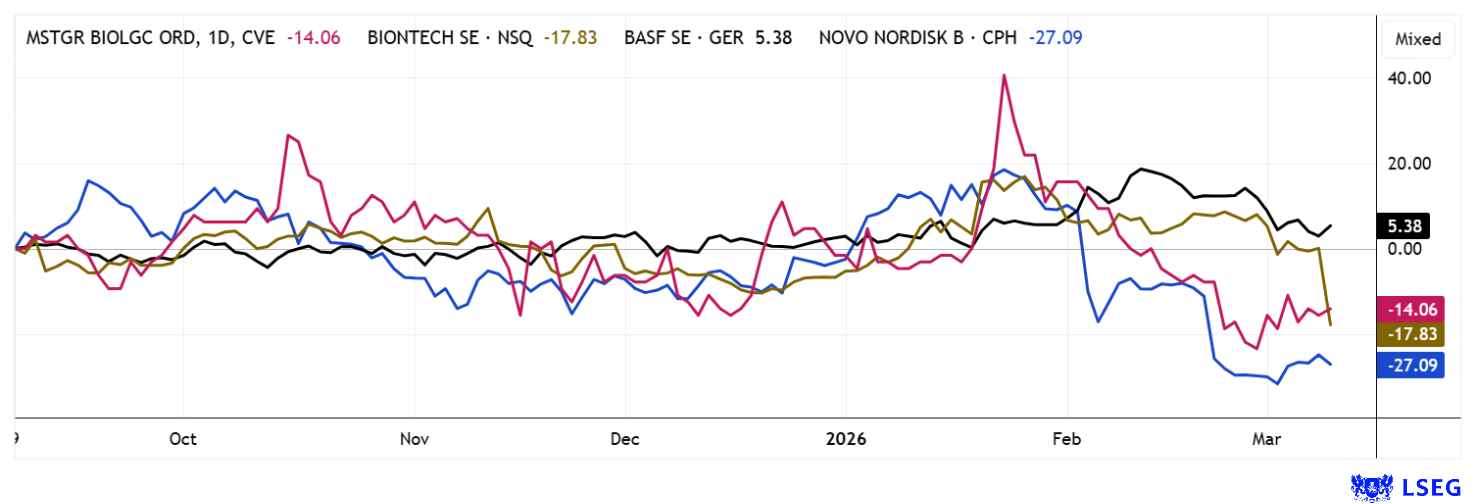
The Life Science sector is still characterized by some skepticism, but has recently shown the first signs of life. Key stocks such as BASF and Novo Nordisk are likely to finally turn the tide in 2026, while BioNTech may be facing restructuring. CropScience innovator MustGrow Biologics is moving into the spotlight with its promising patented mustard technology. Rapid valuation premiums are possible here.
Conflict of interest
Pursuant to §85 of the German Securities Trading Act (WpHG), we point out that Apaton Finance GmbH as well as partners, authors or employees of Apaton Finance GmbH (hereinafter referred to as “Relevant Persons”) currently hold or hold shares or other financial instruments of the aforementioned companies and speculate on their price developments. In this respect, they intend to sell or acquire shares or other financial instruments of the companies (hereinafter each referred to as a “Transaction”). Transactions may thereby influence the respective price of the shares or other financial instruments of the Company.
In this respect, there is a concrete conflict of interest in the reporting on the companies.
In addition, Apaton Finance GmbH is active in the context of the preparation and publication of the reporting in paid contractual relationships.
For this reason, there is also a concrete conflict of interest.
The above information on existing conflicts of interest applies to all types and forms of publication used by Apaton Finance GmbH for publications on companies.
Risk notice
Apaton Finance GmbH offers editors, agencies and companies the opportunity to publish commentaries, interviews, summaries, news and the like on news.financial. These contents are exclusively for the information of the readers and do not represent any call to action or recommendations, neither explicitly nor implicitly they are to be understood as an assurance of possible price developments. The contents do not replace individual expert investment advice and do not constitute an offer to sell the discussed share(s) or other financial instruments, nor an invitation to buy or sell such.
The content is expressly not a financial analysis, but a journalistic or advertising text. Readers or users who make investment decisions or carry out transactions on the basis of the information provided here do so entirely at their own risk. No contractual relationship is established between Apaton Finance GmbH and its readers or the users of its offers, as our information only refers to the company and not to the investment decision of the reader or user.
The acquisition of financial instruments involves high risks, which can lead to the total loss of the invested capital. The information published by Apaton Finance GmbH and its authors is based on careful research. Nevertheless, no liability is assumed for financial losses or a content-related guarantee for the topicality, correctness, appropriateness and completeness of the content provided here. Please also note our Terms of use.
Stockhouse does not provide investment advice or recommendations. All investment decisions should be made based on your own research and consultation with a registered investment professional. The issuer is solely responsible for the accuracy of the information contained herein. For full disclaimer information, please click here.