

Shell: Turning CO₂ into Aviation Fuel
Shell is continuing to drive the development of synthetic fuels. Together with the Fraunhofer IKTS and the Austrian technology group AVL, the energy giant is launching a 4-year research program for a new power-to-liquids technology. The focus is on producing synthetic jet fuel from CO₂ and low-carbon electricity.
Shell plans to build a pilot plant for this purpose at the Shell Energy Transition Campus in Amsterdam. The technology combines high-temperature co-electrolysis, membrane separation, and the Fischer-Tropsch synthesis. A 24-kW electrolyzer will be coupled with Shell’s existing Fischer-Tropsch pilot plant. This is intended to ensure that the individual process steps integrate more efficiently and to reduce the currently high production costs of e-SAF in the long term.
Shell is contributing its X-to-Liquids technology, which is based on decades of experience with gas-to-liquids processes. Fraunhofer is providing the co-electrolysis technology, while AVL is contributing its expertise in electrolysis systems.
Aviation is one industry where direct electrification is difficult to achieve. Liquid fuels are therefore likely to remain necessary for a long time to come; however, their production must become more climate-friendly.
Shell is therefore not relying on a single technology. The company is attempting to apply its experience with molecules, refineries, and fuels to a world in which CO₂ itself is increasingly becoming a raw material. If it succeeds in producing synthetic kerosene more economically, this could, in the long term, create a new billion-dollar market for the energy industry.
A.H.T. Syngas: Replacing Natural Gas with Waste Materials
A.H.T. Syngas operates much earlier in the value chain. The company develops decentralized plants that convert biomass and waste materials into synthesis gas. At the heart of the system is the standardized R116 gas generator, which operates on the dual-fire principle. In addition to various types of wood, the system can also use waste materials such as fermentation residues, sewage sludge, or manure. The gas produced can then be utilized to provide heat and electricity.
This can be particularly interesting for industrial companies. Instead of purchasing natural gas, companies can use locally available waste materials for energy. A.H.T. addresses supply security, waste disposal, and decarbonization all at once.
Strategically, the company aims to evolve beyond its role as a traditional plant builder. In the future, some plants will be operated either independently or in collaboration with partners. Through this contracting model, A.H.T. could generate recurring revenue from energy supply in addition to one-time plant sales. According to the company, it is currently supporting projects in Germany, Austria and Poland.
In Poland, an exclusive partnership with INNOTEC was agreed upon in March. The partner is responsible for project development and acts as the general contractor; at the time of the announcement, it held rights to 17 projects.
Hydrogen offers additional potential. A.H.T., together with partners, received a patent for hydrogen production from solid biomass. In the long term, the synthesis gas could not only replace natural gas but also serve as a starting point for hydrogen, methanol, or sustainable aviation fuels.
A.H.T. is still in an early stage of development. For this very reason, it will be crucial to see whether the project pipeline, contracting, and patented technology actually generate scalable revenue. Analysts at GBC AG also recently identified significant potential. In their December 2025 research note, they reaffirmed their “Buy” rating and a price target of EUR 8.50. Based on a current share price of EUR 2.70, this would mathematically correspond to a potential gain of approximately 215%.

OPAL Fuels: Landfill Gas Becomes an Energy Resource
OPAL Fuels is already demonstrating, at an industrial scale, the value that so-called waste can hold. On September 16, the US specialist extended its gas usage rights at the Miramar Landfill in San Diego for another 5 years. There, methane, which would otherwise be released into the atmosphere, is captured and subsequently used to generate electricity.
Over the additional contract term, OPAL expects electricity production of approximately 400,000 MWh. Mathematically, this corresponds to the annual electricity consumption of more than 6,000 US households. The facility supplies the city of San Diego and also supports Marine Corps Air Station Miramar, a militarily significant installation. The partnership has been in place for 28 years.
However, the business model goes well beyond electricity generated from landfill gas. OPAL produces and markets Renewable Natural Gas (RNG) as well as compressed natural gas and is building the necessary refuelling infrastructure. Methane from landfills and other organic sources is thereby transformed from a climate problem into a usable energy source.
For heavy-duty transportation and other applications that are difficult to electrify, RNG offers an alternative to fossil natural gas. In addition, methane is captured before it is released uncontrollably into the atmosphere.
Miramar demonstrates that such projects are no longer merely theoretical technologies of the future. OPAL combines existing waste infrastructure with energy production and long-term usage rights. Increasing requirements for reducing methane emissions could make additional projects economically viable—and turn more and more landfills into energy plants.
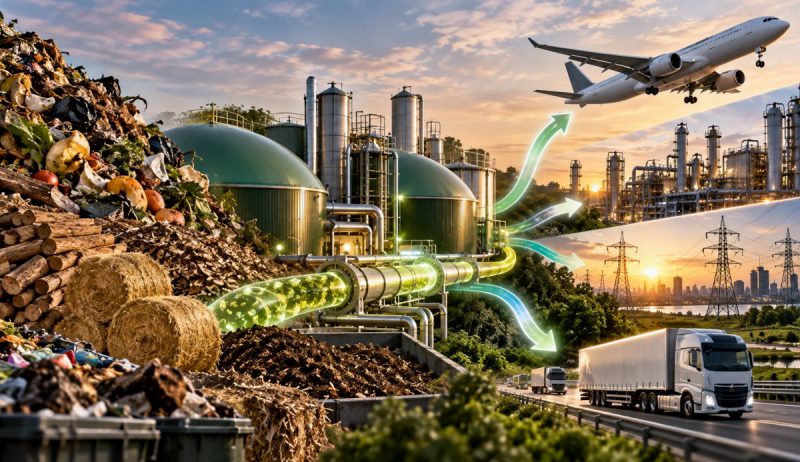
What used to be disposed of is now becoming a raw material. Shell is working to convert CO₂ and electricity into synthetic kerosene. OPAL Fuels generates energy from landfill gas. A.H.T. Syngas positions itself in between with a technology that converts biomass and waste materials into synthesis gas. If the company also succeeds in expanding its contracting business, the small plant builder could increasingly evolve into an energy supplier with recurring revenue.
Conflict of interest
Pursuant to §85 of the German Securities Trading Act (WpHG), we point out that Apaton Finance GmbH as well as partners, authors or employees of Apaton Finance GmbH (hereinafter referred to as “Relevant Persons”) may hold shares or other financial instruments of the aforementioned companies in the future or may bet on rising or falling prices and thus a conflict of interest may arise in the future. The Relevant Persons reserve the right to buy or sell shares or other financial instruments of the Company at any time (hereinafter each a “Transaction”). Transactions may, under certain circumstances, influence the respective price of the shares or other financial instruments of the Company.
In addition, Apaton Finance GmbH is active in the context of the preparation and publication of the reporting in paid contractual relationships.
For this reason, there is a concrete conflict of interest.
The above information on existing conflicts of interest applies to all types and forms of publication used by Apaton Finance GmbH for publications on companies.
Risk notice
Apaton Finance GmbH offers editors, agencies and companies the opportunity to publish commentaries, interviews, summaries, news and the like on news.financial. These contents are exclusively for the information of the readers and do not represent any call to action or recommendations, neither explicitly nor implicitly they are to be understood as an assurance of possible price developments. The contents do not replace individual expert investment advice and do not constitute an offer to sell the discussed share(s) or other financial instruments, nor an invitation to buy or sell such.
The content is expressly not a financial analysis, but a journalistic or advertising text. Readers or users who make investment decisions or carry out transactions on the basis of the information provided here do so entirely at their own risk. No contractual relationship is established between Apaton Finance GmbH and its readers or the users of its offers, as our information only refers to the company and not to the investment decision of the reader or user.
The acquisition of financial instruments involves high risks, which can lead to the total loss of the invested capital. The information published by Apaton Finance GmbH and its authors is based on careful research. Nevertheless, no liability is assumed for financial losses or a content-related guarantee for the topicality, correctness, appropriateness and completeness of the content provided here. Please also note our Terms of use.
Stockhouse does not provide investment advice or recommendations. All investment decisions should be made based on your own research and consultation with a registered investment professional. The issuer is solely responsible for the accuracy of the information contained herein. For full disclaimer information, please click here.