

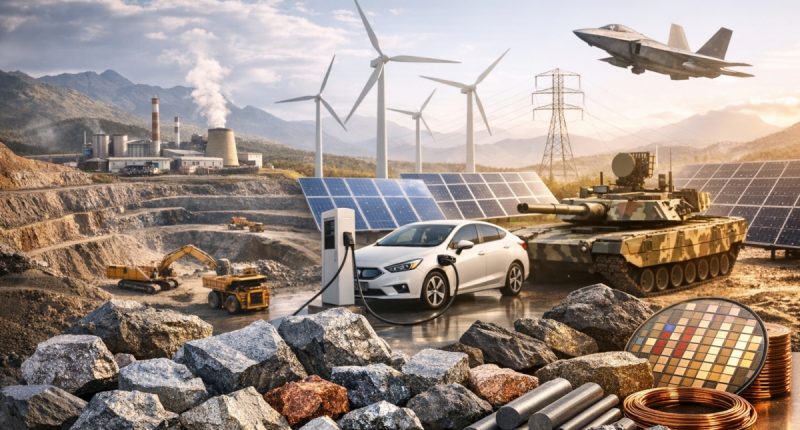
- Strategic minerals are becoming core to national security and industrial competitiveness, driven by electrification, defence modernization, and geopolitical rivalry
- Government policy is reshaping markets, with the U.S., EU, Canada, and allies using subsidies, mandates, and trade rules to secure domestic and allied supply chains
- Supply remains structurally constrained due to long mine‑development timelines, underinvestment, permitting hurdles, and heavy reliance on China for processing
- For investors, the opportunity is long‑term and systemic, with particular upside in secure jurisdictions, midstream processing, and vertically integrated industrial players
In a world reshaped by geopolitical rivalry, energy transition, and rapid technological change, strategic minerals have moved from obscure commodity markets into the centre of national policy and corporate strategy.
Lithium, nickel, cobalt, rare earths, graphite, copper—once viewed as niche industrial inputs—are now essential to national security, clean‑energy deployment, and the future competitiveness of advanced manufacturing.
For investors, this realignment presents both a generational opportunity and a rapidly evolving risk landscape.
This article is a journalistic opinion piece that has been written based on independent research. It is intended to inform investors and should not be taken as a recommendation or financial advice.
Why strategic minerals matter now
1. The energy transition is material‑intensive
The shift to electrification is accelerating. Electric vehicles use up to six times more mineral inputs than internal‑combustion cars, and wind turbines require nine times more minerals than gas plants. Batteries, motors, semiconductors, and power‑grid reinforcements all depend on materials with constrained global supply.
The result: mineral demand for clean‑energy technologies is projected to more than double over the next decade.
2. Geopolitical tensions are reshaping supply chains
China currently dominates the processing and refining of most critical minerals. Even when raw materials originate elsewhere, Chinese firms often control key midstream steps—from lithium hydroxide refining to rare‑earth magnet production.
As U.S.–China competition intensifies, mineral supply chains have become a strategic vulnerability. Western governments now view resource independence not just as an economic issue, but a national‑security imperative.
3. Industrial strategy is back
Across North America, Europe, and parts of Asia, governments are adopting industrial policies reminiscent of post‑war manufacturing strategies. The goal: build domestic or allied supply chains from mine to magnet, mine to cathode, mine to chip.
Subsidies, tax credits, investment guarantees, and permitting reforms are transforming the economics of mineral production and processing.
Policy momentum: Governments are rewriting the mining playbook
United States
The Inflation Reduction Act and Bipartisan Infrastructure Law have created the most aggressive industrial‑policy push in generations. The U.S. is funding exploration, processing capacity, and battery production while tightening sourcing rules for EV incentives.
Washington’s stance is clear: domestic and allied‑produced minerals aren’t just preferred—they’re required.
Canada
Canada is positioning itself as a reliable, ESG‑aligned supplier of critical minerals. With vast deposits of nickel, copper, cobalt, and graphite—and a reputation for regulatory and political stability—it aims to become the Western Hemisphere’s preferred resource partner.
European Union
Facing declining industrial competitiveness, the EU’s Critical Raw Materials Act targets diversified sourcing and accelerated project approvals. Member states now recognize that without secure mineral inputs, flagship industries like automotive manufacturing face structural risk.
Australia
As one of the world’s largest producers of lithium, nickel, and rare earths, Australia is deepening partnerships with the U.S., Japan, and Europe to counterbalance China’s dominance in refining.
Supply‑chain reality: Tight markets, long lead times, and high capital costs
Even with policy support, mining remains a long‑cycle business. A new mine can take 7–15 years to bring online, and permitting remains the single largest bottleneck.
Key constraints
- Exploration lag after a decade of underinvestment.
- Infrastructure deficits in emerging resource regions.
- Refining concentration, especially in China, which still processes:
- ~60 per cent of global lithium
- ~70 per cent of cobalt
- ~90 per cent of rare‑earth elements
- Environmental and community concerns, which slow or block projects regardless of economic necessity.
These structural factors mean supply shortages are likely to remain a recurring theme throughout the 2030s, especially for minerals tied to batteries and high‑performance electronics.
Industrial demand: A secular growth story
Electric vehicles
EV penetration continues to rise globally, driven by falling battery prices, climate mandates, and consumer adoption. Even with battery chemistry innovation, demand for lithium, nickel, and graphite will remain robust.
Semiconductors and defence technology
Advanced chips, radar systems, jet engines, drones, and satellites all require rare earths and specialty metals. Defence spending cycles—especially in the U.S., NATO, and Indo‑Pacific—are adding additional layers of demand.
Power grids and renewable energy
Copper and nickel are the backbone of electrical infrastructure. Grid modernization alone could represent one of the largest multi‑decade investment themes, with strategic minerals at the foundation.
What this means for investors
1. The cycle is structural, not cyclical
Short‑term price volatility may mask a long‑term supercycle driven by:
- Electrification
- Defence modernization
- Supply‑chain reshoring
- Policy mandates
2. Midstream processing may offer the best asymmetric upside
Mining is capital‑intensive and politically fraught. Processing, refining, and conversion assets—particularly outside China—benefit from policy support and higher margins.
3. Jurisdiction matters more than ever
Stable, ESG‑credible countries (Canada, Australia, U.S., parts of South America) are receiving the majority of Western capital flows.
4. Vertical integration will create winners
Automakers, battery makers, chipmakers, and defence companies are securing upstream supply through:
- Direct equity stakes
- Long‑term offtakes
- Joint ventures
- Government‑backed financing
This blurs the line between industrials and mining—and creates new investment opportunities in hybridized value chains.
Strategic minerals are the new energy
As the world reconfigures around electrification and geopolitical blocs, strategic minerals have become the new oil—finite, contested, and indispensable.
Governments are racing to secure them. Industries are restructuring around them. Supply chains are being rebuilt from the ground up.
For investors with the patience to navigate complex markets and frontier policy landscapes, the next decade may offer one of the most compelling commodity‑driven opportunities since the shale revolution.
Join the discussion: Find out what the Bullboards are saying about metals and mining and check out Stockhouse’s stock forums and message boards.
Stockhouse does not provide investment advice or recommendations. All investment decisions should be made based on your own research and consultation with a registered investment professional. The issuer is solely responsible for the accuracy of the information contained herein. For full disclaimer information, please click here.