

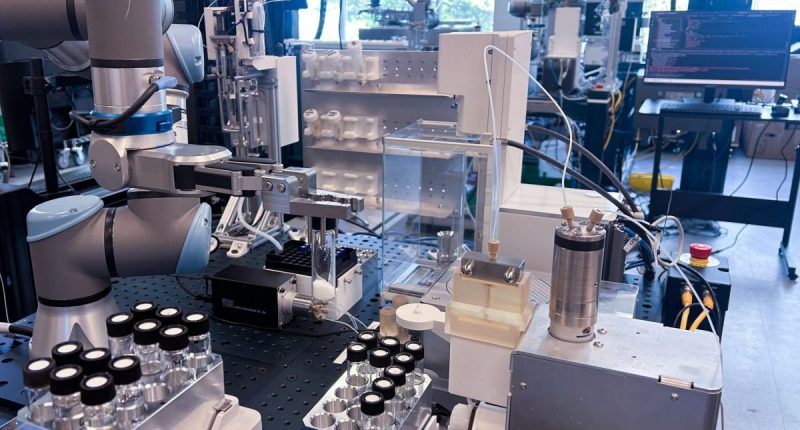
- Telescope Innovations (CSE:TELI) signed a deal to install a third Self-Driving Lab in fiscal 2026 with a major global pharmaceutical company in Europe
- The agreement builds on earlier deployments with Pfizer (NYSE:PFE) and the Korean Pharmaceutical and Biopharma Manufacturers Association, showing growing global demand
- The new system will focus on automating crystallization, aiming to speed up a critical and traditionally time-intensive stage of drug development
- Telescope Innovations stock (CSE:TELI) closed trading at $0.75
Telescope Innovations (CSE:TELI) has signed a new agreement with a major global pharmaceutical company to deploy its autonomous Self-Driving Lab (SDL) platform at the partner’s European operations, marking the company’s third such deployment in its 2026 fiscal year.
The Vancouver-based developer of intelligent automation and advanced chemical manufacturing technologies said the new system is expected to be installed within the next several months. While the pharmaceutical partner was not named, Telescope indicated the company ranks among the largest in the industry by revenue, underscoring the scale and significance of the project.
This article is a journalistic opinion piece that has been written based on independent research. It is intended to inform investors and should not be taken as a recommendation or financial advice.
Building momentum in autonomous R&D
The agreement represents a notable milestone for Telescope, which has now secured three SDL deployments with leading pharmaceutical organizations in a single fiscal year. Earlier installations included a system delivered to the Korean Pharmaceutical and Biopharma Manufacturers Association in December 2025, followed by a deployment at Pfizer (NYSE:PFE) in February 2026.
The addition of a third global pharmaceutical client—this time in Europe—suggests growing international demand for automated laboratory platforms designed to accelerate research and development. It also highlights Telescope’s expanding footprint across key pharmaceutical markets in Asia, North America, and now Europe.
Company representatives described the latest deal as evidence that their technology can meet the performance and reliability standards required by large-scale pharmaceutical R&D programs. By securing repeat business with top-tier industry players, the firm is reinforcing its positioning in a competitive field increasingly focused on automation and artificial intelligence.
What self-driving labs do
Self-Driving Labs combine robotics, advanced analytics, and machine learning to automate experimental workflows. In these systems, robotic platforms conduct chemistry experiments while integrated analytical instruments assess results in real time. The data generated is then processed by machine learning algorithms, which determine the next set of experiments to run, creating a continuous, iterative cycle.
This approach is designed to significantly accelerate the optimization of chemical processes while reducing the need for manual intervention. By allowing experiments to run autonomously and continuously, SDLs can improve efficiency and shorten timelines in areas that traditionally require substantial human oversight.
Focus on crystallization
The SDL platform being installed in Europe will be configured specifically to address crystallization, a critical stage in pharmaceutical development. Crystallization influences the purity, stability, and manufacturability of drug compounds, making it a key step in the process of bringing new therapies to market.
However, optimizing crystallization conditions is often time-consuming, involving extensive trial-and-error experimentation. Telescope’s automated system aims to streamline this process by rapidly testing multiple variables and learning from each iteration to identify optimal conditions more quickly.
Industry observers note that automation of crystallization workflows represents a particularly high-value application for self-driving technologies, given the complexity of the underlying chemistry and the potential impact on product quality.
Expanding role of automation in pharma
The latest deployment reflects a broader trend within the pharmaceutical sector toward adopting automation, artificial intelligence, and data-driven decision-making tools. As companies seek to reduce development timelines and costs, technologies that can accelerate experimentation and improve reproducibility are gaining traction.
For Telescope, the European project provides another opportunity to demonstrate the scalability and adaptability of its SDL platform across different therapeutic areas and operational environments. It also signals ongoing confidence from major pharmaceutical organizations in the company’s approach to laboratory automation.
Looking to the horizon
With three high-profile SDL deployments secured in its current fiscal year, Telescope Innovations appears to be gaining momentum as a provider of advanced laboratory automation solutions. The company has indicated that it expects installation of the latest system to proceed in the coming months, with additional updates likely as the project progresses.
If adoption continues at its current pace, self-driving laboratories could become an increasingly common feature in pharmaceutical R&D, potentially reshaping how new drugs are discovered and developed.
Focus on leadership
“We’re encouraged by the continued momentum that we are developing with top-tier pharmaceutical partners. Each new SDL deployment expands our global footprint and reflects increasing confidence in our ability to deliver this Physical AI technology,” Telescope’s CEO, Henry Dubina commented in a media release. “We’re excited to be leading the global transition with our Biopharmaceutical partners for autonomous labs to significantly improve their essential R&D infrastructure.”
About Telescope Innovations Corp.
Telescope is a chemical and automation technology company developing scalable manufacturing processes and tools for the pharmaceutical and chemical industries. Its products improve experimental throughput, efficiency and data quality.
Telescope Innovations stock (CSE:TELI) closed trading 17.19 per cent higher at $0.75 and has risen more than 154.24 per cent since this time last year.
Join the discussion: Find out what the Bullboards are saying about Telescope Innovations and check out Stockhouse’s stock forums and message boards.