


Tungsten in a structural shift: From industrial metal to geopolitical bottleneck
Word has now gotten around! Over the past 12–18 months, the tungsten market has shifted from a cyclical industrial market to a structurally constrained key geopolitical market. According to current commodity analyses, China continues to control around 80% of global primary production and nearly the entire downstream APT and refining chain. Studies by international commodity institutions such as the British Geological Survey, as well as industry analyses by major research firms, show that this dominance has not only solidified but has recently been further tightened through export quotas and licensing systems. At the same time, the price of tradable tungsten (APT Rotterdam) has risen from around USD 300 to USD 400 per Metric Ton Unit (MTU) to, at times, over USD 3,000 per MTU—a tenfold increase in just 18 months, a very short timeframe. Even conservative research models, such as those from Couloir Capital or GBC, no longer use “normal prices” but instead rely on structurally higher equilibrium ranges between USD 1,500 and USD 2,500 per MTU. This appears to be the correct approach for a medium-term analysis, as it is reasonable to assume that new mines will be developed or that idled properties will be reactivated in the future. However, even under optimistic expectations, this will take several more years. Consequently, the market has begun to price in scarcity not as a cyclical phenomenon, but as a permanent one.
Excess Demand: Defence, High-Tech, and No Industrial Elasticity
The demand side further amplifies this effect, as tungsten is used simultaneously in several strategic growth industries. According to industry studies, global demand is growing at approximately 3-7% per annum (CAGR), with individual segments significantly exceeding this rate. Particularly relevant is the defence sector, which is experiencing exorbitant growth due to rising demand for ammunition and tank alloys, and the semiconductor industry, where tungsten hexafluoride (WF₆) serves as a critical process gas. Added to this is the traditional tool and cemented carbide sector, which continues to account for around 60% of total consumption and is virtually irreplaceable. The remarkably low price elasticity is a key factor here: even sharp price increases rarely lead to shifts in demand, as physical properties, such as the extremely high melting point of 3,422 °C, preclude genuine substitutes. All in all, this creates a market where supply shocks directly translate into price spikes. A one-way street!
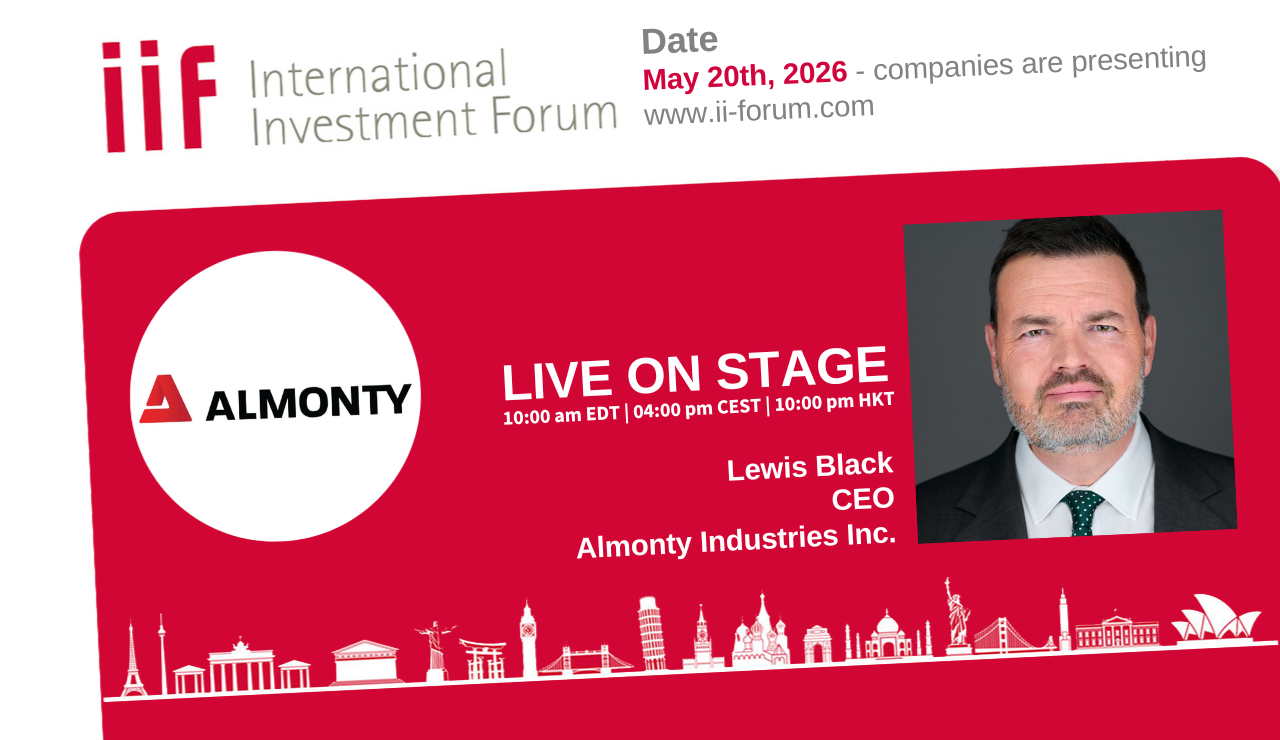
IIF moderator Lyndsay Malchuk in conversation with CEO Lewis Black about Almonty Industries’ strategic direction for the current year.

Almonty Industries: Production Leverage in a Decoupled Supply System
According to several analyst reports, including those from Couloir Capital and GBC, Sangdong ranks among the world’s largest known tungsten resources outside China’s dominant zone. Almonty marks a decisive turning point with its transition from developer to producer: While the industry often remains stuck in project evaluation, Almonty has already begun operational monetization in a high-priced environment. At current price levels, the operational logic shifts dramatically: With estimated production costs in the low three-digit USD per MTU range, a “dream margin structure” emerges in which nearly every additional dollar directly impacts cash flow. Additionally, molybdenum, as a medium-term byproduct, enhances profitability, as even a 10–15% share of the revenue mix can significantly stabilize overall profitability while simultaneously reducing unit costs by 5–10% through shared infrastructure.
Things are set to get exciting at the upcoming 19th International Investment Forum. Here, CEO Lewis Black will delve deeper into market structures. Those who listened closely to him at recent conferences has been invested since 2024, when the market capitalization was still at CAD 60 million. Click here to register.

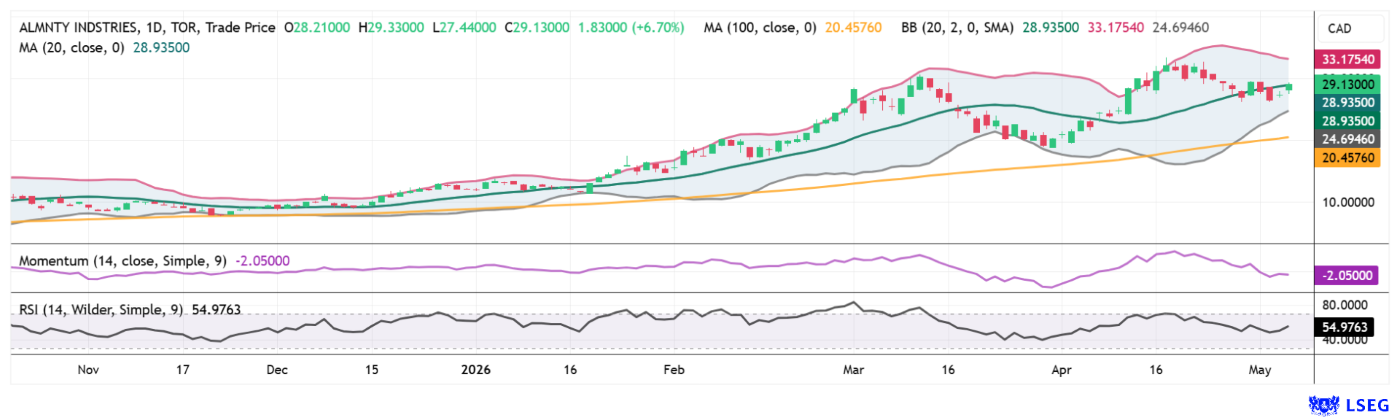
The technical picture speaks volumes
The Almonty chart speaks volumes. Throughout 2025, the stock saw massive accumulation, as fund managers in particular had to include critical metals in their portfolios. Now, in 2026, the operational reality announced by the company over the past months is unfolding. After a price increase of over 2,000%, the market saw two major profit-taking waves in March and April, which it processed accordingly. The 100-day moving average was never breached; it reached a value of CAD 20.45 yesterday. Following the completion of consolidation, the normalized Bollinger Band now offers a solid trading range between CAD 24.70 and CAD 33.17. With a price of CAD 28.60, Almonty was right in the middle of this upward channel yesterday. Technical analysts refer to this movement as a “reversion to the mean.” Typically, a new upward move begins after this consolidation if momentum and revenue increase. Buy more!
Anyone who understands the dynamics behind the tungsten shortage will hardly be surprised by Almonty’s share price rally toward previous highs, especially as stock markets regain momentum following the easing of tensions in the Middle East and critical metals return to the spotlight. At the end of this chain of reasoning, Almonty Industries, with its strategic Sangdong project in South Korea, is not only ready but increasingly at the center of global supply chain disruptions. Here, solutions are offered instead of empty promises, and investors increasingly value this reliability. The next surge is likely just around the corner!
Conflict of interest
Pursuant to §85 of the German Securities Trading Act (WpHG), we point out that Apaton Finance GmbH as well as partners, authors or employees of Apaton Finance GmbH (hereinafter referred to as “Relevant Persons”) currently hold or hold shares or other financial instruments of the aforementioned companies and speculate on their price developments. In this respect, they intend to sell or acquire shares or other financial instruments of the companies (hereinafter each referred to as a “Transaction”). Transactions may thereby influence the respective price of the shares or other financial instruments of the Company.
In this respect, there is a concrete conflict of interest in the reporting on the companies.
In addition, Apaton Finance GmbH is active in the context of the preparation and publication of the reporting in paid contractual relationships.
For this reason, there is also a concrete conflict of interest.
The above information on existing conflicts of interest applies to all types and forms of publication used by Apaton Finance GmbH for publications on companies.
Risk notice
Apaton Finance GmbH offers editors, agencies and companies the opportunity to publish commentaries, interviews, summaries, news and the like on news.financial. These contents are exclusively for the information of the readers and do not represent any call to action or recommendations, neither explicitly nor implicitly they are to be understood as an assurance of possible price developments. The contents do not replace individual expert investment advice and do not constitute an offer to sell the discussed share(s) or other financial instruments, nor an invitation to buy or sell such.
The content is expressly not a financial analysis, but a journalistic or advertising text. Readers or users who make investment decisions or carry out transactions on the basis of the information provided here do so entirely at their own risk. No contractual relationship is established between Apaton Finance GmbH and its readers or the users of its offers, as our information only refers to the company and not to the investment decision of the reader or user.
The acquisition of financial instruments involves high risks, which can lead to the total loss of the invested capital. The information published by Apaton Finance GmbH and its authors is based on careful research. Nevertheless, no liability is assumed for financial losses or a content-related guarantee for the topicality, correctness, appropriateness and completeness of the content provided here. Please also note our Terms of use.
Stockhouse does not provide investment advice or recommendations. All investment decisions should be made based on your own research and consultation with a registered investment professional. The issuer is solely responsible for the accuracy of the information contained herein. For full disclaimer information, please click here.