

BYD as the Gold Standard: How the Cost Leader Operates
BYD’s rise to become the world’s leading manufacturer of electric vehicles is closely linked to its deep vertical integration. The company manufactures around 75% of its vehicle components in-house, including essential system elements such as battery cells, semiconductors, and electric motors. In this way, BYD reduces transaction costs, eliminates markups by intermediaries, and effectively protects itself from turbulence in the raw materials markets. Thanks to this independence, BYD has long been the cost leader. According to industry analyses, Chinese battery packs are 20 to 35% cheaper than comparable Western battery packs. Nevertheless, extensive vertical integration also carries risks. The enormous capital requirements for building and maintaining global mining and manufacturing infrastructure weigh on the balance sheet and limit financial agility during periods when business is not going so well. There is also the risk of technological path dependence. So far, however, this has not been a problem for BYD.
Mercedes-Benz: Balancing Margin Pressure and Raw Material Security
Given shrinking margins, establishing a fully integrated, in-house raw material and battery production system is financially unfeasible for Mercedes-Benz and strategically unwise. To regain control of the supply chain nonetheless, the Stuttgart-based company is relying on direct procurement. Under this approach, the automaker purchases critical raw materials such as lithium hydroxide directly from qualified producers and makes them available to its battery cell partners. This approach breaks away from the traditional, opaque supplier model, protects the automaker from typical mining risks, and preserves a high degree of technological flexibility should battery technology advance.
Rock Tech Lithium Bridges the Gap to the Auto Industry
The Canadian-German company Rock Tech Lithium is the go-to partner for automakers seeking reliable partners in secure jurisdictions as part of their direct procurement strategies. The company owns the Georgia Lake lithium deposit in Ontario and is planning the Red Rock processing plant nearby. Thanks to this geographical proximity, the company aims to reduce logistical risks and fully leverage the advantages of the secure jurisdiction. To further secure its lithium supply, Rock Tech has acquired a call option for the approximately 9,875-hectare Victory Project in northwestern Ontario. The project boasts world-class surface samples with grades of up to 5.11% lithium oxide and direct access to rail and road networks. In close cooperation with Queen’s University and STARK Resources, Rock Tech Lithium is also relying on groundbreaking sensor-based ore sorting processes designed to enrich the feed grade by a factor of 1.4 to 1.8 and reduce on-site processing capital costs by up to 50%.

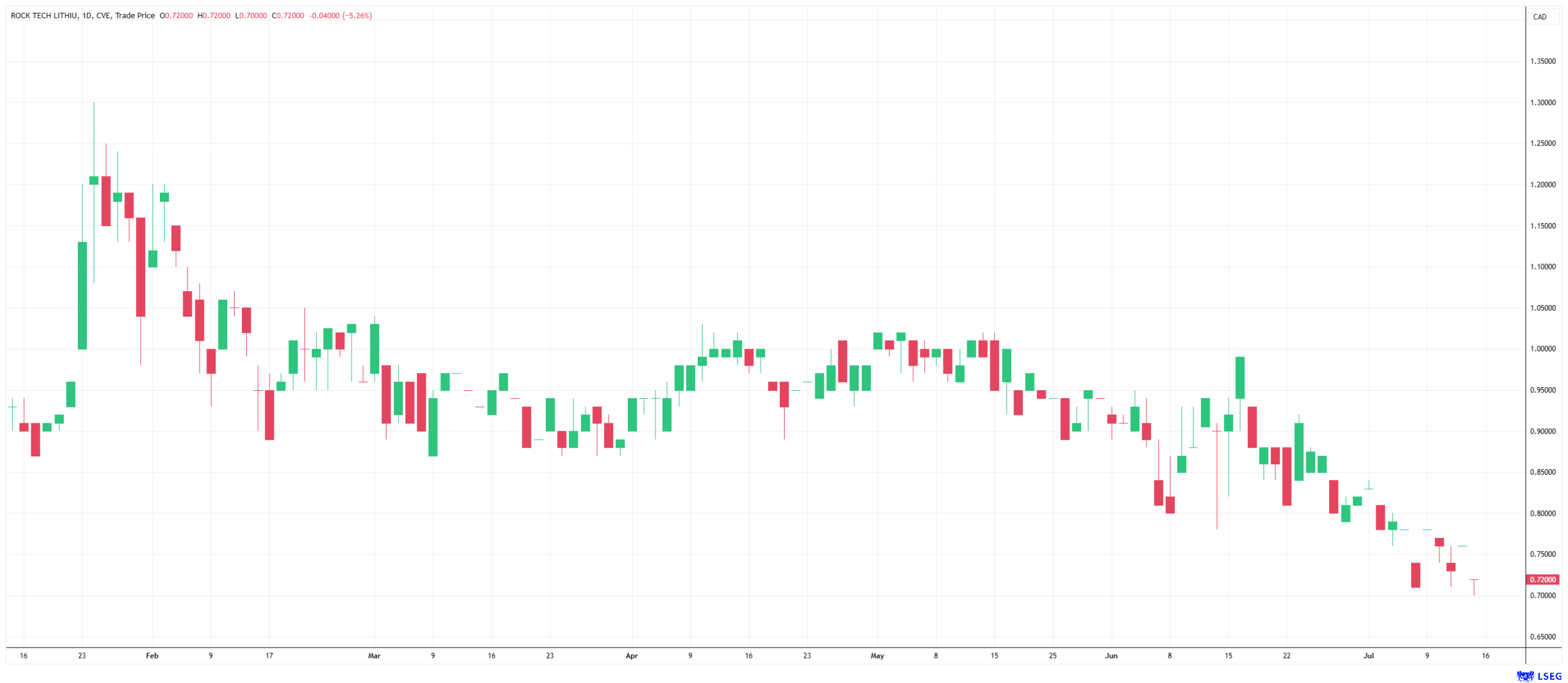
Rock Tech Lithium is also active in Germany. Although the planned lithium converter in Guben, Brandenburg, was originally conceived as the flagship project, having already received final building approval and the official operating license in May 2024 and boasting a binding supply agreement with Mercedes-Benz, the project has recently suffered from the challenging conditions facing the German industrial sector. To continue the Guben project despite high energy prices and other uncertainties, management has fine-tuned the details and reduced projected operating costs by 23% to an estimated EUR 3,878 per metric ton of lithium hydroxide. In addition, Rock Tech Lithium is pursuing a capital-efficient partnership model for Guben. It is seeking financial investors or strategic partners to provide the majority of the capital, while the company itself would act as the operator. A sale of the facility is also being actively discussed, provided that construction and subsequent operation can be contractually secured.
Is Rock Tech Lithium Turning a Corner?
The upcoming introduction of the EU Battery Passport on February 18, 2027, and the strict requirements of the EU Critical Raw Materials Act are regulatory catalysts for Rock Tech Lithium that could help the company get a fresh start. Since the supply of lithium could be crucial for the struggling European auto industry, a decisive phase is now beginning for the entire sector. If the company succeeds in cutting the Gordian knot together with lawmakers and industry partners, Guben could still see a positive turnaround. Furthermore, Rock Tech is already active in Canada, where market dynamics differ, and energy prices are significantly lower. Rock Tech remains an interesting watchlist candidate for speculative investors.

Conflict of interest
Pursuant to §85 of the German Securities Trading Act (WpHG), we point out that Apaton Finance GmbH as well as partners, authors or employees of Apaton Finance GmbH (hereinafter referred to as “Relevant Persons”) may hold shares or other financial instruments of the aforementioned companies in the future or may bet on rising or falling prices and thus a conflict of interest may arise in the future. The Relevant Persons reserve the right to buy or sell shares or other financial instruments of the Company at any time (hereinafter each a “Transaction”). Transactions may, under certain circumstances, influence the respective price of the shares or other financial instruments of the Company.
In addition, Apaton Finance GmbH is active in the context of the preparation and publication of the reporting in paid contractual relationships.
For this reason, there is a concrete conflict of interest.
The above information on existing conflicts of interest applies to all types and forms of publication used by Apaton Finance GmbH for publications on companies.
Risk notice
Apaton Finance GmbH offers editors, agencies and companies the opportunity to publish commentaries, interviews, summaries, news and the like on news.financial. These contents are exclusively for the information of the readers and do not represent any call to action or recommendations, neither explicitly nor implicitly they are to be understood as an assurance of possible price developments. The contents do not replace individual expert investment advice and do not constitute an offer to sell the discussed share(s) or other financial instruments, nor an invitation to buy or sell such.
The content is expressly not a financial analysis, but a journalistic or advertising text. Readers or users who make investment decisions or carry out transactions on the basis of the information provided here do so entirely at their own risk. No contractual relationship is established between Apaton Finance GmbH and its readers or the users of its offers, as our information only refers to the company and not to the investment decision of the reader or user.
The acquisition of financial instruments involves high risks, which can lead to the total loss of the invested capital. The information published by Apaton Finance GmbH and its authors is based on careful research. Nevertheless, no liability is assumed for financial losses or a content-related guarantee for the topicality, correctness, appropriateness and completeness of the content provided here. Please also note our Terms of use.
Stockhouse does not provide investment advice or recommendations. All investment decisions should be made based on your own research and consultation with a registered investment professional. The issuer is solely responsible for the accuracy of the information contained herein. For full disclaimer information, please click here.