

As we established in part one of this three-part series, when it comes to optimizing the performance of lithium-ion batteries and modern defense technology, graphite is as essential as it gets, with the global market for the critical mineral expected to compound at more than 15 per cent annually through 2030, catalyzed by accelerating EV, military and renewable energy demand.
This article is disseminated in partnership with Graphite One Inc. It is intended to inform investors and should not be taken as a recommendation or financial advice.
Graphite’s robust growth runway, constricted by China’s more than 80 per cent of production capacity, plus more than 90 per cent of refining capacity, is logically shining a light on companies advancing mining projects with the potential to give the state-run economic powerhouse a run for its money.
We then raised the curtain on explorer and developer Graphite One (TSXV:GPH), whose stock has given back 10.5 per cent since 2021, highlighting a widely dislocated value play, given that the company represents the United States’ best chance at meaningfully reducing its 100-per-cent reliance on graphite imports, predominantly from China, and reinforcing domestic technological leadership. Here’s why:
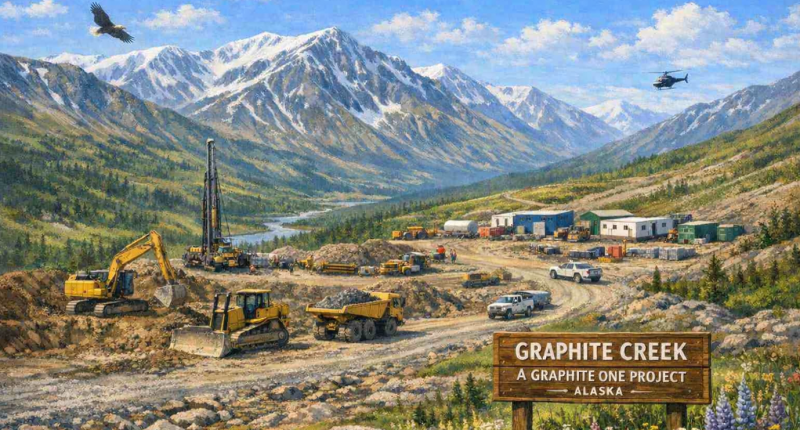
- The company’s Graphite Creek property in Alaska, housing one of the largest graphite deposits in the world, is currently being permitted and is on track for production in 2030.
- An active anode material (AAM) facility in Ohio, on track for initial revenue in early 2028, will round off Graphite One’s vertical integration, accommodating both artificial and natural graphite, to more thoroughly meet domestic and allied demand.
This brings us to part two, in which we’ll delve deeper into the scale, jurisdiction and go-to-market strategy that elevate Graphite Creek into a differentiated asset.
Strong government support in a mining-friendly state
From the federal level, Graphite Creek is a viable catalyst to bolster the US graphite market because the government recognizes that domestic production is lacking.
US President Biden made this official in 2022, acknowledging graphite’s critical roles in defense and clean energy technology, invoking the Defense Production Act to advance the development of an end-to-end supply chain, supercharge battery production and reduce the impact of legacy transportation and power technology, which is responsible for more than half of US carbon emissions.
President Trump built on this progress in 2025 with his executive order to increase critical minerals production, bolster economic prosperity and strengthen national security by keeping reliance on hostile foreign powers at bay. The new legislation led to Graphite Creek’s addition to the government’s expedited FAST-41 permitting pathway in June, reflecting the project’s tangible potential to re-establish a domestic graphite supply chain.
At the state level, the Alaskan government has also aligned itself with the White House’s focus on critical minerals, collaborating with Graphite One on Graphite Creek’s permitting process since 2022, keen to add as many as 256 jobs to the local economy as the mine progresses towards production, while reinforcing the state’s reputation as one of the world’s premier mining jurisdictions in terms of policy, best practices and investment attractiveness.
Support for Graphite Creek continues all the way down to the ground level, marked by ongoing engagements with local Iñupiaq communities, including Teller, Mary’s Igloo and Brevig Mission, to develop and implement frameworks that address environmental stewardship, employment and educational opportunities, as well as the preservation of their traditional ways of life.
The largest graphite deposit in the United States
According to the company, Graphite Creek’s feasibility study pit and mineral resource footprint represents only 1.2 miles (1.9 km) or 12.6 per cent of the 9.5 mile-long (15.3 km) electromagnetic anomaly. Even so, the resource stands as the largest in the country, hosting more than 15 million tons of graphitic carbon, representing a more than US$10 billion deposit, making it readily apparent why the project has been the object of so much government attention. When we compare the resource to US imports, which reached 60,000 tons of natural graphite in 2024, this works out to a more than 250-year supply.
Operations are planned to bring this unmatched tonnage to market over an only 20-year mine life, as laid out in a 2025 bankable feasibility study, which will help us quantify the project’s scale. Here’s a breakdown:
- According to the study, Graphite Creek will yield about 175,000 tons of graphite concentrate per year. Designed for a 95 per cent purity rate, the mine’s yearly output falls just short of tripling US imports in 2024, effectively nullifying the country’s reliance on third-party graphite.
- Based on only 1.9 miles of the main 15.3-mile mineralized anomaly, which remains open to the west, east and down dip, the study also suggests that the top US deposit will gradually evolve into increasing prominence on the global stage, newly minting the US as a major player in the quest for ex-China graphite supply.
- Looking further ahead, Graphite Creek’s total 38.8-square-kilometre land package, only 60 km north of Nome, positions the company to harvest even more exploration upside, growing the deposit into a multi-generational safeguard for US graphite sovereignty.
Graphite Creek’s massive scale, aligned with US nation-building efforts, has led the government to show support with public funds, including a US$670 million letter of interest from the Export-Import Bank of the United States to expedite the development of the Graphite Creek mine, as well as a US$1.4 billion letter of interest to build an AAM manufacturing facility to produce artificial graphite anode battery materials for the electric vehicle and energy storage systems markets. The capital, subject to a definitive agreement, will be issued under the Make More in America and China and Transformational Exports Program initiatives, both of which seek to help American companies compete on a global scale.
Graphite One is also conducting ongoing discussions with North America’s top 5 investment banks, which hold the potential to elevate the project into fully funded status and place the company in a position of strength, emphasizing early cash flow and phased, cost-controlled development on the road to US graphite independence by as soon as 2030.
A vertically integrated path to US graphite sovereignty
While Graphite Creek is an exemplary asset within the US critical mineral supply chain, the country’s ability to process its tonnage is virtually non-existent, with processing of graphite into anode materials currently under Chinese dominance. This is why Graphite One has devised a plan to build the downstream infrastructure required to get the resource out of the ground and into the marketplace.
The company intends to connect Graphite Creek ore to EV and energy storage companies driving the green energy transition, as well as defense companies keeping American citizens safe on a daily basis, through an intermediary processing facility to be built in Ohio.
Artificial graphite
The facility’s first pursuit, artificial graphite and related active anode material (AAM), will link Graphite One with industrial and technology clients that rely on the sub-type for battery and electrode manufacturing. The company will initially use third-party precursor material, allowing it to generate cash flow by as soon as Q4 2027, while immediately beginning AAM testing backed by an exclusive license to proven technology.
Graphite’s One growth plan, laid out in its latest investor presentation, sees AAM production reaching 10,000 tons per year (tpy) by 2027 for only US$73 million in CAPEX, setting the company up to garner initial market share. Operations will then ramp up to 25,000 tpy by 2030, multiplying in equal modules to 100,000 tpy by 2032, with operating profits expected to eclipse total CAPEX in less than three years.
This initial development phase will involve the construction of finishing/blending, graphitization and precursor plants, which will set the foundation for Graphite One to graduate from high-potential explorer to active contributor to the US critical minerals supply chain.
Natural graphite
Once artificial graphite operations are in place, Graphite One plans to expand its processing capabilities into natural graphite, whose more diverse use-cases, including foundries and refractories, and lower costs compared to its artificial counterpart, make it a strategic avenue for future revenue.
The company will also use third-party material at this stage, following the same 25,000-tpy module framework to reduce costs and increase operational flexibility, enabling it to build a customer base and perfect its natural graphite AAM process on its own terms.
All-in-all, Graphite One forecasts that its Ohio facility will produce an average of 256,500 tpy of graphite and carbon-based products over 22 years, including 169,000 tpy of AAM, 25,000 tpy of purified products and 31,000 tpy of unpurified products. As stated in the feasibility study, the average price of all products over the facility’s life is estimated at US$7,843 per ton, placing estimated annual revenue at just over US$2 billion, almost 8 times Graphite One’s C$264 million market cap. This discrepancy opens the door for a deep-value thesis we’ll discuss at the end of the article.
Starting up the Graphite Creek mine from a position of strength
Once natural graphite AAM revenue is coming through the door, Graphite Creek’s permitting and production processes will be significantly de-risked, as ore will benefit from an established path downstream to immediately bolster the company’s income statements, as well as the US defense and clean energy industries.
Graphite One plans to ship ore via the Port of Nome into Ohio at mining and transportation costs of only US$982.40 per ton, leaving a healthy margin to the average price per ton quoted in the previous section. This speaks highly of the company’s ability to achieve profitable growth over the project’s 20-22 years of production.
Taking this measured, cost-conscious approach, the company intends to lead the charge towards an integrated US graphite supply chain, which onshores the entire progression, from ore to battery anode materials, reducing vulnerability with every ton that makes its way into the lower 48.
Graphite One’s value proposition is fundamentally sound
Graphite’s industrial tailwind, squarely aligned with US national security, combined with Graphite Creek’s differentiated resource and high-conviction path to market, makes Graphite One a must-consider stock for investors keen to leverage their portfolios to the limitations of the US supply chain.
To this end, the key question investors should ask is, “How accurately does the company’s valuation reflect its solid fundamentals and considerable potential, including a near-term path to inaugurating a new era of US graphite independence?” The answer, as we’ve established in this article, is not very well at all, with Graphite One stock shedding 10.5 per cent of its value since 2021, despite being only a few years away, subject to permitting and financing, from creating transformational value and revitalizing how the US acquires a mineral critical to its long-term future.
As development at the Ohio facility leads to a firm foundation for Graphite Creek production, look for the broader market to realize what it’s been missing, closing the gap between Graphite One’s market cap and expected revenue as the company embarks on its path to profitability.
Stay tuned for the third and final article in this series, where we’ll analyze Graphite Creek’s role as a foundational supply chain project, painting a picture of the meaningful change its resource stands to jumpstart across essential US industries.
Join the discussion: Find out what investors are saying about this critical mineral stock on the Graphite One Inc. Bullboard and make sure to explore the rest of Stockhouse’s stock forums and message boards.
Stockhouse does not provide investment advice or recommendations. All investment decisions should be made based on your own research and consultation with a registered investment professional. The issuer is solely responsible for the accuracy of the information contained herein.
For full disclaimer information, please click here.